Best Day Trips from Chengdu (2026): Leshan, Dujiangyan, Qingcheng & Sanxingdui Compared
Short answer: With one spare day, pick Leshan for the single most impressive sight, Dujiangyan plus Mount Qingcheng for the best full-day mix of ancient engineering and mountain walking, or Sanxingdui for a rain-proof indoor morning.
Leshan runs about ¥250–290 per person all in; the Dujiangyan–Qingcheng pair costs ¥202 without the cable car or ¥262 with it; Sanxingdui is ¥72 for adults and free for under-18s from 4 November 2026. All prices below are as of November 2026.
Key takeaways for choosing a Chengdu day trip
- First-timers should start with Leshan. As Asia Odyssey Travel puts it, "Leshan is usually the easiest all-round third-day add-on" — one huge sight, about an hour away by high-speed train, and a clear choice between climbing to the Buddha's feet or viewing it from a boat.
- Book Leshan and Sanxingdui ahead — there is no walk-up option. Leshan tickets go on sale at 7:00 each morning, up to 7 days ahead, through the official mini-program only. Sanxingdui releases tickets at 20:00 daily for entry up to 5 days ahead.
- Dujiangyan and Qingcheng are the best value pair. Two United Nations Educational, Scientific and Cultural Organization (UNESCO) sites on one rail line for ¥202 per person, or ¥262 with the Qingcheng cable car — against ¥480–680 for a group tour covering the same route, according to MyChina.guide's 2026 cost breakdown.
- Sanxingdui is the weather-proof pick. Almost everything is indoors, the train from Chengdu East takes as little as 18 minutes, and under-18s now enter free under a long-term policy that started on 4 November 2026.
- Do not try Jiuzhaigou as a day trip. It is roughly 9 hours of driving for about 3 hours at the site — spend 2–3 days there or skip it this time. Mount Emei likewise deserves an overnight stay.
The four day trips at a glance
| Day trip | From Chengdu | Entry ticket | All-in cost | Time needed | Best for |
|---|---|---|---|---|---|
| Leshan Giant Buddha | High-speed train ~1 hr (¥54) | ¥80 climb / ¥70 boat | ¥250–290 | 9–10 hours | First-timers |
| Dujiangyan + Mt Qingcheng | High-speed train 18–30 min (¥10) | ¥80 + ¥80 | ¥202–262 | 10–12 hours | Nature and walking |
| Sanxingdui Museum | High-speed train from 18 min (from ¥18) | ¥72 | ~¥110–130 | Half day | History, rainy days |
| Mount Emei | High-speed train ~1 hr | Varies by route | — | 2 days | Overnight only |
Sources: fares and totals per MyChina.guide Chengdu day trip guide 2026; Sanxingdui pricing per Sohu / Upstream News (31 Oct 2026) and ChinaGuide101; Leshan fares per Sina News (Oct 2026). Prices as of November 2026; confirm on the day, as fares change.
Leshan Giant Buddha: the single most impressive day out
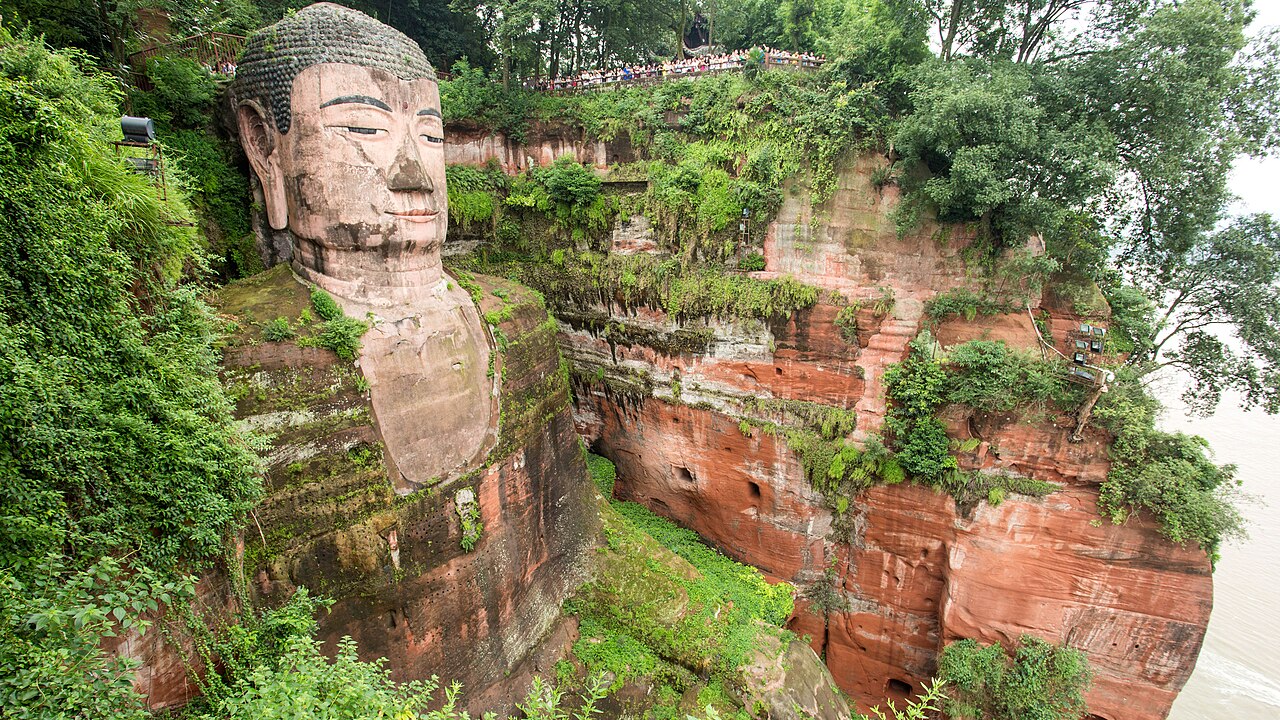
The Leshan Giant Buddha is a 71-metre Maitreya statue cut into a red sandstone cliff where three rivers meet, south of Chengdu. Work began in the Tang dynasty and took about 90 years to finish, and it is still the tallest stone Buddha in the world. From the river, the statue's head, shoulders and feet line up with the hillside so clearly that locals call the whole ridge a "sleeping Buddha" — a detail you only catch from the boat.
Climb or boat: how to choose
There are two ways to see it, and the choice shapes the day. The climb ticket costs ¥80 and takes you down the Nine-Bend Plank Road — 217 steep stone steps along the cliff face — to the viewing platform at the Buddha's feet, where you look straight up at a statue whose single toenail is larger than a person. In peak season the one-way stairs can mean a wait of around 2 hours.
The boat ticket costs ¥70, lasts 30–40 minutes, and gives you the classic head-to-toe view from the water with no climbing at all. Families with older travellers or small children should take the boat without hesitation; fit travellers who want the close-up should climb. Students pay ¥40, and visitors aged 65 and over enter free outside public holidays.
Booking rules that catch people out
The booking rule is the part that catches people out. Since 2026, Leshan has run on timed, real-name reservations only: there is no ticket window at the gate. Book through the official "Dafo Lvyou" mini-program on WeChat or Alipay — tickets are released at 7:00 daily, up to a week ahead, and on public holidays the daily climb quota of 28,000 can sell out days early, according to Sina News' October 2026 booking guide.
The practical route is Chengdu East to Leshan by high-speed train (¥54 second class, about an hour), then bus K1 or a short ride-hail trip of ¥10–25 to the scenic area. All in, expect ¥250–290 per person and 9–10 hours door to door.
Dujiangyan and Mount Qingcheng: two UNESCO sites on one rail line
Morning: Dujiangyan's 2,300-year-old waterworks
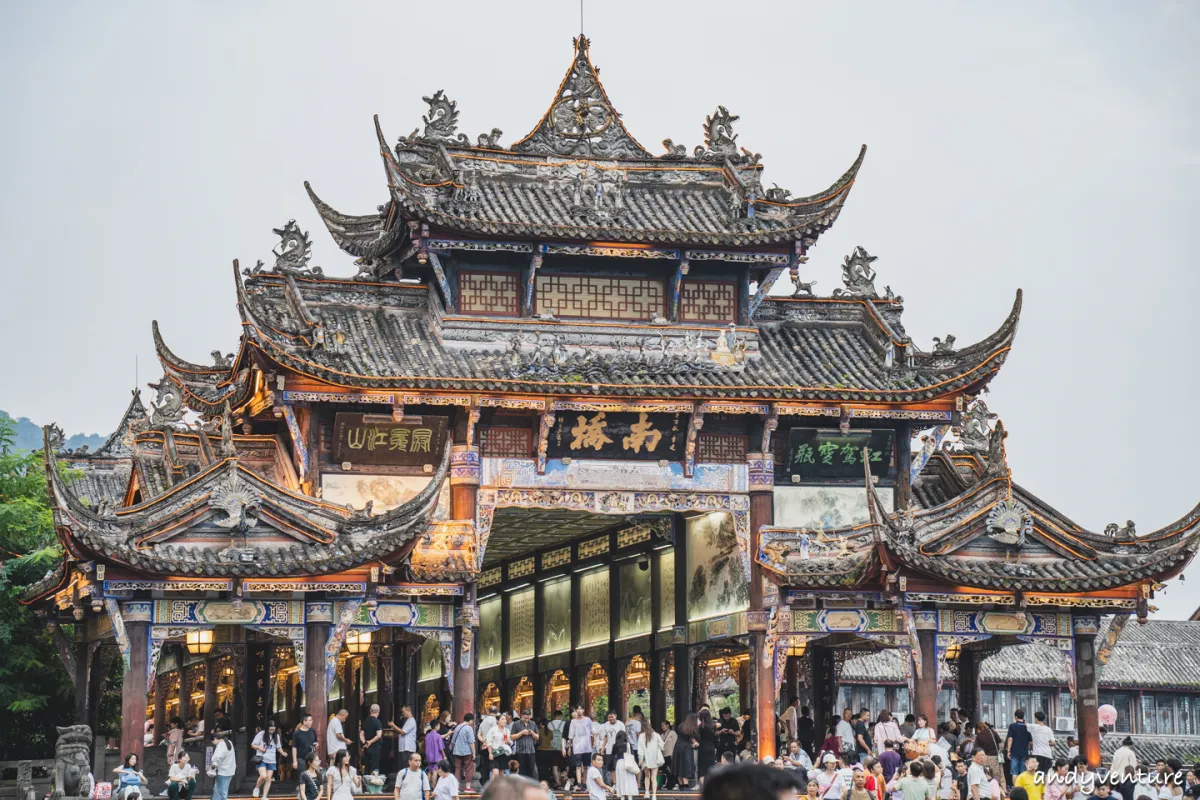
The Dujiangyan–Qingcheng pair is the easiest independent day trip in Sichuan. Both sites sit on the same intercity rail line from Xipu Station, at the western end of Chengdu Metro Line 2. Start at Dujiangyan in the morning: a 2,300-year-old irrigation system, built in 256 BC (Before Christ), that still waters the Chengdu plain today. Walk the Fish Mouth dyke that splits the river, the Flying Sand Weir that flushes away silt, the narrow Bottle Neck channel, and the Erwang Temple honouring Li Bing, the engineer who designed it all — then cross the Anlan suspension bridge, which sways underfoot.
The system has been working for more than two millennia without a dam, which is why it holds United Nations Educational, Scientific and Cultural Organization (UNESCO) World Heritage status.
Afternoon: Mount Qingcheng
After lunch, take the 10-minute train to Qingchengshan Station for the front mountain of Mount Qingcheng, one of the birthplaces of Taoism, where temples sit among mossy stone steps and tea houses.
The front mountain takes 4–5 hours on foot; the cable car costs ¥35 one way or ¥60 return, plus a ¥5 electric boat across Yuecheng Lake to reach its base. The walk down is the best part of the mountain, so ride up and walk down if your knees allow it. The mountain runs 8–12°C cooler than Chengdu, so bring a layer even on a warm day.
What the Dujiangyan–Qingcheng day costs
The money works out neatly, per MyChina.guide's 2026 breakdown: three rail legs at ¥10 each, ¥80 entry at each site, and the optional ¥60 cable car — ¥202 per person without the cable car, ¥262 with it. A group tour covering the same route typically charges ¥480–680 per person, lunch included.
New for autumn 2026: the "Tiangong Kaiyan" water-conservancy experience hall opened beside Fulong Temple on 17 October. The roughly 6,000-square-metre space runs 12 shows a day from 10:00 to 17:00, turning the engineering story into a 20-minute live performance. It is worth half an hour if you want the history to land. Both sites still sell tickets at the gate with a passport, so this is the only pair on this list that needs no advance booking.
Sanxingdui Museum: the strangest half day in Sichuan
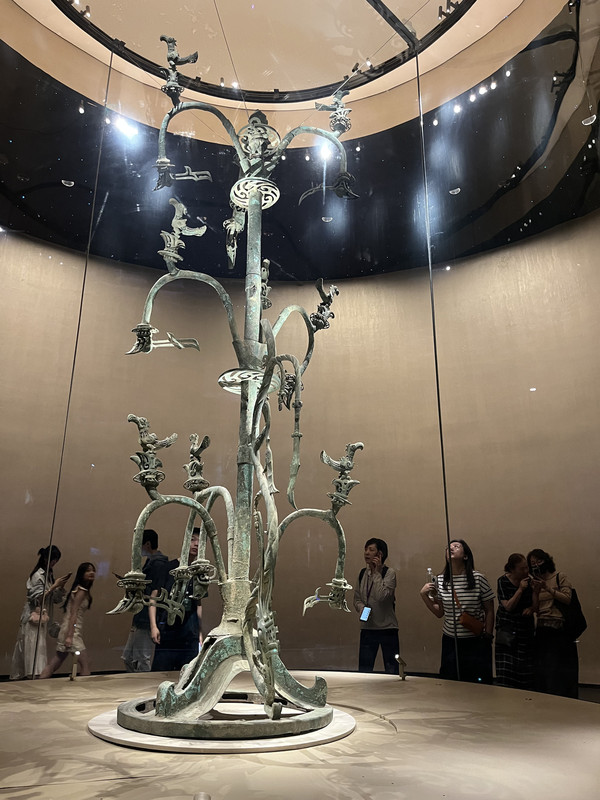
About 40 km northeast of Chengdu, in Guanghan, Sanxingdui displays the relics of a 3,000-year-old Shu civilisation that looks like nothing else in Chinese archaeology: bronze masks with protruding eyes, towering bronze figures, and a reconstructed bronze sacred tree. The new exhibition hall holds the main collection, and the Restoration Hall shows conservators at work on pieces still being pieced together. Plan on a half day inside, then a wander around Guanghan town if you want to stretch it to a full day.
Tickets cost ¥72 for adults and ¥36 for students, and from 4 November 2026 visitors under 18 enter free — a long-term policy confirmed by museum staff to Upstream News on 31 October 2026, not a short promotion. Visitors aged 60 and over also enter free.
The museum opens 08:30–18:00 with last entry at 17:00, and stays open until 20:00 on extended days during holidays and school breaks. Tickets are released at 20:00 each day for entry up to 5 days ahead, through the museum's official website, WeChat account or mini-program — foreign visitors have a dedicated inbound-booking window on the official site, and no walk-up tickets are sold at the gate.
The fast train from Chengdu East to Guanghan North takes as little as 18 minutes, with second-class fares from ¥18, so the whole trip can cost as little as about ¥110–130 per person. Because nearly everything is indoors, this is the day trip to pick when the forecast turns wet: as MyChina.guide's 2026 guide notes, "Rainy day: skip mountain hikes. Do Sanxingdui Museum (indoor)".
Which day trip fits your group?
Key takeaway: match the trip to your group's energy and interests, not to a checklist of famous names.
- First-time visitors with one free day: Leshan. One unmistakable sight, a straightforward train ride, and the boat option keeps it easy.
- Families with children: Sanxingdui in the morning — indoors, flat floors, and free entry for under-18s since November 2026 — or the Leshan boat for a low-effort wow.
- Active travellers: Dujiangyan and Qingcheng, with the cable car up and the stone steps down.
- History lovers: Sanxingdui, ideally with a guide, since the bronze masks make little sense without the story behind them.
- Short on time: Sanxingdui again — the only one of the four that genuinely fits in a half day.
- Bad weather: Sanxingdui indoors; skip Qingcheng in heavy fog, when the views vanish and the steps turn slippery.
Two common mistakes are worth naming. Mount Emei looks like a day trip on the map — it shares Leshan's rail line — but the Golden Summit deserves a night in Emeishan town, and trying both in one day means rushing both. Jiuzhaigou is worse: tour companies still sell it as a day trip, but the driving time dwarfs the sightseeing time.
"It is 9 hours of driving for 3 hours at the actual site. Spend 2–3 days there or do not go." — MyChina.guide, Day Trip from Chengdu Without a Tour (2026)
If you have the extra days, our Huanglongjiuzhai station pickup guide and 5-day Sichuan itinerary cover that route properly.
Getting there: train, tour, or private car?
High-speed rail is cheap and reliable for all four trips — trains to Dujiangyan run every 20–30 minutes, and Leshan and Guanghan North are easy same-day returns. What the train cannot do is remove the transfers: metro to the station, station to the site, site to site, and back again, each with its own queue.
A private car collects you at your hotel, drops you at the gate you actually want — Leshan's north gate, Dujiangyan's main entrance, Sanxingdui's ticket centre — waits while you walk the site, and carries you straight to lunch and the next stop, with no timetable to chase. For Dujiangyan and Qingcheng, a car also removes the mid-day rail hop between the two sites, which is where independent travellers lose the most time.
Drivers communicate with guests via translation apps, so pickup times and route changes are easy to sort on the day. Our Leshan and Emei 2-day itinerary and Dujiangyan and Qingcheng day trip guide show how the same routes run with a car.
Bottom line: One free day means one choice — Leshan for the spectacle, Dujiangyan and Qingcheng for the fullest day, Sanxingdui for history or rain. Book Leshan and Sanxingdui the moment your dates are fixed, leave Dujiangyan and Qingcheng flexible, and do not let anyone sell you Jiuzhaigou or Emei as a single day.
In summary: pick the trip that fits your group, book the two that need booking, and let a private car handle the transfers.
Want the day trip without the station transfers?
A private car can collect you at your hotel, run the Leshan, Dujiangyan–Qingcheng or Sanxingdui route at your pace, and wait at each gate — with a driver who communicates with guests via translation apps, so pickup times and route changes are easy to sort on the day. These day trips are among the Chengdu routes run by Western China Private Car Tours, the Chengdu-based team behind this guide.
Get a Private Car Quote on WhatsAppFrequently Asked Questions About Day Trips from Chengdu
What is the best day trip from Chengdu for first-time visitors?
Leshan Giant Buddha is the strongest all-round choice for a first visit: a 71-metre statue carved into a riverside cliff, about an hour from Chengdu by high-speed train, with a climb ticket at ¥80 or a river boat at ¥70 as of November 2026. Sanxingdui suits history lovers, while Dujiangyan and Mount Qingcheng suit travellers who want more walking and nature.
How much does a day trip from Chengdu cost in 2026?
A Leshan day trip runs about ¥250–290 per person including high-speed rail and entry. The Dujiangyan and Mount Qingcheng pair costs ¥202 without the cable car or ¥262 with it. Sanxingdui costs ¥72 for an adult ticket plus about ¥18–40 for the train, and under-18s enter free from 4 November 2026. A group tour covering the same Dujiangyan–Qingcheng route typically charges ¥480–680 per person.
Can I do Leshan and Mount Emei in one day from Chengdu?
Technically yes, since both sit on the same high-speed rail line, but in practice it means rushing both sights. Pick one, or stay overnight in Emeishan town and take the Golden Summit the next morning.
Do I need to book day trip tickets in advance?
Yes for Leshan and Sanxingdui, no for Dujiangyan and Qingcheng. Leshan sells only timed, real-name bookings through its official mini-program, released at 7:00 every morning, up to a week ahead, with no ticket window on site. Sanxingdui releases tickets at 20:00 each day for entry up to 5 days ahead. Dujiangyan and Mount Qingcheng still sell tickets at the gate with a passport.
What is the best rainy-day day trip from Chengdu?
Sanxingdui Museum. It is almost entirely indoors, about 40 km from Chengdu, and a high-speed train from Chengdu East reaches Guanghan North in as little as 18 minutes. Skip Mount Qingcheng in heavy fog or rain — the views disappear and the stone steps get slippery.
Sources: MyChina.guide — Day Trip from Chengdu Without a Tour (2026 Local Guide; Dujiangyan ¥80, Qingcheng ¥80, cable car ¥60, HSR fares, Leshan ¥80/¥70, ¥202/¥262 totals, group tour ¥480–680) / Asia Odyssey Travel — How Many Days in Chengdu? Best Itineraries for 1–7 Days (updated 19 Oct 2026; Leshan best all-round day trip, Sanxingdui for history lovers, Dujiangyan–Qingcheng for nature and walking) / Sina News — Leshan Giant Buddha ticket booking guide (Oct 2026; ¥80 climb, ¥70 boat, 7:00 release, 7 days ahead, 28,000 holiday cap, 217-step plank road) / Sohu / Upstream News — Sanxingdui free entry for under-18s from 4 Nov 2026 (31 Oct 2026; ¥72 adult, ¥36 student, long-term policy) / ChinaGuide101 — Sanxingdui Museum Travel Guide 2026 (¥72 ticket, 08:30–18:00 hours, 20:00 ticket release, 5 days ahead) / Sohu — Tiangong Kaiyan water-conservancy experience hall opens at Dujiangyan (13 Oct 2026; opens 17 Oct, 10:00–17:00, 12 shows a day, ~6,000 sq m).