Chaka Salt Lake Guide (2026): Mirror of the Sky Tickets, Train & Photo Tips
TL;DR: Chaka Salt Lake is Qinghai's "Mirror of the Sky" — peak tickets ¥60, free entry 1 November 2026–28 February 2027, sightseeing train ¥50 one way, best light before 09:00 or after 17:00.
Short answer: Chaka Salt Lake in Qinghai — China's "Mirror of the Sky" — is a 105-square-kilometre salt lake at 3,059 metres, about 300 km west of Xining. A thin film of brine over white salt crust turns the lake into a perfect mirror on calm, clear days. Peak-season tickets (1 May–31 October) cost ¥60, and admission is free from 1 November 2026 to 28 February 2027 under the park's off-season announcement — you only need a real-name reservation. The sightseeing train into the lake costs ¥50 one way, and the best photographs come before 09:00 or after 17:00.
It is also freshly in the news: on 5 November 2026, the Ministry of Culture and Tourism listed Chaka Salt Lake among 17 sites proposed for national 5A status, which usually means tighter crowd control and stricter booking in the seasons ahead.
All facts below are as of November 2026.
In short: Chaka is the easiest "sky mirror" in China to reach — no multi-day trek, no permit, and a train that carries you into the middle of the lake. Come in June to September for the strongest reflections, in May or October for thinner crowds, or in winter for free entry and snow on the salt. Pair it with Qinghai Lake, 150 km away, for a two-day loop from Xining.
Key takeaways for visiting Chaka Salt Lake
- Free entry this winter. Admission is free from 1 November 2026 to 28 February 2027, with a real-name reservation and identity-document scan at the gate, per the scenic area's off-season announcement carried by Sohu (31 October 2026). Winter hours are 08:15–17:30, and the train and cruise boat are suspended.
- Peak-season tickets are ¥60. From 1 May to 31 October, full price is ¥60 and half price ¥30; in March–April it is ¥30 and ¥15, with multiple entries within 48 hours, according to China Dragon Travel's ticket guide (18 March 2026).
- Ride the train in, walk out. The sightseeing train costs ¥50 one way (¥100 round trip) and runs about 3 km into the lake. Most experienced visitors ride in and walk back, photographing as they go.
- Shoe covers are mandatory on the lake. Rent them for ¥10 plus a refundable ¥50 deposit. Do not wear your own shoes into the brine.
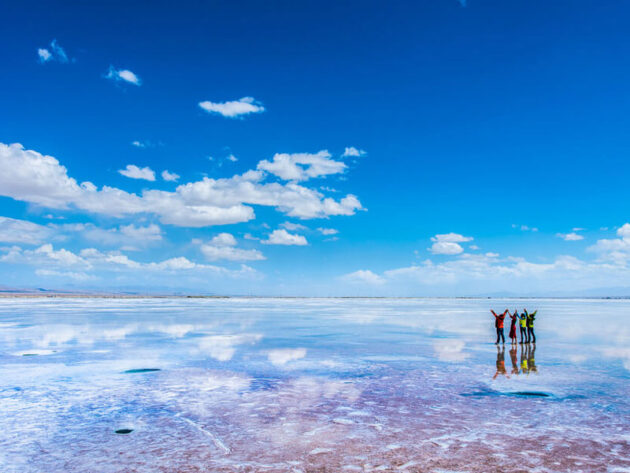
- Photograph early or late. The mirror is clearest before 09:00 and after 17:00, when the light is soft and the water calms. Wear red or yellow — dark clothes disappear against the white salt.
- It sits at 3,059 metres. Take it easy on arrival, drink water, and protect yourself from the sun — the reflective surface intensifies ultraviolet light.
What is Chaka Salt Lake?
Chaka Salt Lake is a salt lake in Chaka Town, Ulan County, on the eastern edge of the Qaidam Basin in Qinghai Province. The oval lake covers about 105 square kilometres — roughly 16 West Lakes of Hangzhou, as one Chinese guide puts it — at an altitude of 3,059 metres. It has been mined for salt for more than 3,000 years, and the working salt fields still sit behind a dividing strip from the tourist area.
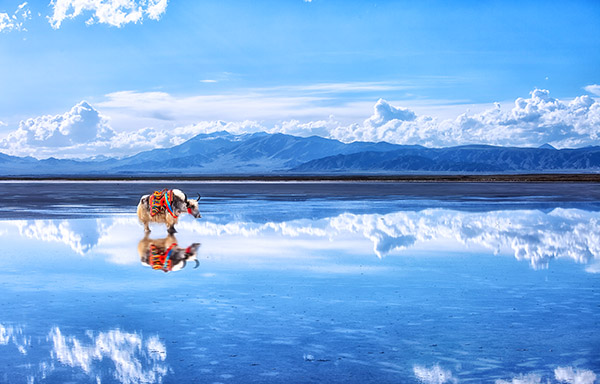
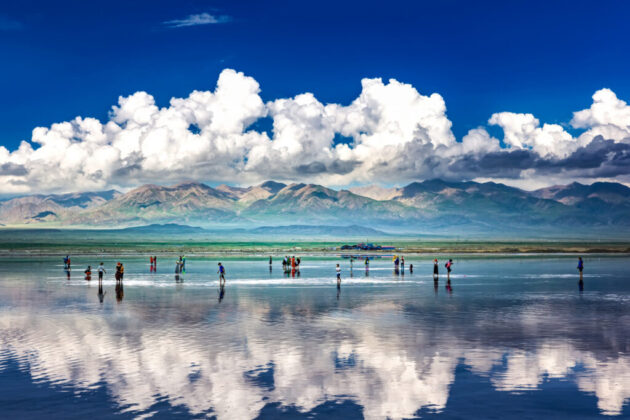
What made it famous is the mirror. In summer, a shallow layer of brine — often only ankle-deep — spreads over the white salt crust, and on a windless day the surface reflects sky, clouds and the distant mountains so cleanly that people and their reflections seem to walk on the sky.
National Tourism Geographic Magazine named it one of the "55 places to visit in a lifetime", and it is also China's first designated starry-sky photography base, because the high-altitude night sky is exceptionally clear. The lake's salt reserves are said to be enough to supply China for 75 years, according to Danana GO's 2026 Chaka guide.
The site has two faces. The original scenic area — the "Mirror of the Sky" core — is the classic salt-flat walk and train ride. A newer area, Sky No.1, sits nearby and charges its own fees for some sections. If your time is short, the original area is the one to prioritise.
Chaka Salt Lake tickets and opening hours
Ticket prices change with the season, and the winter of 2026–27 is the cheapest window in years. The table below combines the scenic area's off-season announcement (31 October 2026) with China Dragon Travel's ticket guide (18 March 2026).
| Season | Dates | Full price | Half price | Hours |
|---|---|---|---|---|
| Peak season | 1 May–31 Oct | ¥60 | ¥30 | 08:15–19:00, last entry 18:10 |
| Spring off-peak | 1 Mar–30 Apr | ¥30 | ¥15 | 08:15–19:00; ticket valid for multiple entries within 48 hours |
| Winter free period | 1 Nov 2026–28 Feb 2027 | Free | Free | 08:15–17:30; real-name reservation required |
Sources: free winter period and winter hours per the scenic area's off-season announcement, via Sohu (31 October 2026); peak and spring prices and hours per China Dragon Travel (18 March 2026). Prices as of November 2026.
Who gets in free or half price?
Children under 6 years old or under 1.2 metres tall, seniors aged 70 and above, active military personnel, people with disabilities, and Zhejiang residents (Zhejiang provides paired assistance to Haixi Prefecture) enter free with valid documents. Half-price tickets go to seniors aged 60–69, children over 1.2 metres, full-time college students with a student card, and Haixi Prefecture residents. Bring the original documents — a photo on your phone is often not accepted at the ticket window.
What costs extra inside the park?
| Item | Price | Notes |
|---|---|---|
| Sightseeing train | ¥50 one way / ¥100 round trip | About 3 km into the lake; departs roughly every 20 minutes; suspended in winter |
| Battery car | ¥5 one way | Short shuttle between the old auditorium and Chaka Salt Station |
| Shoe covers | ¥10 rental + ¥50 deposit | Mandatory on the lake; deposit refunded in full when covers are returned intact |
| Cruise boat | ¥130 | Suspended in winter, along with the water bikes and salt culture museum |
| Parking | ¥10 per 12 hours | 3,500 spaces; free for the first 30 minutes; free in the winter period |
Sources: extra-service prices per China Dragon Travel (18 March 2026) and the scenic area's off-season announcement via Sohu (31 October 2026). Prices as of November 2026.
Buy tickets online a day ahead in peak season — on-site queues are long and ticket sales can stop when the park hits its flow-control limit. Online tickets usually need to be bought 1–2 hours before entry. In the free winter period, reserve through the scenic area's official online channel or at the visitor centre, then scan your identity document at the gate.
"Chaka Salt Lake, nestled in the heart of Qinghai Province, is one of China's most breathtaking natural wonders, often dubbed the 'Mirror of the Sky.'" — Danana GO, Chaka Salt Lake Travel Guide (2026)
How to get to Chaka Salt Lake from Xining
Xining, the capital of Qinghai, is the gateway. The lake is about 300 km west of the city, and every route below starts there.
- Reach Xining by air or train from Chengdu or another major Chinese city.
- Choose your onward transport: a private car (3.5–4 hours along the G109), the seasonal tourist train (July–September, about 4.5 hours), or a bus (about 4 hours).
- Cover the last 4 km from Chaka Town to the lake entrance by taxi or private car — taxis are scarce here in the off-season.
By private car: the most flexible option, 3.5–4 hours along the G109 national highway, with the Qinghai Lake shoreline on the way if you take the longer scenic route. A private car also solves the last 4 km between Chaka Town and the lake entrance, where taxis are scarce in the off-season. This is the option we run ourselves — see the quote box below.
By train: a seasonal "Mirror of the Sky" tourist train runs from Xining Railway Station to Chaka Station in July–September, about 4.5 hours for ¥34–62 in second class, and the station is only about 200 metres from the lake entrance. Regular trains run year-round — for example, K6961 departs Xining at 08:25 and arrives at Chaka at 12:23 (¥62.50 for a hard seat), returning at 16:30 — but timetables change with the season, so check before you travel, according to Danana GO.
By bus: tourist shuttles run from Xining Bus Station in July–September (about 4 hours, ¥40–65 one way). Year-round regular buses from Xining Passenger Station to Chaka Town run about six times a day (¥65, 4 hours); from the town you need a taxi or a walk to the lake, about 4 km away.
From Chengdu: Chaka is not a day trip from Chengdu — it is roughly 1,300 km away. The practical way to fold it into a Chengdu-based trip is the Qinghai–Gansu grand loop: drive or fly to Xining, then loop through Qinghai Lake, Chaka, and on to Zhangye and Dunhuang. Our Qinghai–Gansu grand loop itinerary lays out that 7-day route, including the winter free-entry window at Chaka and the half-price winter tickets at Zhangye Danxia.
When is the best time to visit Chaka Salt Lake?
| Season | What to expect |
|---|---|
| June–September | Golden season. The lake is fullest, the mirror strongest, and the grasslands green. July–August is the peak — the best reflections and the biggest crowds. |
| May–June, September–October | Best balance. Still reflective, cooler air, far fewer people, and lower hotel prices in Chaka Town. |
| November–February | Winter. Snow on the salt flats, free admission, very few visitors — but the train and cruise boat are suspended and some areas close. |
| March–April | Spring. The salt harvest season, so you can watch salt being collected; the lake may be less reflective as water levels change. |
Sources: seasonal guidance per Danana GO (2026) and China Dragon Travel (18 March 2026). Conditions as of November 2026.
Within a day, the mirror is clearest before 09:00 and after 17:00, when the light is soft and the wind drops — the water needs to be still to reflect. Midday sun is harsh and the surface ripples with the breeze, so use the middle of the day for the train ride, the salt sculptures and lunch, then return to the lake for the late-afternoon light. Summer daytime temperatures average around 19.6°C, but the plateau sun is strong at any hour.
What to see and do at Chaka Salt Lake
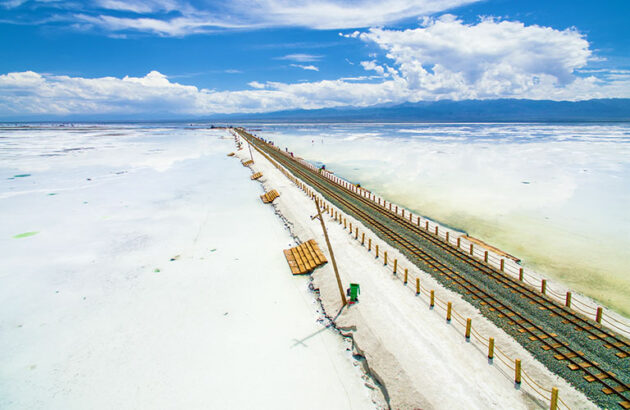
Ride the sightseeing train. The narrow-gauge line was built to haul salt, suspended in 2008 and rebuilt for visitors in 2016. It runs about 3 km from Sky Mirror Station at the entrance into the deep part of the lake, stopping at the main photography spots. Buy a one-way ticket (¥50) and walk back — the walk is the best part.
Walk on the mirror. In the designated areas the brine is ankle-deep over a firm salt crust. Rent the shoe covers (¥10 + ¥50 deposit), step out, and wait for the water to settle before you shoot. The crunch of salt crystals underfoot is part of the experience — but do not walk barefoot, because the salt is abrasive and the brine stings broken skin.
Photograph the salt sculptures. Large salt carvings stand near the lake, including figures of Genghis Khan and the Queen Mother of the West, recognised by the World Record Association. The Qianying Muxue Platform and the Love Platform are the two most photographed viewpoints, according to Danana GO. Wear red, yellow or bright blue — dark clothes blend into the white salt and vanish in photographs.
Stay for the stars. Chaka is China's first designated starry-sky photography base, and on a clear night the sky reflects in the lake. Stay overnight in Chaka Town (4 km away) rather than rushing back to Xining, and check the moon phase — a new moon gives the darkest sky.
Visit during the Lake Sacrifice Ceremony. On the 15th day of the fifth lunar month, the lake hosts a Tibetan ceremony with a 240-year history — prayer flags, offerings and ethnic performances at the Prayer Flag Square and the oboo (sacred stone cairn). Dates follow the lunar calendar, so confirm the year's date before planning around it.
Want Chaka Salt Lake in a private-car loop from Xining?
Western China Private Car Tours runs private cars across Qinghai and Gansu — Xining pickup, Chaka Salt Lake, Qinghai Lake, Zhangye Danxia and Dunhuang — with the route and overnight stops planned around the mirror's best light, not a fixed group timetable. Our drivers communicate with guests via translation apps, so pickup times and route changes are easy to arrange on the road.
See our Qinghai–Gansu grand loop itinerary and our best time to visit Tibet and Qinghai guide for the full route and seasonal timing.
Get a Private Car Quote on WhatsAppWhere to stay and eat near Chaka Salt Lake
Chaka Town (4 km from the lake): the practical base. Guesthouses and small hotels run about ¥50–200 a night, with the main hotel, Yanhu Binguan, around ¥100–200; prices roughly double in peak season, so book early in July and August. Small restaurants serve Tibetan and Chinese dishes — yak meat, noodles and tsampa (roasted barley flour) — for about ¥20–50 a meal.
Xining (300 km away): the comfortable base if you are only doing a long day trip. Budget hostels run about ¥100–200 a night, mid-range hotels ¥300–500, and five-star options from about ¥600, according to Danana GO.
Qinghai Lake (150 km away): if you are combining both lakes, stay near Erlangjian on Qinghai Lake (about ¥200–400 a night) and catch the sunrise there before driving to Chaka. Heimahe township, about 80 km from Chaka, is the classic sunrise spot on Qinghai Lake.
Eating inside the park: kiosks sell snacks, noodles and drinks for about ¥15–30, but the choice is limited and prices are high for the plateau — bring water and dry food, especially in the off-season when some kiosks close.
Altitude, weather and practical tips
Sun and altitude at 3,059 metres
Chaka sits at about 3,059–3,100 metres, high enough that altitude sickness is a real possibility for travellers arriving straight from sea level. Take it easy on your first day, drink plenty of water, avoid strenuous activity, and rest if you feel dizzy. Our altitude sickness guide covers the 24–48 hour acclimatisation rule, warning signs and when to descend.
The lake's reflective surface intensifies ultraviolet light. Sunscreen, sunglasses and a hat are not optional — apply sunscreen twice, because the reflection burns from below as well as above.
What to pack
Temperatures swing sharply between morning and evening, even in summer. Layer up, bring a windproof jacket, and wear bright colours for photographs. In winter, bring full cold-weather clothing — Qinghai winters are dry, windy and well below freezing at night.
Cash, signal and respecting the lake
Some areas around the lake have weak mobile signal, and not every stall takes card payments. Carry enough renminbi in cash, and download offline maps before you leave Xining.
Respect the lake: stay in the open areas and out of the closed salt-production zone. The lake was closed for a period in 2015 because of pollution from over-visiting — do not litter, do not break the salt crust, and do not enter fenced-off sections.
Bottom line: Chaka Salt Lake is the most accessible sky mirror in China — a half-day visit from Xining, a train into the middle of the lake, and photographs that look impossible. This winter is the cheapest time to go in years, with free admission until 28 February 2027, and the new 5A nomination means the quiet winters may not last. Go soon, go early in the day, and bring the shoe covers.
In summary: Peak tickets are ¥60 (May–October), spring tickets ¥30, and admission is free from 1 November 2026 to 28 February 2027 with a reservation. The train is ¥50 one way, shoe covers are mandatory on the lake, and the best light is before 09:00 and after 17:00. Pair Chaka with Qinghai Lake, 150 km away, and give yourself a night in Chaka Town for the stars.
Frequently Asked Questions About Chaka Salt Lake
How much does it cost to visit Chaka Salt Lake?
In peak season (1 May–31 October) a full-price ticket costs ¥60 and a half-price ticket ¥30. In March–April the price drops to ¥30 full and ¥15 half, with multiple entries allowed within 48 hours. From 1 November 2026 to 28 February 2027 admission is free for all visitors, with a real-name reservation made in advance. Inside the park, the sightseeing train costs ¥50 one way, a battery car ¥5 one way, and shoe-cover rental ¥10 plus a refundable ¥50 deposit.
When is the best time to visit Chaka Salt Lake?
June to September gives the strongest mirror effect, with July and August the peak months for reflections — and the biggest crowds. May–June and September–October are a good compromise: still reflective, with fewer people. Winter (November–February) brings snow on the salt flats and free admission, but the train and cruise boat are suspended. For photography, go before 09:00 or after 17:00, when the light is soft and the water is calm.
Is Chaka Salt Lake free in winter?
Yes. Under the scenic area's off-season announcement of 31 October 2026, admission is free from 1 November 2026 to 28 February 2027. Entry is by real-name reservation through the scenic area's official online channel or at the visitor centre, then scanning your identity document at the gate. The free ticket covers admission only — the train, battery car, shoe covers and parking are still charged. Winter hours are 08:15–17:30.
How do I get to Chaka Salt Lake from Xining?
Chaka Salt Lake is about 300 km west of Xining, roughly 3.5–4 hours by private car along the G109 national highway. A seasonal tourist train runs from Xining Railway Station to Chaka Station in July–September (about 4.5 hours, ¥34–62 for a second-class seat), and regular trains such as K6961 run year-round (08:25–12:23, ¥62.50 for a hard seat). Buses from Xining take about 4 hours and cost ¥40–65 one way in summer. The lake entrance is about 4 km from Chaka Town.
Can I walk on the lake at Chaka Salt Lake?
Yes, in the designated walking areas. The water is only ankle-deep in places, and the salt crust crunches underfoot. Shoe covers are mandatory when you step onto the lake — rent them inside the park for ¥10 plus a ¥50 refundable deposit, and do not wear your own shoes into the water, as the brine corrodes footwear and can irritate bare skin. Wear bright colours (red or yellow photograph best against the white salt) and bring sunscreen, sunglasses and a hat, because the reflective surface intensifies ultraviolet light.
Sources: Danana GO — Chaka Salt Lake Travel Guide (2026; 105 sq km, 3,059 m, 3,000-year salt history, "55 places to visit in a lifetime", first starry-sky photography base, train ¥34–62, K6961 timetable, Lake Sacrifice Ceremony, salt sculptures) / China Dragon Travel — Chaka Salt Lake Ticket Prices (18 March 2026; peak ¥60/¥30, spring ¥30/¥15, winter free, train ¥50, battery car ¥5, shoe covers ¥10 + ¥50 deposit, cruise ¥130, parking ¥10) / Sohu — Chaka Salt Lake off-season announcement (31 October 2026; free admission 1 Nov 2026–28 Feb 2027, real-name reservation, winter hours 08:15–17:30, train every 20 minutes, cruise suspended) / Sohu — Ministry of Culture and Tourism 5A announcement (6 November 2026; 17 sites proposed for 5A status including Chaka Salt Lake, comment period 5–11 November 2026). Images: lake photographs courtesy of Danana GO.