Chengdu 3-Day Itinerary (2026): Pandas, Teahouses, and a Day Out to Leshan or Dujiangyan
Short answer: Three days in Chengdu works best as two days in the city and one day out of it. Day 1 is the pandas at opening time, a teahouse afternoon and Kuanzhai Alley at dusk. The second day covers Wuhou Shrine and Jinli, Du Fu Thatched Cottage, then Chunxi Road and the riverside at night. The last day is one train trip — either the Leshan Giant Buddha or Dujiangyan and Mount Qingcheng, never both.
The one booking you cannot leave late is the panda base: tickets open 14 days ahead, sell in your real name, and a day can sell out. Everything else in this plan can be arranged around that one ticket. All prices below are as of November 2026.
TL;DR: Book the panda base 14 days ahead, stay on Metro Line 2, spend the first two days in town and the last one out — Leshan for the spectacle, Dujiangyan and Qingcheng for walking and history.
Key takeaways for a 3-day Chengdu trip
- Book the panda base first, 14 days out. The Chengdu Research Base of Giant Panda Breeding caps entry at 85,000 visitors a day, and morning slots go first — pandas are most active between 8:00 and 10:30, and after 11:00 most are asleep, according to WaysChina's October 2026 guide.
- Keep each day in one part of town. Day 1 runs north-east to north-west (pandas, then the old town), Day 2 runs south-west to the centre (Wuhou Shrine, then Chunxi Road), and Day 3 is a single train out and back. That is the whole trick to a plan that never feels rushed.
- Day 3 is one trip, not two. Leshan and Dujiangyan sit in different directions and leave from different stations; each takes a full day. If you want both, add a fourth day.
- Stay on Metro Line 2. A hotel between People's Park and Chunxi Road puts both Day 3 departures one metro ride away — east to Chengdu East station for Leshan, west to Xipu for Dujiangyan and Qingcheng.
- Spring and autumn are the sweet spot. March to June and September to November are the most comfortable months; summer is humid and rainy, winter damp and cold, and the first week of October is the busiest week of the year.
The 3-day plan at a glance
| Day | Morning | Afternoon | Evening | Main cost |
|---|---|---|---|---|
| Day 1 | Panda Base at opening (¥55) | People's Park & Heming Teahouse (tea ~¥30) | Kuanzhai Alley at dusk, hotpot or opera | ~¥140–240 |
| Day 2 | Wuhou Shrine (¥50) + Jinli (free) | Du Fu Thatched Cottage (¥50) | Chunxi Road & Taikoo Li, Jiuyan Bridge | ~¥100 + dinner |
| Day 3 | Leshan Giant Buddha (¥80 climb / ¥70 boat) or Dujiangyan + Mt Qingcheng (¥80 + ¥80) | Back in Chengdu, late dinner | ~¥202–290 | |
Sources: ticket prices and hours per WaysChina 3-day Chengdu itinerary (updated 30 Oct 2026) and ChinaSimply Chengdu guide (12 Aug 2026); family 3-day shape per Sohu (25 Oct 2026). Prices as of November 2026; confirm on the day, as fares change.
What to book first: the countdown
Chengdu rewards one habit above all: booking in the right order. Work backwards from your arrival date, and the plan almost runs itself.
- As soon as you have dates: a 12306 railway account. Day 3 needs train tickets, and China Railway's booking site only sells once your identity check shows "passed". Foreign passport holders can pass it by uploading a passport photo, or by going to a station ticket window in person.
- 15 days before Day 3: train tickets go on sale. Tickets are sold up to 15 days ahead, counting the travel day. Both day-trip routes have many trains a day, so outside holidays you rarely need to book at the 15-day mark — during national holidays, book as soon as sales open.
- 14 days before Day 1: the panda base. All tickets are sold online in the visitor's real name, up to 14 days ahead. The official channels are the base's WeChat account and mini-program, plus authorised platforms including Trip.com. Choose the morning slot. On the day, passport holders use the separate lane marked "Lane for Passport & Other Documents".
- 14 days before Day 2: Wuhou Shrine and Du Fu Thatched Cottage. Both sell tickets 14 days ahead on their official sites or WeChat accounts; foreign visitors book with their passport.
- No booking needed: Wenshu Monastery (free), People's Park, Jinli outside the Spring Festival fair, Kuanzhai Alley and Chunxi Road.
"Three days in Chengdu works best as two days in the city and one day out of it." — WaysChina, 3 Days in Chengdu (updated October 2026)
Day 1: pandas at opening, a teahouse afternoon, Kuanzhai at dusk
Morning: Chengdu Research Base of Giant Panda Breeding
Be at the gate when it opens. From March to October, morning tickets allow entry from 7:30 to 12:00; from November to February, from 8:00 to 12:00. An adult ticket costs ¥55, students pay ¥27, and children under 6 or under 1.3 metres get in free without booking. The ticket is good for one entry in the half-day slot you booked.
Take Metro Line 3 north to Panda Avenue, leave by exit A and take the 408 shuttle bus to the South Gate. A taxi from Chunxi Road takes 25–35 minutes and costs around ¥40, according to the base's own guide.
Inside, the base is large and hilly: the sightseeing cart costs ¥30 and works all day from any stop. Walk the adult enclosures and the nursery houses first, while the pandas are still eating and moving — head for the Moonlight Nursery before the tour groups get there.
One thing to know: as a trial, the busy Villa No. 6 area closes every Monday except on public holidays, and the star panda He Hua takes Mondays off, so plan around her if she is the reason you are going. Three to four hours is enough for most people; leave in the late morning, when the pandas settle down to sleep and the paths get crowded.
Early afternoon: People's Park and the Heming Teahouse
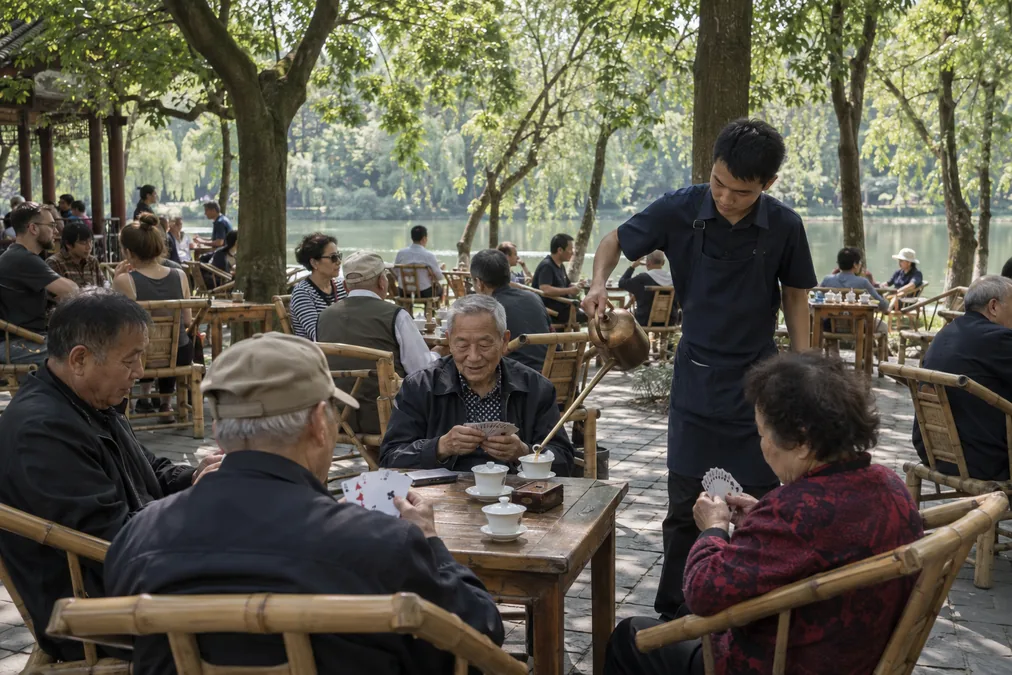
People's Park has been free since 2004. It is the classic picture of Chengdu life: retirees playing cards, dancing and singing, and the open-air Heming Teahouse by the lake, where you sit in a bamboo chair with a lidded cup of tea for as long as you like. The cheapest time is early morning: from 6:30 to 8:30 a cup costs ¥3. Later in the day the price is higher — a gaiwan tea runs about ¥30 with free refills — so check the price board at the counter.
Ear cleaning, the city's most famous teahouse ritual, costs about ¥30–60 a session. The stage shows at the teahouse (face-changing, storytelling and the long-spout teapot pour) are free for anyone having tea, except the 20:00 evening show.
Late afternoon and evening: Kuanzhai Alley, then hotpot or opera
Kuanzhai Alley is three parallel lanes of restored courtyard houses — Wide Alley, Narrow Alley and Well Alley — full of snack stalls, teahouses and shops. It is touristy, but the lanes look their best when the lanterns come on, so late afternoon into dusk is the right time.
Walk the lanes at dusk rather than filling up on snacks there, then choose one of two evenings. For hotpot, skip the chains on the main squares and head to the Yulin neighbourhood, where locals go to eat: budget about ¥80–150 per person at a mid-range local shop, and order a split pot (yuanyang) with a mild broth on one side if you are unsure about the spice. For Sichuan opera with face-changing, Shufeng Yayun in the Culture Park on Qintai Road runs a show every night at 20:00 — go in 30 minutes early, and eat an early dinner first. A no-frills alternative is the Baijiaban show in the Maoye Mall near Chunxi Road: about ¥28 for a 60-minute performance.
Day 2: Wuhou Shrine and Jinli, Du Fu's cottage, Chunxi Road
Morning: Wuhou Shrine Museum and Jinli Ancient Street
Wuhou Shrine honours Zhuge Liang, the strategist of the Three Kingdoms period. You do not need to know the history: the red walls, old cypress trees and statues of generals are enjoyable on their own. It is open 9:00–18:00, with last entry at 17:00, and a full ticket costs ¥50; half price is ¥25 for visitors aged 7 to 18 and eligible full-time students. Allow one to one and a half hours.
Jinli Ancient Street is right next to the shrine: a roughly 550-metre old street that is free on normal days and open 8:00–22:30. Late morning, straight after the shrine, is its quietest time, and it is the easiest place to graze on snacks for lunch. At dusk the red lanterns switch on and the food stalls start smoking — which is why many visitors come back here on Day 1 as well.
Afternoon: Du Fu Thatched Cottage Museum
Du Fu Thatched Cottage is a garden park built around the home of the Tang-dynasty poet Du Fu, with bamboo paths, ponds and a rebuilt thatched cottage — calmer than Wuhou Shrine, and a short ride-hail trip from Jinli. The museum is open 9:00–18:00, ticket sales stop at 17:00, and it has no regular closing day. A full ticket is ¥50 and a half-price ticket is ¥25. Plan on an hour and a half.
Note that the Jinsha Site Museum, which older itineraries send you to at this point, is closed for a full renovation from 5 December 2025 to 30 April 2027 — leave it out.
Evening: Chunxi Road and Taikoo Li, then Jiuyan Bridge
Chunxi Road is the main shopping street, and the low-rise Taikoo Li complex next to it is built around the old Daci Temple; the International Finance Square (IFS) mall on the corner has the big panda sculpture climbing its outer wall. Walk around at dusk and have dinner here — if you went to the opera on Day 1, tonight is a good night for hotpot.
After dinner, head to Jiuyan Bridge, the riverside bar area, lit up at night and relaxed. If you still have energy, the Jin River night cruise leaves from the Hejiang Pavilion pier: about ¥120 per person for around 60 minutes past lit-up bridges and riverside teahouses.
Day 3: Leshan Giant Buddha, or Dujiangyan and Mount Qingcheng
Choose one. Leshan is one huge sight: a Buddha carved into a riverside cliff, seen on foot or from a boat. Dujiangyan and Qingcheng give you two smaller things: an ancient irrigation system that still works, and a forested Taoist mountain with stone steps. Leave on an early train either way.
Option A: Leshan Giant Buddha
Trains to Leshan leave mainly from Chengdu East, with some from Chengdu South. There are about 78 direct trains a day, and most take 46–60 minutes; the first leaves around 05:55, and the last train back from Leshan is around 23:07. Second-class seats cost about ¥26–63 depending on the train, because fares float — check the day's price on 12306. At the station, passport holders go through the staffed lane, not the automatic gates. From Leshan station, buses K1 and 3 run to the Giant Buddha scenic area, or take a taxi or ride-hail car.
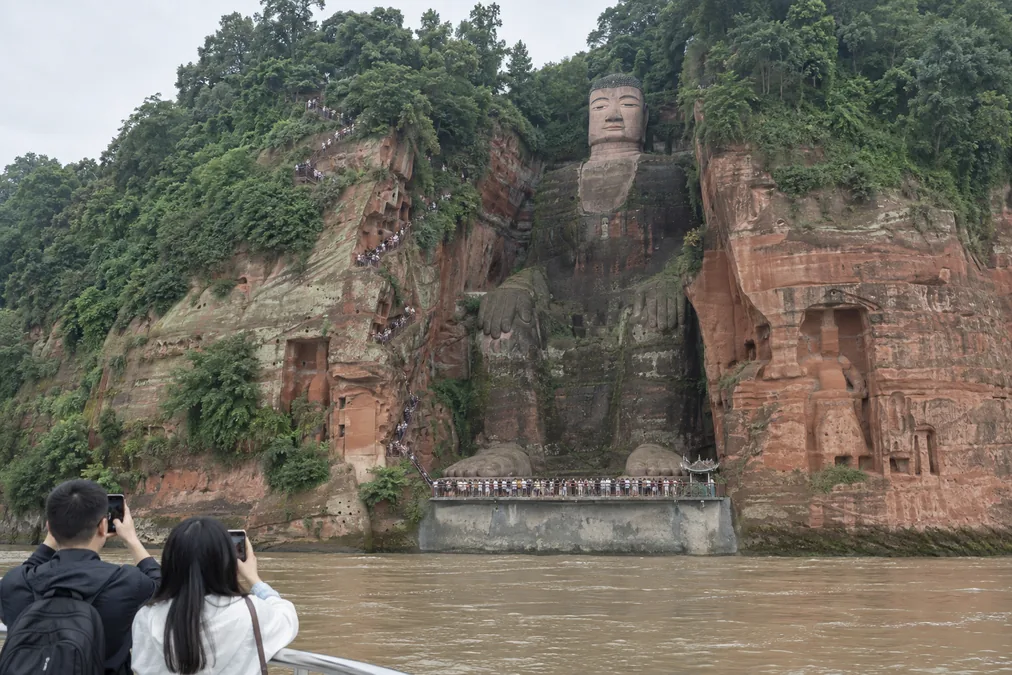
The daytime climbing ticket costs ¥80 and covers the walking route to the Buddha; children under 1.2 metres or under 6 go free. The scenic area is open 7:30–18:30 from 1 April to 7 October and 8:00–17:30 the rest of the year. The famous Nine-Turn Plank Road beside the Buddha is closed for maintenance, so walkers now go down to the Buddha's feet by the Lingyun Plank Road instead. On foot you see the head up close from the top and the feet from the bottom, but never the whole figure at once.
The boat shows you the entire Buddha from the river: it costs ¥70 and sails on a rolling schedule, boarding 08:30–17:30 in the winter season. If you have the whole day, do both, with the walk first and the boat after. If the queues are long or you are short on time, the boat alone still gives you the view people come for. All in, expect ¥250–290 per person and 9–10 hours door to door.
Option B: Dujiangyan Irrigation System and Mount Qingcheng
The Chengdu–Dujiangyan line leaves mainly from Xipu, the western end of Metro Line 2. From Xipu it is about 20–30 minutes to Dujiangyan (around 40 trains a day) and 23–35 minutes to Qingchengshan (around 48 a day), with second-class fares from ¥10.
The last trains back leave Qingchengshan around 23:08 and Dujiangyan around 23:18. Do Mount Qingcheng in the morning, while it is cool, and Dujiangyan in the afternoon, because it stays open later. Qingcheng's Front Mountain opens 8:30–17:30 from May to September and 8:30–17:00 the rest of the year; Dujiangyan is open 8:00–18:00 in summer and 8:00–17:30 in winter. Each site costs ¥80, and the Qingcheng cable car is extra.
New for autumn 2026: the "Tiangong Kaiyan" water-conservancy experience hall opened beside Fulong Temple on 17 October, running 12 shows a day from 10:00 to 17:00 in a roughly 6,000-square-metre space. In the summer rainy season, these mountain areas close at short notice when there is a weather alert — check the scenic area's WeChat account the evening before, and keep Leshan as your backup. Our Dujiangyan and Qingcheng day trip guide and Leshan and Emei 2-day itinerary cover both options in more detail.
Getting around: metro, cards and last trains
Since 28 July 2025 you can tap a foreign Visa, Mastercard or American Express card, or a UnionPay card, directly on Chengdu metro gates, as long as it is a contactless chip card. Fares go by distance, from ¥2. A 1-day pass costs ¥20 and a 3-day pass ¥50; on this plan, with Day 3 spent mostly on trains, paying per ride with your card usually works out about the same.
Most lines run their last train from the first station between 22:30 and 23:30 — if you take one of the last trains back from Leshan or Qingchengshan, you may reach Chengdu after the metro has stopped, so plan on a ride-hail car from the station. Both Chengdu Shuangliu and Chengdu Tianfu airports are entry points for China's 240-hour visa-free transit, so a three-day Chengdu stop fits in a transit trip if your passport qualifies — see our 240-hour visa-free transit guide. For the full picture, see our Chengdu metro guide for foreign visitors and getting around guide.
What the 3 days cost
| Item | Cost per person | Notes |
|---|---|---|
| Panda Base | ¥55 | Morning slot; students ¥27; under 6 free |
| Wuhou Shrine + Du Fu Cottage | ¥50 + ¥50 | Half price ¥25 for ages 7–18 |
| Hotpot dinner | ¥80–150 | Yulin neighbourhood, mid-range local shop |
| Sichuan opera | From ~¥28 | Baijiaban 60-min show; Shufeng Yayun from higher |
| Day 3 — Leshan | ~¥250–290 | Train + ¥80 climb or ¥70 boat, all in |
| Day 3 — Dujiangyan + Qingcheng | ¥202–262 | ¥80 + ¥80 entry, ¥10 rail legs, optional cable car |
| Metro | From ¥2 a ride | Foreign cards tap at the gates |
Sources: costs per WaysChina (updated 30 Oct 2026) and ChinaSimply (12 Aug 2026); Dujiangyan–Qingcheng totals per our earlier day-trip breakdown. Prices as of November 2026; hotels not included.
Variations: 48 hours, kids, rain, and no spice
Only 48 hours?
Keep Day 1 as it is, with the opera or hotpot in the evening. On Day 2, do Wuhou Shrine and Jinli in the morning and go straight to Chunxi Road and Taikoo Li in the afternoon, skipping Du Fu Thatched Cottage. There is no room for a day trip as well. If Leshan or Dujiangyan matters more to you than the city's history sites, swap Day 2 for one of the Day 3 options instead — you can fit one out-of-town trip in 48 hours, not two.
Travelling with children in Chengdu
The panda base is free for children under 6 or under 1.3 metres, and they need no booking. For a second panda day, make Day 3 Dujiangyan Panda Valley, a quieter branch of the same base near Dujiangyan — tickets are ¥55 and can only be booked online through the Panda Valley WeChat account. Our Chengdu with kids guide has the full family version of this plan.
If it rains
A covered teahouse is a perfectly good way to spend a wet afternoon in Chengdu, so rain costs you less here than in most cities. At the panda base, head for the villas and nursery houses with indoor viewing. For a museum, the Chengdu Museum on Tianfu Square is open Tuesday to Sunday, with late hours until 20:30 on Fridays and Saturdays. Keep Day 3 flexible: if heavy rain is forecast, Leshan is the safer choice over the mountain.
If you cannot eat spicy food
You can still eat very well. For hotpot, order a split pot with a clear or mushroom broth on one side. In restaurants, say "bu la" (not spicy) or "wei la" (a little spicy), and point to dishes on picture menus that are not covered in red chilli oil. Jinli and Kuanzhai have plenty of sweet and mild snacks too — see our Chengdu food tour guide.
Bottom line: Book the panda base first, 14 days out, and pick the morning slot; then book Wuhou Shrine and Du Fu Thatched Cottage, and set up and verify your 12306 account so Day 3's train is one tap away. The route runs north-east to north-west on Day 1, south-west to the centre on Day 2, and out by train on Day 3 — Leshan from Chengdu East or Dujiangyan and Qingcheng from Xipu, never both.
In summary: the first two days at a slow Chengdu pace, and one day out on the train, with every ticket booked in the right order before you fly.
Want the 3 days without the station queues?
A private car can collect you at your hotel each morning, run the panda base, the old town and your Day 3 trip at your pace, and wait at each gate. The driver communicates with guests via translation apps, so pickup times and route changes are easy to sort on the day.
These routes are among the Chengdu itineraries run by Western China Private Car Tours, the Chengdu-based team behind this guide. For where to stay, see our where to stay in Chengdu guide.
Get a Private Car Quote on WhatsAppFrequently Asked Questions About 3 Days in Chengdu
Is 3 days enough for Chengdu?
Yes, for a first visit. The first two days cover the pandas, the teahouses, the old streets and the main historical sites, and the third day gets you out to Leshan or Dujiangyan and Mount Qingcheng. If you want both Leshan and Dujiangyan, or Mount Emei, add a fourth day.
How far ahead do I need to book the Chengdu Panda Base?
Tickets open 14 days ahead and sell in the visitor's real name, with a daily cap of 85,000 visitors as of November 2026. Book the morning slot as soon as sales open — same-day tickets often sell out in peak season. Pandas are most active between 8:00 and 10:30.
Should I choose Leshan or Dujiangyan for my third day?
Choose Leshan if you want one famous sight you will remember: a 71-metre Buddha, best seen from the river boat at ¥70. Choose Dujiangyan and Mount Qingcheng if you prefer walking, forest and history, with a shorter train ride from Xipu. In the summer rains, Leshan is the safer bet, because mountain areas sometimes close for weather alerts.
How much does 3 days in Chengdu cost in 2026?
Sightseeing and food run about ¥700–900 per person excluding hotels: Panda Base ¥55, Wuhou Shrine ¥50, Du Fu Thatched Cottage ¥50, hotpot ¥80–150 per person, a Sichuan opera show from about ¥28, and a Leshan day at roughly ¥250–290 all in, or Dujiangyan and Qingcheng at ¥202–262. Metro rides start at ¥2.
Can I do this itinerary without speaking Chinese?
Yes. The metro has English signs and, since 28 July 2025, accepts foreign bank cards tapped at the gates. The panda base has an English ticket page and a passport lane, and Wuhou Shrine takes passport bookings. Save each place's Chinese name on your phone, and use a ride-hailing app with an English interface for taxis.
Sources: WaysChina — 3 Days in Chengdu: A Day-by-Day Itinerary from Pandas to Leshan (updated 30 Oct 2026; panda base ¥55, 85,000 cap, 14-day booking, Wuhou Shrine ¥50, Leshan ¥80/¥70, 78 trains a day, Dujiangyan–Qingcheng ¥80 each, metro card tap from 28 Jul 2025, Jinsha closure to 30 Apr 2027) / ChinaSimply — Chengdu Travel Guide: Pandas, Teahouses & Slow Days (12 Aug 2026; hotpot ¥80–150, opera ~¥28, Jin River cruise ~¥120, tea ~¥30, ear cleaning ¥30–60, He Hua rests Mondays) / Sohu — Six family-friendly cities (25 Oct 2026; Chengdu 3-day shape: pandas + Kuanzhai + People's Park, Dujiangyan + Qingcheng, Jinli + Wuhou + Chunxi; best seasons Mar–Apr and Sep–Nov).