How to Get Around Chengdu: Metro, Taxi, DiDi and Walking (2026)
Short answer: Take the metro for almost everything inside the city, DiDi or a taxi when you have luggage or travel late, and walk the old-city lanes — that trio covers a first visit to Chengdu without a car of your own (Trip.com, 2026; Ruqin Travel, May 2026).
Bottom line: the metro is the backbone, not the whole answer. It reaches the shopping streets, the parks, the temples and both airports for a few yuan, but it stops around 23:00, it does not reach the Panda Base gates, and it is no fun with a suitcase at rush hour. Plan the day around the metro, and keep DiDi ready for the first and last leg of every day.
Chengdu's network is now one of the largest in the world — more than 750 km and close to 490 stations across 18 lines including the tram, per a June 2026 network update — and the 2026 National Day week proved how heavily visitors lean on it: the system carried 41.0516 million rides in seven days, an average of 5.8645 million a day, up 6.84% on the year before, with foreign-card use up 59.73% and day-pass sales up 40.71% (Sohu / Chengdu Rail Transit Group, October 2026).
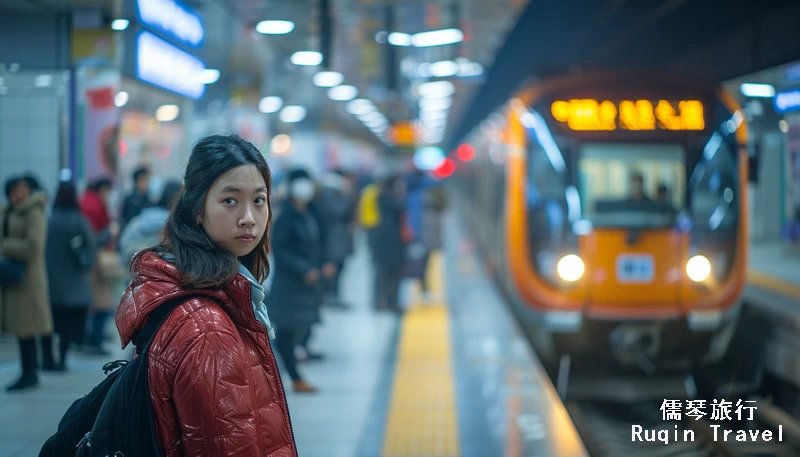
Key takeaways: getting around Chengdu at a glance
- Default mode: metro, about 06:00–23:00, ¥2–7 for most city rides.
- Door to door: DiDi in English, or a metered taxi — save destinations in Chinese characters.
- Cheap extras: buses at about ¥2, shared bikes for short hops, walking for the old city.
- After 23:00: taxi, DiDi or a pre-booked private car — the metro has closed.
The metro: your first tool, and the one to learn first
Chengdu's metro is clean, air-conditioned, punctual and bilingual: station names, route maps and announcements all appear in Chinese and English, which is why first-time visitors settle into it faster here than in many larger Chinese cities (Trip.com, 2026; Ruqin Travel, May 2026). The busiest visitor route in the 2026 National Day week tells the story — Chengdu East station to Chunxi Road, then onward from Chunxi Road to Tianfu Square, People's Park, Wuhou Shrine and Wenshu Monastery (Sohu, October 2026). Those are exactly the stations a first visit needs.
Lines visitors use most
The lines that matter most for sightseeing are Lines 1 to 4, plus the two airport lines. Heading north–south, Line 1 passes Wenshu Monastery, Tianfu Square and South Railway Station. Across the city, Line 2 links People's Park, Tianfu Square, Chunxi Road and Chengdu East station. To the north, Line 3 reaches Panda Avenue for the Panda Base area and Gaoshengqiao for Wuhou Shrine and Jinli. Westbound, Line 4 serves Kuanzhai Alley and the west of the city. For transfers, Line 7 is the loop line, handy for changing lines without going through the centre. Finally, the airport lines are Line 10 for Shuangliu Airport (CTU), Line 18 as the express to Tianfu Airport (TFU), and Line 19 linking the two airports (Trip.com, 2026).
A new station and a name trap
Two recent changes are worth knowing. Lines 13 and 30 opened in December 2025, and on 30 October 2026 a new Line 2 station, Longquanyi Railway Station, opened — 12 minutes from Chengdu East station and within half an hour of Chunxi Road and Tianfu Square, with a signed ground-level transfer to Line 30 within 30 minutes at no extra fare (Sohu, 30 October 2026). Station names that look alike are a real trap here: the new station is Longquanyi Railway Station on Line 2, distinct from the older Longquanyi terminus and from Longquanyi Railway Station South on Line 30 — check the full name before you tap in.
Metro fares and how to pay
Fares are charged by distance, and the bands are easy to remember. Short hops are almost free by international standards, and even a cross-city ride rarely passes ¥12.
| Distance | Fare | Typical trip |
|---|---|---|
| 0–4 km | ¥2 | One or two stops in the centre |
| 4–8 km | ¥3 | Chunxi Road to People's Park area |
| 8–12 km | ¥4 | Central hotel to Wuhou Shrine area |
| 12–18 km | ¥5 | Centre to outer districts |
| 18–24 km | ¥6 | Longer cross-city rides |
| 24–32 km | ¥7 | Suburban edges |
| Over 50 km | About ¥10–12 | Airport runs on Line 18 or Line 19 |
Source: fare bands per Trip.com Chengdu Metro Map (2026); network scale per the June 2026 network update.
Paying without a Chinese app
Payment is the part that has changed most for foreign visitors. You can buy a single-journey ticket at station machines, use a rechargeable Tianfutong card (which gives about a 10% discount), tap an Alipay or WeChat Pay Quick Response (QR) code, or — since 2026 — tap a contactless foreign bank card at enabled gates, including Visa, Mastercard, American Express and UnionPay. Stick to the same physical card or the same phone for entry and exit: a card and its wallet version can count as different media and cause a gate error.
Day passes cost ¥20 for one day, ¥50 for three days and ¥70 for five days, sold at station service centres; they only pay off if you ride several times a day. Children under 1.3 metres ride free with an adult, bags are scanned before the platform, and you should exit within about four hours of entering (Trip.com, 2026).
Last trains and rush hour
Timing matters as much as price. Most lines run roughly 06:00 to 23:00, Line 18 to about 23:30, and the S3 intercity line roughly 06:30 to 22:00. Rush hours — about 07:00–09:00 and 17:30–19:30 — are the one time the metro feels crowded, and the worst time to travel with large luggage (Trip.com, 2026). On holidays the network extends last trains by 50–60 minutes on the busiest nights, as it did on the final nights of the 2026 National Day week, but do not count on that for an ordinary evening (Sohu, October 2026).
Taxis and DiDi: the door-to-door layer
Street taxis are cheap and plentiful, with fares starting around ¥8–9 for the first 2 km and then rising by distance. Always check the meter is running before you set off, and avoid unlicensed cars at airports and stations. The catch for foreign visitors is language: most drivers do not read English addresses, so keep your destination in Chinese characters on your phone and show it at the start of the ride (Ruqin Travel, May 2026).
DiDi, China's main ride-hailing app, removes most of that friction. The app has an English version, lets you type a destination in English, shows the price before you confirm, and sends the destination to the driver in Chinese; messages between rider and driver are translated in the app. Fares are usually 10–30% below a comparable taxi, and city rides commonly land in the ¥15–40 range. DiDi also works inside WeChat as a mini-program if you already use WeChat, and it accepts Alipay, WeChat Pay or a foreign card. Before getting in, match the licence plate and car colour to the app, and note that the driver may ask for the last four digits of your phone number as a pickup code (Ruqin Travel, May 2026; Baba Goes China, September 2026).
Use taxis and DiDi for the trips the metro handles badly: airport arrivals after 23:00, the last leg from Panda Avenue station to the Panda Base gates, hotel-to-station runs with suitcases, rainy evenings, and any trip with three or more people, where one car often costs little more than three metro fares. Avoid hailing at peak hours in rain, when both taxis and DiDi surge or go scarce.
Buses, bikes and walking: the slow layers
Buses are the cheapest way to see everyday Chengdu: fares run about ¥2, paid by cash, Tianfutong card or mobile payment, and the network reaches neighbourhoods the metro has not yet reached. They are slower, they crawl in peak traffic, and route boards are less forgiving than a metro map — best for short daytime hops when you are not in a hurry, and for the city sightseeing routes that link Wuhou Shrine, Jinli and Kuanzhai Alley (Ruqin Travel, May 2026).
Shared bikes suit the gaps between metro stops: the city is relatively flat, with bike lanes in the centre and along the Jinjiang River, and app-based bikes are parked almost everywhere. Scan a QR code, ride, and park in a marked bay. They work best for short, flat hops — Chunxi Road to Taikoo Li, a riverside stretch, a park loop — and worst in rain, in rush-hour traffic, and anywhere scooters crowd the lane. Wear a helmet when one is available and keep to the bike lane (Ruqin Travel, May 2026).
Walking is not a fallback in Chengdu; for the old city it is the main event. Wide and Narrow Alleys to People's Park, then on toward Tianfu Square or Chunxi Road, is a comfortable half-day on foot, with teahouses, snack stalls and mahjong games as the scenery (Ruqin Travel, May 2026). Wear comfortable shoes, carry water in summer humidity, and leave unplanned time — Chengdu rewards a slow wander more than a tight schedule.
Putting it together: a day without a car
In summary: a practical first-day pattern looks like this. Metro to Chunxi Road in the morning for shopping streets and breakfast snacks; walk to Taikoo Li and Daci Temple; metro or a short DiDi ride to People's Park for a teahouse afternoon; metro to Kuanzhai Alley for the evening lanes. On a panda morning, take Line 3 to Panda Avenue, then a shuttle bus, taxi or DiDi to the gates — do not assume the metro station is the entrance. On a day-trip morning to Leshan, Dujiangyan or Sanxingdui, the high-speed train from Chengdu East or South station is usually faster than any city transport, and a private car earns its keep only when the day packs in two sights or a tight connection.
For airport days, the rule is simple. From Tianfu Airport, Line 18 express takes about 33 minutes to South Railway Station for ¥10; from Shuangliu Airport, Line 10 reaches the city in about 20–30 minutes. If you land after the metro closes, or you carry more luggage than hands, a taxi (about ¥150–200 from Tianfu, ¥50–80 from Shuangliu) or a pre-booked car is the calm option — see our airport comparison for the full breakdown.
Want door-to-door days without the transfers?
A private car removes the metro-to-taxi handoffs entirely: one driver, one car, hotel pickup, and waiting while you explore. Tell us your dates and sights and we will quote a fixed day rate. Our drivers communicate via translation apps, so a change of plan on the road is a message, not a misunderstanding.
Get a Private Car Quote on WhatsAppWhen a private car beats public transport
Public transport wins inside the city. It loses the moment the day leaves the city, stacks two sights, starts before 07:00 for panda opening, or ends after the metro closes. That is the honest dividing line: metro and DiDi for Chengdu itself, a car for Leshan, Emei, Dujiangyan, Sanxingdui and everything beyond the ring roads — where one fixed price, one pickup and no last-train arithmetic change the day.
"Visitors ask us whether they need a car in Chengdu, and our answer is: not inside the city — the metro is excellent and costs a few yuan. You need a car when the day gets ambitious: pandas at opening, two sights before lunch, or a late flight home. That is when transfers, luggage and last trains start eating the day you came for."
— Western China Private Car Tours (Chengdu private car team), Oct 2026
Frequently Asked Questions About Getting Around Chengdu
What is the best way to get around Chengdu for a first-time visitor?
The metro for most city trips: it is fast, cheap (¥2-7 for most rides), bilingual in signs and announcements, and reaches Chunxi Road, Tianfu Square, People's Park, Kuanzhai Alley and both airports. Use DiDi or a taxi for luggage, late nights and places beyond the metro, and walk the old-city lanes.
How much does the Chengdu metro cost?
Fares are distance-based from ¥2 for 0-4 km, rising about ¥1 per band to ¥7 for 24-32 km and up to about ¥12 on the longest trips. A 1-day pass costs ¥20, a 3-day pass ¥50 and a 5-day pass ¥70. Most central sightseeing rides cost ¥2-7.
Can foreigners pay for the Chengdu metro with a foreign bank card?
Yes, at enabled gates: contactless Visa, Mastercard, American Express and UnionPay cards are accepted, and Alipay or WeChat Pay QR codes also work. Use the same card or device to enter and exit, or the fare may not calculate correctly.
Is DiDi easy to use in Chengdu without Chinese?
Yes. The DiDi app has an English version, shows the price before you confirm, and sends your destination to the driver in Chinese. Keep your hotel name in Chinese characters on your phone as a backup, and confirm the licence plate before getting in.
What time does the Chengdu metro stop running?
Most lines run about 06:00 to 23:00, with Line 18 to Tianfu Airport running to about 23:30. Check the last train for your station and direction before a late dinner — after the metro closes, a taxi, DiDi or a pre-booked private car is the way home.
Sources: Trip.com — Chengdu Metro Map 2026 (lines, hours, fare bands ¥2–12, day passes ¥20/¥50/¥70, foreign-card payment, Panda Avenue transfer, rush hours) / Ruqin Travel — How to Get Around Chengdu (updated May 2026; metro 06:00–23:00, bus about ¥2, taxi from about ¥8, DiDi English support, walking routes) / Sohu — Chengdu Metro National Day 2026 ridership (41.0516 million rides, 5.8645 million a day, +6.84%, foreign-card use +59.73%, day passes +40.71%, Chengdu East–Chunxi Road busiest route) / Sohu — Line 2 Longquanyi Railway Station opens 30 October 2026 (12 minutes to Chengdu East, 30-minute ground transfer to Line 30) / Baba Goes China — How to Use DiDi (September 2026; English app, upfront price, pickup code). Images: Chengdu metro and Chunxi Road photographs via Ruqin Travel (converted to JPEG, under 800KB each).