Chengdu Local Specialties & Souvenirs (2026): What to Buy, Where to Shop, and What to Skip
Short answer: The best Chengdu souvenirs fall into three groups: silk crafts you keep, food you cook with, and panda gifts you give away. Shu embroidery and lacquerware are the keepsakes worth real money — small pieces start around ¥50–200 and are best bought at the craft shops near Du Fu Thatched Cottage or in Jinli and Kuanzhai Alley, not from street stalls. For food, sealed Pixian doubanjiang and hotpot base travel well, and so do vacuum-packed beef and rabbit snacks. Museum gift shops sell the best panda and Sanxingdui items, and foreign visitors can claim 8–11% tax back on same-day spending of ¥200 or more at marked stores, according to Ruqin Travel's October 2026 guide.
All prices below are as of November 2026.
TL;DR: Buy embroidery and lacquerware at real craft shops, food at supermarkets, panda gifts at museum shops — and keep every receipt, because ¥200 in one store on one day unlocks a tax refund.
Key takeaways for shopping in Chengdu
- Start with one small craft, not a shopping list. A Shu embroidery handkerchief (¥50–200) or a porcelain-bodied bamboo teacup (¥80–200) is light, packable and unmistakably Chengdu — and it teaches you what the real thing looks like before you spend more, according to Ruqin Travel's October 2026 guide.
- Food is the safest souvenir. Sealed doubanjiang, hotpot base and vacuum-packed snacks clear customs in most countries, while jade, silver and "bargain" luxury goods are where travellers get burned.
- Museum shops beat street stalls for quality. The Panda Base, Sanxingdui and Jinsha museum shops sell the best panda plushies and bronze-mask gifts, with fixed prices and no haggling.
- Shop in one place per outing. Jinli and Kuanzhai Alley cover crafts in one walk, Chunxi Road covers malls and department stores, and Wenshu Fang is the quieter pick for papercuts and artisan workshops.
- November 2026 has a bonus stop. The "Tianfu Haowu" showcase runs at both airports and Chengdu East station until 30 November, putting local food, tea and crafts in front of departing travellers.
The quick pick: what to buy first
| Specialty | Best for | Typical price | Where to buy |
|---|---|---|---|
| Shu embroidery | The classic keepsake | ¥50–800 | Du Fu Cottage area craft shops, Jinli, Kuanzhai Alley |
| Chengdu lacquerware | A gift that lasts | ¥200–2,000 | Lacquerware factory store, Jinli craft shops |
| Porcelain-bodied bamboo weaving | The most unusual craft | ¥80–800 | Intangible Cultural Heritage Expo Park, Kuanzhai Alley |
| Pixian doubanjiang | Home cooks | Supermarket prices | Supermarkets, Hongqi Department Store |
| Hotpot base | Home cooks | Supermarket prices | Supermarkets, airport shops |
| Zhuyeqing & Mengding tea | Tea lovers | Varies by grade | Southwest Tea Market, Wuhou District |
| Panda & Sanxingdui gifts | Easy gifts for anyone | ¥20–300 | Panda Base and museum gift shops |
Sources: prices and shops per Ruqin Travel, What to Buy in Chengdu (updated 8 Oct 2026); craft history per TravelChinaGuide Chengdu Shopping (updated 7 Jul 2026). Prices as of November 2026.
"Shop light but shop thoughtfully." — Ruqin Travel, What to Buy in Chengdu (updated October 2026)
Silk crafts: Shu embroidery and Shu brocade
Chengdu's silk tradition is older than most of the city around it. The character "Shu" itself refers to silkworm breeding and mulberry growing, and Shu brocade was already being exported to Japan and as far as Persia during the Tang Dynasty (618–907); in the Three Kingdoms period (220–280) it was valuable enough to fund an army. The brocade is woven, not printed, with plant-dyed colours in several hundred traditional patterns.
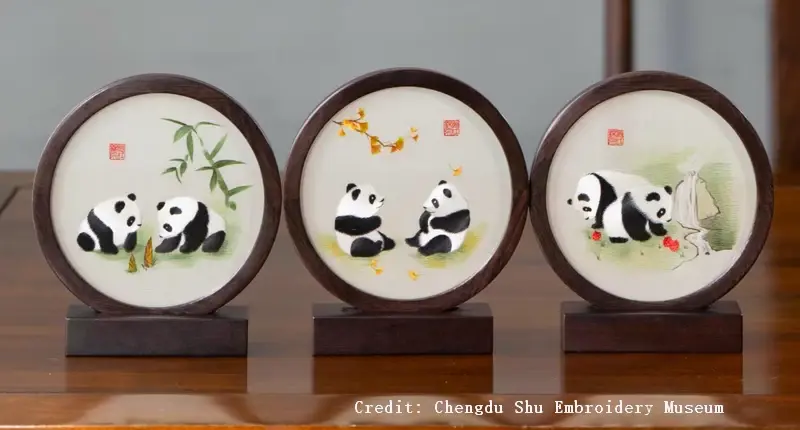
Shu embroidery is the stitched half of the same tradition and one of China's four famous embroidery styles. Its pieces look like ink-and-wash paintings worked in silk thread, and one well-known work — "Cottonrose Hibiscus and the Carp" — hangs in the Great Hall of the People in Beijing, according to TravelChinaGuide.
For a traveller, the practical range is small and affordable. Handkerchiefs run about ¥50–200, silk scarves ¥200–800, embroidered wallets ¥150–400, and double-sided embroidery art — the same image on both sides of the cloth — starts around ¥800 and goes past ¥3,000 for collector pieces, per Ruqin Travel's October 2026 price check.
A small pouch, scarf or framed sample is easier to carry and to judge than a large decorative work. The shops to trust are the Shujiang Embroidery Academy at 2 Caotang East Road, near Du Fu Thatched Cottage, the Chengdu Shu Embroidery Museum shop at 268 Huanhua South Road, and the curated boutiques in Kuanzhai Alley.
Lacquerware and porcelain-bodied bamboo weaving
Chengdu lacquerware is listed as a national intangible cultural heritage, with a history reaching back to the Spring and Autumn Period. Its reputation for surviving the centuries is literal: lacquer pieces dug up from the Mawangdui Han Dynasty tombs in 1972 still looked brilliant after more than 2,000 years underground. A finished piece takes 72 separate procedures, and the wooden base is stored for 30–40 years before lacquering even begins, according to TravelChinaGuide.
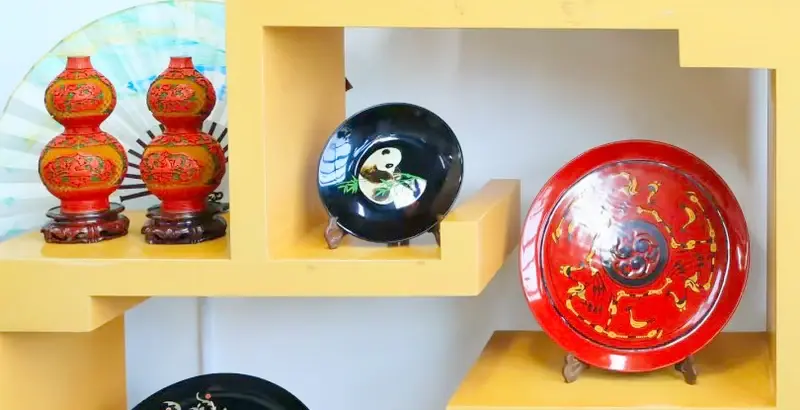
What to look for: jewellery boxes around ¥200–600, tea sets ¥500–2,000, and small decorative pieces ¥300–1,000. The lacquerware factory store at 81 Jinhe Road is the most direct source, and Jinli's craft shops carry a good selection. Each piece is layered and polished by hand, so no two are exactly alike.
Porcelain-bodied bamboo weaving is rarer still — fine bamboo strips woven tightly around a porcelain base, a technique dating to the Qing Dynasty and also listed as a national intangible cultural heritage. Bamboo-wrapped teacups cost about ¥80–200, teapots ¥200–600 and decorative vases ¥300–800, per Ruqin Travel. The Intangible Cultural Heritage Expo Park and the bamboo-weaving shops in Kuanzhai Alley are the places to see it made.
Opera masks, papercuts and other small crafts
Sichuan opera masks are the loudest souvenir in Chengdu, and the easiest to carry: mini mask pendants cost about ¥30–80, medium display masks ¥100–300, and opera-mask bookmarks ¥20–50 a set. Jinli's stalls are full of them, and the shops around the Shufeng Yayun theatre are a natural stop after an evening show.
Sichuan papercuts are the opposite — flat, light and delicate. Panda papercuts run about ¥50–150, opera-mask designs ¥60–180 and scenic landscape cuts ¥40–120. Wenshu Fang, the cultural street around Wenshu Monastery, has the best concentration of artisan shops, and you can watch artists cutting at the Intangible Cultural Heritage Park.
Two more crafts round out the list. Chengdu silver-inlaid work sets hair-fine silver threads into a silver background for screens, tea ware and vases, and bamboo weaving — baskets, fans and household pieces — shows up everywhere from market stalls to the bamboo-weaving factory at No. 12, 1st Section of Jiefang Road.
Food to take home: doubanjiang, hotpot base and dried beef
The single most useful Chengdu souvenir is a jar of Pixian doubanjiang, the fermented broad-bean paste that is the soul of Sichuan cooking. It is the base of mapo tofu and twice-cooked pork, it keeps for months, and supermarkets stock it in sealed jars that survive a suitcase. Buy it at any large supermarket or at the Hongqi Department Store on Shudu Avenue, which TravelChinaGuide lists for local food specialties.
Hotpot base is the second jar to pack: the red-oil seasoning blocks sold by Chengdu's well-known hotpot chains turn a pot of stock into a mala hotpot at home, and they also work for mala stir-fry and mala tang. Vacuum-sealed packs travel better than loose blocks, so check the seal before you buy.
For ready-to-eat gifts, the two classics are Zhang Fei beef — a five-spice, mala-flavoured dried beef sold in individual packs — and lantern beef (dengying niurou), sliced so thin that light shines through it. The lantern-beef story goes back more than 80 years, to a vendor named Liu who put a lamp behind his sliced beef at his stall to show off how thin it was.
Cold-eaten rabbit and hand-torn roasted rabbit, also vacuum-sealed, are the spicier alternative. Before buying any meat snack, check your destination country's customs rules — meat products are the one category that can be confiscated on arrival.
Tea: Zhuyeqing, Mengding and jasmine
Chengdu runs on tea, and its two famous greens travel well. Emei Zhuyeqing, grown on Mount Emei, is one of China's best-known green teas; it was given its name on 20 April 1964 by Marshal Chen Yi. Mengding Mountain tea (Mengding Ganlu), from the Mengding hills west of Chengdu, is the older of the two traditions and is prized for a fresh, clean taste. Jasmine tea is the everyday Chengdu choice — the Sanhua, Bitan and Xufu jasmine brands are the ones locals reach for.
The Southwest Tea Market in Wuhou District is where to compare grades side by side.
Buy tea in sealed tins, not loose leaf, and ask for the harvest date: spring-picked leaf is the standard, and a shop that can tell you the picking season is a shop that knows its stock. Tea also makes the best small gift for someone who does not cook — a tin of Zhuyeqing is light, useful and unmistakably Sichuan.
Panda gifts and Sanxingdui creative souvenirs
Panda plushies are the gift nobody refuses, and the quality gap is real. The best ones are at the Panda Base shop itself (1375 Panda Road) and in museum gift shops, where the stitching and materials are a step above the street-stall versions. Panda clothing, bags and accessories are sold in Kuanzhai Alley and on Chunxi Road, and they work as everyday items rather than shelf ornaments.
Sanxingdui creative gifts are the smarter pick for a history lover: bronze-mask bookmarks and fridge magnets modelled on the ancient Shu civilisation's bronze masks, sold at the Sanxingdui Museum shop and in Jinli. The Jinsha Site Museum shop (2 Jinsha Yizhi Road) is the place for calligraphy, paintings and replica artefacts. Hanfu — traditional Chinese clothing — is sold along Jinli and is popular for photos in the old streets, though it is a costume to wear on the day rather than a suitcase souvenir.
Where to shop: four streets and the malls
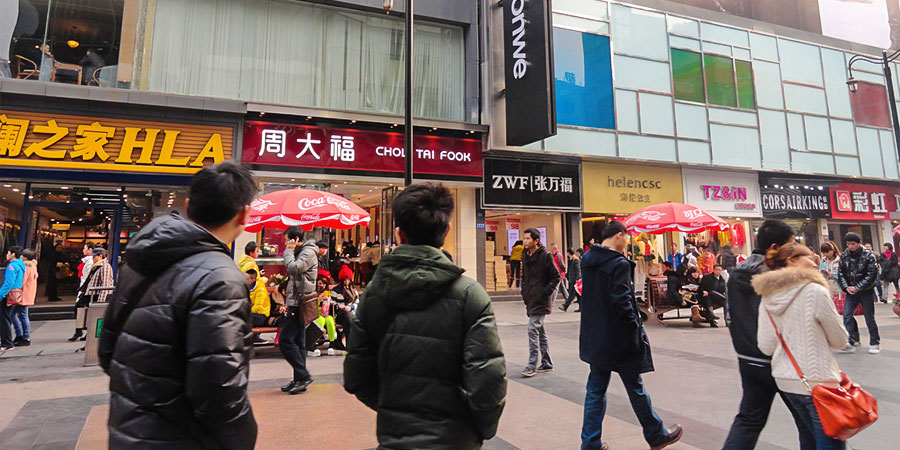
Chengdu's shopping concentrates in a few walkable areas. Chunxi Road is the main commercial street — department stores, boutiques and malls around Taikoo Li and the International Finance Square (IFS) panda sculpture — and the Yanshikou circle next to it holds the big department stores. It is the place for modern shopping and for the tax-refund stores.
Jinli Ancient Street, beside Wuhou Shrine, is the craft street: Shu embroidery, lacquerware, opera masks and panda gifts in a historic setting, free to enter and best in the late afternoon when the lanterns come on. Kuanzhai Alley is the upmarket version — curated boutiques, bamboo weaving and embroidery in restored courtyard houses. Wenshu Fang is the quieter pick, with papercut and artisan workshops around Wenshu Monastery. For a one-stop food shop, the Hongqi Department Store on Shudu Avenue stocks Shu brocade, bamboo crafts, preserved ham and local liquor such as Jiannanchun and Quanxing Da Qu, according to TravelChinaGuide.
Our Chengdu food tour guide covers where to eat what you buy, and our Chengdu attraction tickets guide lists the current ticket prices for the museums whose gift shops are named above.
November 2026: the "Tianfu Haowu" showcase at the airports
If you are leaving Chengdu in November 2026, there is a last-chance shopping stop built into your departure. On 1 November the city opened "Tianfu Haowu" (Tianfu Good Products), a showcase of local food, tea, liquor and crafts at Shuangliu Airport, Tianfu Airport and Chengdu East station, running until 30 November and organised by the Chengdu Municipal Bureau of Commerce.
The stalls are a quick tour of the city's food history: Pengsan Kui's military-tun guokui, a flatbread from Three Kingdoms army rations and a Sichuan intangible heritage; Lai Tangyuan, founded in 1894 and now selling panda-shaped tangyuan overseas; and Yaohua Foods, founded in 1938, whose pastries are sold as edible Chengdu culture.
The tea corner features Qingcheng Dao tea, Chongzhou loquat tea and Qionglai black tea — all national geographical-indication products — while the "take-away Chengdu" zone at Shuangliu's Terminal 1 shows the modern side: earphones sold in more than 20 countries, an AI panda robot, and Shu-embroidery shoes sold in 107 countries, according to Red Star News (2 November 2026).
Tax refund: 8–11% back for foreign visitors
Shopping in Chengdu comes with a refund for overseas visitors. The city has more than 940 tax-free stores, including over 370 offering instant refunds, according to Ruqin Travel. The rules are simple: spend at least ¥200 at the same store on the same day, keep the receipt, and claim 8% or 11% back depending on the product, minus a processing fee, according to Ruqin Travel's October 2026 guide. You must have stayed in mainland China for no more than 183 consecutive days.
At participating stores, show your passport, receipt and refund form; an instant refund needs a credit-card pre-authorisation. Taikoo Li has multilingual self-service refund machines, and refunds are also available at both airports. Keep your purchases handy for the customs check, and note the deadline: you must leave China within 90 days of the purchase, and some instant-refund services require departure within 28 days.
What not to buy in Chengdu
Three things to skip:
- "Too good to be true" brand-name bargains on the street. If a luxury bag or watch looks like a deal, it is almost certainly counterfeit.
- Very cheap jade or silver without a clear price or a proper receipt. If you want jewellery, buy it from a reputable store with fixed pricing.
- Anything made from ivory, rare animal parts or feathers. Restricted wildlife products can cause serious trouble at customs, and they are not worth the risk.
When in doubt, choose food, tea, crafts or museum gift-shop items, which is also Ruqin Travel's rule of thumb.
Bottom line: One small embroidery piece, one sealed jar of doubanjiang and one museum-shop panda gift cover almost every person on your list — and the whole lot fits in a carry-on, with a tax refund on top if you spend ¥200 in a single store.
In summary: crafts from real shops, food from supermarkets, panda gifts from museum shops, receipts kept for the refund — and November travellers get the airport showcase as a final stop.
Want the craft shops without the metro map?
Western China Private Car Tours runs this shopping loop from any Chengdu hotel: Kuanzhai Alley and the embroidery shops in the morning, Jinli and Wenshu Fang in the afternoon, and Chunxi Road for the tax-refund stores — with room in the boot for everything you buy. The driver communicates with guests via translation apps, so stops and timing are easy to change on the day.
These are the same streets covered in our Chengdu food tour guide and 3-day Chengdu itinerary.
Get a Private Car Quote on WhatsAppFrequently Asked Questions About Chengdu Souvenirs and Local Specialties
What is the best souvenir to buy in Chengdu?
A small piece of Shu embroidery is the classic choice: handkerchiefs start around ¥50–200 and silk scarves run ¥200–800, and both are light, flat and unmistakably local. Buy them at the craft shops in the Du Fu Cottage area, in Jinli or Kuanzhai Alley, or at the Shu Embroidery Museum shop — not from street stalls, where machine-made copies are common.
Can I bring Pixian doubanjiang and hotpot base home from Chengdu?
Yes, in most cases. Sealed jars of Pixian doubanjiang and vacuum-packed hotpot base are sold in supermarkets and at the airport, and they travel well in checked luggage. Check your destination country's rules on meat and dairy first — the dried beef and rabbit snacks are the items most likely to be restricted, so buy those only if your customs rules allow them.
Where is the best place to shop for souvenirs in Chengdu?
Jinli Ancient Street and Kuanzhai Alley have the widest range of craft stalls in one walk, Chunxi Road has the big malls and department stores, and Wenshu Fang is quieter and better for papercuts and artisan shops. For the best quality panda and Sanxingdui items, go to the gift shops inside the Panda Base and the Sanxingdui and Jinsha museums.
Can foreign visitors get a tax refund on shopping in Chengdu?
Yes. Chengdu has more than 940 tax-free stores, including over 370 offering instant refunds. Spend at least ¥200 at the same store on the same day, keep the receipt, and claim 8% or 11% back depending on the product, minus a processing fee, according to Ruqin Travel. You must leave China within 90 days of the purchase, and some instant-refund services require departure within 28 days.
What should I not buy in Chengdu?
Skip street bargains on luxury brands — they are almost always counterfeit — and be cautious with very cheap jade or silver sold without a clear price or receipt. Never buy ivory, rare animal parts or feathers: they can cause serious trouble at customs. When in doubt, stick to food, tea, crafts and museum gift-shop items.
Sources: Ruqin Travel — What to Buy in Chengdu: Best Souvenirs, Snacks & Gifts (updated 8 Oct 2026; embroidery ¥50–800, lacquerware ¥200–2,000, bamboo weaving ¥80–800, masks ¥20–300, papercuts ¥40–180, tax refund 940+ stores, ¥200 minimum, 8%/11%, 90-day departure) / TravelChinaGuide — Chengdu Shopping: What to Buy, Where to Shop (updated 7 Jul 2026; Shu brocade Tang Dynasty export, lacquerware 72 procedures, Mawangdui 1972 finds, lantern beef story, Hongqi Department Store, Chunxi Road) / Sohu / Red Star News — "Tianfu Haowu" at Chengdu transport hubs (2 Nov 2026; showcase 1–30 Nov 2026 at both airports and Chengdu East station, Lai Tangyuan since 1894, Yaohua since 1938, Shu-embroidery shoes in 107 countries).