Chengdu Metro Guide for Foreign Visitors (2026)
Short answer: Yes — a foreign visitor can ride the Chengdu metro with no Chinese at all. Signs, maps and announcements are bilingual, ticket machines have an English option, and since 2026 you can tap a contactless foreign bank card at enabled gates. Set up one payment method before you fly, learn the airport lines, and check the exit letter, not just the station name (Trip.com, 2026; Mapa-Metro, June 2026).
Bottom line: the metro is the easiest part of a Chengdu trip, and the mistakes are all avoidable. Travellers go wrong by taking Line 10 to the wrong airport, getting off at Panda Avenue and expecting the Panda Base gates, picking the wrong direction on the Line 7 ring, or arriving at a station after the last train. Every one of those is fixed by a thirty-second check before you tap in.
Scale is the first thing to grasp. Chengdu opened its first metro line on 27 September 2010 and, by mid-2026, the network counted 18 lines, 489 stations and around 758 kilometres including the T2 tram — one of the five largest urban rail networks in the world (Mapa-Metro, June 2026). The system set an all-time ridership record of 9.97 million rides on 31 December 2025, and during the 2026 National Day week foreign-card use on the metro rose 59.73% year on year, while day-pass sales rose 40.71% (Sohu / Chengdu Rail Transit Group, October 2026). In other words, foreign visitors are already riding it in large numbers — the infrastructure has caught up with them.
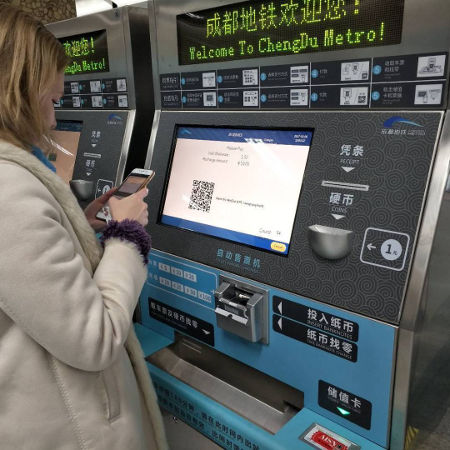
Key takeaways for foreign riders
- Language: bilingual signs and announcements throughout; ticket machines switch to English.
- Payment: tap a contactless foreign card at enabled gates, or use an Alipay or WeChat Pay Quick Response (QR) code — same method in and out.
- Price: ¥2–7 for most city rides, about ¥12 at most; day passes ¥20 / ¥50 / ¥70.
- Hours: most lines about 06:00–23:00; Line 18 to Tianfu Airport runs to about 23:30.
- Traps: wrong airport line, Panda Avenue versus the Panda Base gates, Line 7 ring direction, and exit letters.
Before you arrive: set up one payment method
Do this at home, not at a crowded gate. The simplest option for most visitors is a contactless Visa, Mastercard, American Express or UnionPay card, accepted at enabled gates since 2026 (Mapa-Metro, June 2026; Trip.com, 2026). The rule that causes the most gate errors is consistency: enter and exit with the same physical card or the same phone. A card and its phone-wallet version can register as different media, which can leave a fare uncalculated and send you to the service desk.
The second option is a QR code in Alipay or WeChat Pay: activate the Chengdu transit code inside the app before you travel, link a card, and scan at the gate on entry and exit. A third option is the local Tianfutong card, sold at stations, which gives roughly a 10% discount and also works on buses (TravelChina.tips, July 2026) — worth it if you will ride daily, less so for a two-day stay. Single-journey tickets remain available at station machines: choose English, pick the destination station, select the number of passengers, pay by cash, Alipay, WeChat Pay or a compatible card, and keep the token or ticket — you need it to exit, and the ticket is valid only for that trip and within its time window (Mapa-Metro, June 2026; Trip.com, 2026).
One more pre-trip habit pays for itself: save a screenshot of the metro map and your key destinations in Chinese characters on your phone. Station staff can read a Chinese address instantly, and so can a taxi driver if the metro is not the right tool for a particular leg. Local mapping apps (Amap and Baidu Maps) give better walking and transit directions in China than the mapping apps most visitors use at home, so install one before arrival (Mapa-Metro, June 2026).
Fares: what a ride actually costs
Chengdu charges by distance, and the bands are gentle by international standards. Almost every central sightseeing ride lands in the ¥2–7 range; only airport and cross-city runs approach ¥12.
| Distance | Fare | Typical trip |
|---|---|---|
| 0–4 km | ¥2 | One or two stops in the centre |
| 4–8 km | ¥3 | Chunxi Road to the People's Park area |
| 8–12 km | ¥4 | Central hotel to the Wuhou Shrine area |
| 12–18 km | ¥5 | Centre to outer districts |
| 18–24 km | ¥6 | Longer cross-city rides |
| 24–32 km | ¥7 | Suburban edges |
| Over 50 km | About ¥10–12 | Airport runs on Line 18 or Line 19 |
Source: fare bands per Trip.com Chengdu Metro Map (2026) and Mapa-Metro (June 2026); day passes ¥20 / ¥50 / ¥70 per both sources.
Children under 1.3 metres ride free with an adult, and riders should exit the system within about four hours of entering (Trip.com, 2026). Day passes sound tempting but only pay off with several rides a day: at ¥2–4 a ride, a ¥20 one-day pass needs five or six central trips to break even. The three-day pass at ¥50 is the better bet for a visitor who plans to ride constantly (Mapa-Metro, June 2026).
Which lines does a first-time visitor actually need?
You do not need to learn 18 lines. Five corridors cover nearly every first visit, and the rest are for residents and repeat trips.
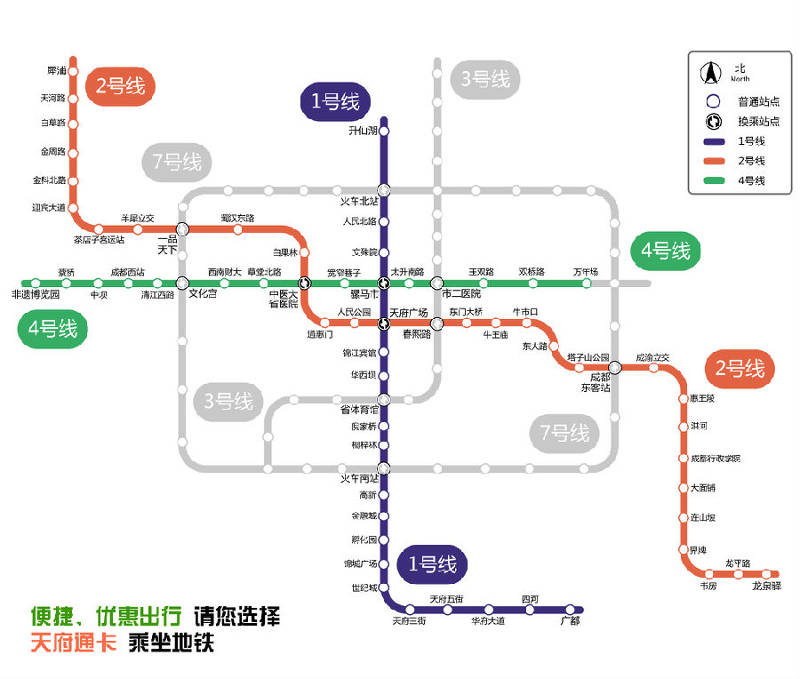
The centre: Lines 1, 2, 3 and 4
Line 1 runs north–south through Wenshu Monastery, Tianfu Square and South Railway Station. Line 2 crosses the city from Xipu to Longquanyi, passing People's Park, Tianfu Square, Chunxi Road and Chengdu East Railway Station — the single most useful line on a first visit. Line 3 runs northeast to southwest via Panda Avenue, Chunxi Road and Gaoshengqiao for the Wuhou Shrine and Jinli area. Line 4 runs east–west and serves Kuanzhai Alley directly at Wide and Narrow Alley station, plus Du Fu Thatched Cottage at Caotang North Road (Trip.com, 2026; Mapa-Metro, June 2026).
The ring and the new lines
Line 7 is the loop line: it links North, East, South and West railway stations and lets you change between corridors without passing through the centre. On a ring there is no terminus to aim for, so check whether the Inner Loop or the Outer Loop is shorter for your destination — the wrong direction adds many stations (Mapa-Metro, June 2026). Lines 13 and 30 opened on 16 December 2025; Line 13 cuts east–west through Qingyang Palace, Xinnanmen and Jiuyan Bridge, and Line 10's 2025 extension now reaches Wuhou Shrine directly, where visitors previously had to walk from Gaoshengqiao (Mapa-Metro, June 2026).
Airports: do not mix these up
Chengdu has two airports far apart, and the metro lines are different. Line 10 serves Shuangliu Airport (CTU) — check whether your flight uses Terminal 1 or Terminal 2, because the line has a separate station for each. Lines 18 and 19 serve Tianfu Airport (TFU); the usual city route is Line 18 from South Railway Station, an express run of about 33 minutes, and Line 19 links the two airport areas. On Line 18, check the platform indicator: express, ordinary and direct services share track and do not all stop at the same stations, and the passenger station for Tianfu Airport is Terminals 1 and 2, not Tianfu Airport North (Trip.com, 2026; Mapa-Metro, June 2026).
What should you check at the station: security, exits and etiquette?
Every station screens bags: backpacks, suitcases and parcels go through a scanner before the platform, and liquids may be inspected separately. The process is fast but queues build at rail stations, airports, Chunxi Road and Tianfu Square, and at rush hour — roughly 07:00–09:00 and 17:30–19:30 — so allow extra time and avoid travelling with large luggage at those hours (Mapa-Metro, June 2026; Trip.com, 2026).
Exits matter more than stations. Central stations have many exits separated by wide avenues, and the wrong letter can add a ten-minute walk in the wrong direction. Check the exit letter and the landmark listed beside it before going up the stairs. Modern stations generally have lifts, escalators, tactile paving, platform screen doors and accessible toilets, but stations can be enormous — an accessible route can involve long corridors and several lifts, so wheelchair users should check the exact exit, not just whether the station is listed as accessible (Mapa-Metro, June 2026).
Etiquette is simple and noticed: give up seats for elderly, pregnant and child passengers, keep belongings close in very crowded stations, and stand clear of platform screen doors.
The metro is generally safe, with staff, cameras and screen doors throughout; the real risks for visitors are getting lost, choosing the wrong exit, miscalculating the last train, or boarding an express that skips their station (Mapa-Metro, June 2026; TravelChina.tips, July 2026).
Common first-ride mistakes, and the fix for each
- Wrong airport line: Line 10 is Shuangliu only; Tianfu is Lines 18 and 19. Check the airport code (CTU or TFU) before boarding.
- Panda Avenue is not the entrance: from Panda Avenue station, take a shuttle bus, taxi or ride-hailing car to the Panda Base gates. Chengdu Zoo is a different place on the same line.
- Metro ticket versus train ticket: a metro ride to Xipu does not cover the intercity train to Dujiangyan or Qingcheng Mountain — buy a separate rail ticket.
- Ring direction: on Line 7, confirm Inner Loop or Outer Loop; on Line 18, confirm the train's destination and stopping pattern.
- Last train: most lines end around 23:00 and Line 18 around 23:30, but the exact last train depends on station, direction and day. On major holidays the network has extended last trains by 50–60 minutes on the busiest nights — but do not count on that for an ordinary evening (Mapa-Metro, June 2026).
- Dead phone: QR-code payment dies with the battery. Carry a power bank, and keep a bank card or a Tianfutong card as backup (Mapa-Metro, June 2026).
Metro for the city, a car for everything beyond it?
The metro wins inside Chengdu. It loses the moment a day leaves the city, stacks two sights, starts before 07:00 for panda opening, or ends after the last train — and it never reaches the Panda Base gates on its own. A private car removes the transfers, the luggage hauls and the last-train arithmetic in one fixed day rate. Our drivers communicate via translation apps, so a change of plan on the road is a message, not a misunderstanding.
Get a Private Car Quote on WhatsAppWhen the metro is not the right tool
Be honest about the dividing line. The metro covers the historic centre, the shopping streets, the parks, the rail stations and both airports beautifully. It does not cover the last kilometre to the Panda Base gates, mountain destinations such as Leshan or Emei, or day trips to Dujiangyan beyond the Xipu train — and it is no fun with a suitcase at rush hour or after 23:00. That is where a taxi, a ride-hailing car or a pre-booked private car earns its keep, especially for airport arrivals after the last train, hotel-to-station runs with luggage, and any day that packs in two sights.
"Foreign visitors ask us whether they can manage Chengdu on the metro alone, and our answer is: inside the city, absolutely — the signs are in English and a foreign card now taps at the gate. The trouble starts at the edges: the Panda Base gates, a 06:30 start, a late flight, or two sights in one day. That is when one car, one pickup and no transfers change the trip."
— Western China Private Car Tours (Chengdu private car team), Nov 2026
In summary: set up one payment method before you fly, learn Lines 1–4 plus your airport line, check the exit letter and the last train, and keep a power bank and a Chinese-character address in your pocket. Do that, and Chengdu's metro — 18 lines, 489 stations, rides from ¥2 — becomes the easiest part of the trip rather than the most confusing one.
Looking ahead, the planned Line 18 Phase 3 would one day run from South Railway Station through Tianfu Square to Chengdu Railway Station, removing the current change at South Railway Station for airport trips — but no firm opening timetable has been published, so plan on today's network, not tomorrow's (Mapa-Metro, June 2026).
Frequently Asked Questions About the Chengdu Metro for Foreign Visitors
Can a foreign visitor ride the Chengdu metro without speaking Chinese?
Yes. Station names, route maps and announcements are in Chinese and English, ticket machines offer an English option, and the system is designed so a first-time visitor can follow signs alone. Save your destination in Chinese characters as a backup for staff and taxi drivers.
Can I pay for the Chengdu metro with a foreign bank card?
Yes, at enabled gates you can tap a contactless Visa, Mastercard, American Express or UnionPay card, a service rolled out in 2026. Use the same card or the same phone for entry and exit, or the fare may not calculate. Alipay and WeChat Pay QR codes also work.
How much does a Chengdu metro ride cost?
Fares are distance-based from ¥2 for 0-4 km, rising about ¥1 per band to ¥7 for 24-32 km and about ¥12 on the longest trips. A 1-day pass costs ¥20, a 3-day pass ¥50 and a 5-day pass ¥70, and they only pay off if you ride several times a day.
Which metro line goes to each Chengdu airport?
Line 10 serves Shuangliu Airport (CTU), with separate stations for Terminal 1 and Terminal 2. Lines 18 and 19 serve Tianfu Airport (TFU); Line 18 express runs from South Railway Station to the airport in about 33 minutes, but not every Line 18 train stops at every station.
Does the metro go right to the Panda Base entrance?
No. Take Line 3 to Panda Avenue station, then continue by shuttle bus, taxi or ride-hailing car to the gates. Chengdu Zoo, also on Line 3, is a different place — do not confuse the two.
Sources: Mapa-Metro — Chengdu Metro Map (June 2026 rewrite; 18 lines, 489 stations, ~758 km, first line 27 September 2010, Lines 13 and 30 opened 16 December 2025, 9.97 million record 31 December 2025, foreign-card gates, Line 18 express 33 minutes) / Trip.com — Chengdu Metro Map 2026 (fare bands ¥2–12, day passes ¥20/¥50/¥70, hours 06:00–23:00, Line 18 to 23:30, rush hours, Panda Avenue transfer) / TravelChina.tips — Chengdu Metro FAQ for Foreign Visitors (July 2026; bilingual signage, Tianfutong 10% discount, security and exit tips) / Sohu — Chengdu Metro National Day 2026 ridership (41.0516 million rides, foreign-card use +59.73%, day passes +40.71%). Images: Chengdu metro train and network map via Mapa-Metro, under 800KB each.