Danba Jiaju Tibetan Village Guide (2026): Stone Houses, Watchtowers & a 2-Day Plan from Chengdu
TL;DR: Jiaju is the hillside village Chinese National Geographic ranked first among China's most beautiful villages in 2005 — about 140 Jiarong Tibetan stone houses stacked above the Dadu River, 325 km and roughly 6 hours by car from Chengdu. Entry is ¥50 (about ¥25 for students, children and seniors), the shuttle is ¥35, and the village is open all day, all year.
Come in late March to late April for pear blossom, or mid-October to early November for autumn colour — and stay a night, because the morning mist and the sunset are the whole point.
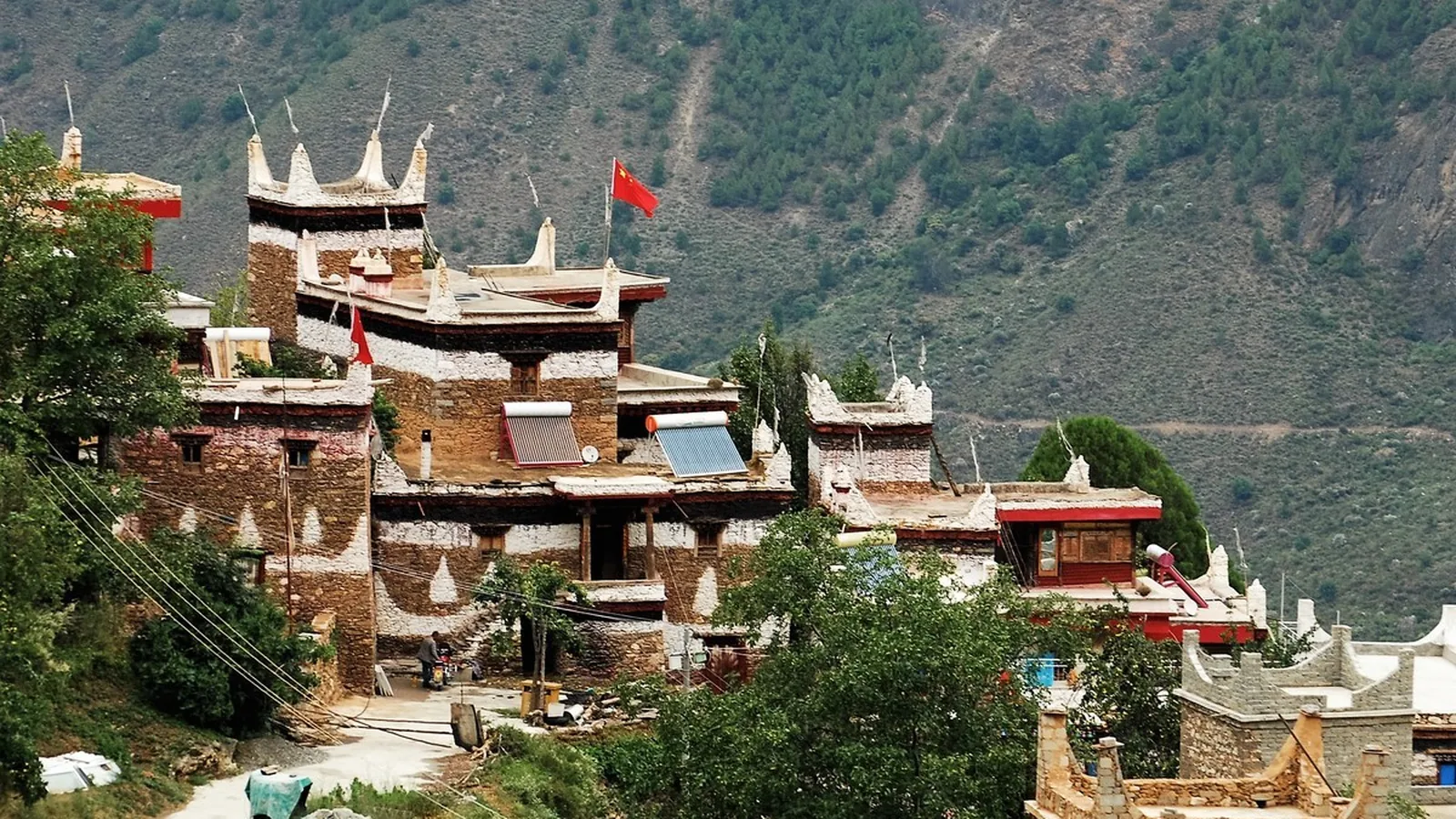
Short answer: Jiaju Tibetan Village (甲居藏寨) sits 8 km northwest of Danba town, in the Garze Tibetan Autonomous Prefecture of western Sichuan. The name means "one hundred households" in Tibetan, and the village still holds roughly 140 Jiarong Tibetan families across about 5 sq km of hillside, according to Travel of China and China Discovery. The houses are the sight: three- to six-storey stone buildings with whitewashed walls, flat roofs and window frames painted in bands of red, black and white, with ancient watchtowers rising above them.
The village became a national 4A-level scenic area in September 2016, but it is still a working village first and a sight second — families farm the terraces and live in the houses visitors photograph.
The visit is simple and cheap by Sichuan standards. Admission is ¥50 per person at the visitor-centre gate, the sightseeing shuttle is an optional ¥35, and the village never closes — it is a living village, not a gated park, so the gates are open 24 hours a day, all year round, per Trip.com's 2026 guide and China Discovery. Budget about 3 hours inside the village itself, and two days from Chengdu including the drive.
The visa warning
One paperwork warning matters before anything else: China's 240-hour transit visa-free entry does not cover Ganzi. Its Sichuan stay area is a fixed list of eleven cities — Chengdu, Zigong, Luzhou, Deyang, Suining, Neijiang, Leshan, Yibin, Ya'an, Meishan and Ziyang — and Danba is not among them, per Field Guide to China (checked October 2026). A trip that includes Danba has to be built on an ordinary tourist visa or a unilateral visa-free arrangement of up to 30 days. No separate travel permit is needed once you hold the right visa.
In short: If you want one village that explains western Sichuan — Tibetan stone architecture, watchtowers, terraced fields and a valley that changes colour twice a year — Jiaju is it, and it fits neatly into the western Sichuan 5-day loop, which runs the same road onward to Tagong and Xinduqiao.
Key takeaways for Danba Jiaju
- Entry is ¥50, shuttle ¥35, open all day. Adult admission ¥50; about ¥25 for students, children aged 6–18 and seniors aged 60 and over; the ¥35 shuttle is optional if you drive in. Tickets are bought at the visitor-centre gate and are valid for the day of purchase, per Trip.com (2026) and Field Guide to China (checked October 2026).
- Two seasons rule the calendar. Pear blossom runs late March to late April; autumn colour peaks mid-October to early November. Those are also the busiest windows — book village guesthouses 4 or more weeks ahead, per Travel of China.
- Stay the night for the light. Morning mist fills the valley roughly 06:30–09:00 and the sunset glow runs about 17:30–19:30, per Trip.com; Sina's November 2026 field notes put the mist at 08:00–09:30. Both are missed by day-trippers, and the 11:00–16:00 hours are the most crowded.
- Two nearby villages are worth the second day. Zhonglu, 14 km away, is free, quieter and holds 88 surviving ancient watchtowers; Suopo, across the river, is the place to see the towers up close for about ¥30, according to Field Guide to China.
- Check your visa before you go. The 240-hour transit visa-free arrangement does not cover Ganzi — Danba needs an ordinary tourist visa or a unilateral visa-free entry, Field Guide to China notes. No travel permit is required beyond that.
What is Jiaju?
Jiaju is a village of the Jiarong (also written Rgyalrong) Tibetans, a distinct group within the Tibetan world who have farmed the Dadu River valley for well over a thousand years, per Travel of China. For most of the 20th century almost nobody outside Sichuan had heard of it. That changed in 2005, when Chinese National Geographic ranked it first among China's most beautiful villages — the designation that put Danba on the map — and the village became a national 4A-level scenic area in September 2016, per Travel of China and China Discovery.
The village is not a museum. Around 140 households still live here, farming the terraced fields, drying grain on rooftop terraces and keeping livestock on the ground floor of their houses, exactly as they always have, per Travel of China. That is the first thing to understand about a visit: you are walking through people's homes, not a preserved site. As Field Guide to China puts it:
"Treat the villages as living places rather than monuments and the whole area reads more clearly." — Field Guide to China, Danba in 2026
Danba county itself is known in China as the "Beauty Valley" (美人谷), and the name is still live news: on 14 November 2026 the final of the 2026 Danba Jiarong Tibetan Culture Season "Beauty Valley" pageant was held at Dongnüguo Square in Danba, with 30 contestants and Xingzhao Xiamu taking the "Golden Flower" title, per Sohu / Cover News (16 November 2026). The county tourism bureau is using the pageant to push folk-culture experiences, eco-sightseeing and intangible-heritage study tours — so expect more cultural programming around the village in 2027.
How much are tickets, and how do you buy them?
Admission, the shuttle and the neighbouring villages are three separate purchases, and the common budgeting mistake is to stop at the ¥50 entry fee. The table below shows the standard prices as of November 2026, per Trip.com's 2026 guide, Field Guide to China (checked October 2026) and China Discovery.
| Item | Price | Notes |
|---|---|---|
| Jiaju admission (adult) | ¥50 | Paid at the visitor-centre gate; valid for the day of purchase |
| Jiaju admission (concession) | ~¥25 | Students, children aged 6–18, seniors aged 60 and over |
| Sightseeing shuttle (return loop) | ¥35 | Optional; loops to the main viewpoints. Skip it if you drive in |
| Zhonglu village | Free | No gate charge, 14 km from Jiaju |
| Suopo watchtowers | ~¥30 | Reported price; confirm at the gate |
Sources: ticket table per Trip.com, Jiaju Tibetan Village Tickets 2026; Field Guide to China, Danba in 2026 (checked October 2026); China Discovery, Jiaju Tibetan Village. Prices as of November 2026.
Buy at the gate — unlike Jiuzhaigou or Siguniangshan, Jiaju tickets are sold on the spot at the visitor centre and do not need advance booking, per Sina (November 2026). If you stay at a village guesthouse, ask the owner to register you: Trip.com's 2026 guide reports that registered guests can often get a discounted ticket of about ¥30.
Children under 6 and seniors over 65 are commonly free at Chinese scenic areas, but confirm the exact age bands at the gate, since the published concession rules differ slightly between sources.
Jiaju opening hours
There are effectively none. Because families live in the village, Jiaju is open 24 hours a day, all year round, per Trip.com and China Discovery. The practical hours are the light hours: the golden windows for the viewing platforms are 06:30–09:00 for morning mist and 17:30–19:30 for sunset, per Trip.com. Between 11:00 and 16:00 the shuttle is crowded and the main viewpoints fill up, per Travel of China — the worst time to be there, and the time most day-trippers arrive.
The houses, floor by floor
The Jiarong stone house is a working building before it is a photograph, and knowing the layout changes what you see on a walk through the village. Each house stands three to six storeys, faces south into the valley, and stacks domestic life by floor, per Travel of China: livestock and grain storage on the ground floor, the kitchen and dining room on the first floor, bedrooms and living quarters above, and a family chapel or grain-drying terrace on top.
The details that make the style recognisable are all on the outside. Horizontal bands in yellow, black and white ring every exterior wall in a fixed sequence — the Jiarong signature no other Tibetan group replicates in quite the same way — and each roofline carries a small white stone tower at each of its four corners, one per cardinal direction, as spiritual markers rather than structure, per Travel of China.
Doors and window surrounds come in deep reds, blues and yellows, and no two households are identical, yet the palette holds together across the whole hillside.
One feature catches first-time visitors off guard: the hanging toilet, a small balcony jutting from the side wall with its floor open over a sealed pit below. It is a normal part of the architecture here, not a quirk — and a reminder that these are real homes, so keep voices down in the lanes and ask before photographing people at close range.
The watchtowers of Danba
The stone towers above Jiaju are not decorative. Most date from the Qing dynasty's 18th-century Battle of Jinchuan, built for military signalling, and a handful are traced by local historians to the Tang dynasty, per Travel of China. They stand 10 to 30 metres tall, leaning slightly with age, and the tallest in the Danba valley system are described in published accounts as reaching around 50 metres, per Field Guide to China.
The best angle on the towers is not from inside the village. Cross to the opposite hillside and the full cascade of towers, coloured walls and terraced orchards falls into a single frame — the angle behind the Chinese National Geographic photographs, per Travel of China. The opposite-hillside viewpoint is reached by the scenic-area shuttle, included in the ¥35 ticket.
The best time is the hour after dawn, when mist pools at mid-slope and the towers surface and vanish through it — reason enough, on its own, to sleep in the village rather than drive in for the day.
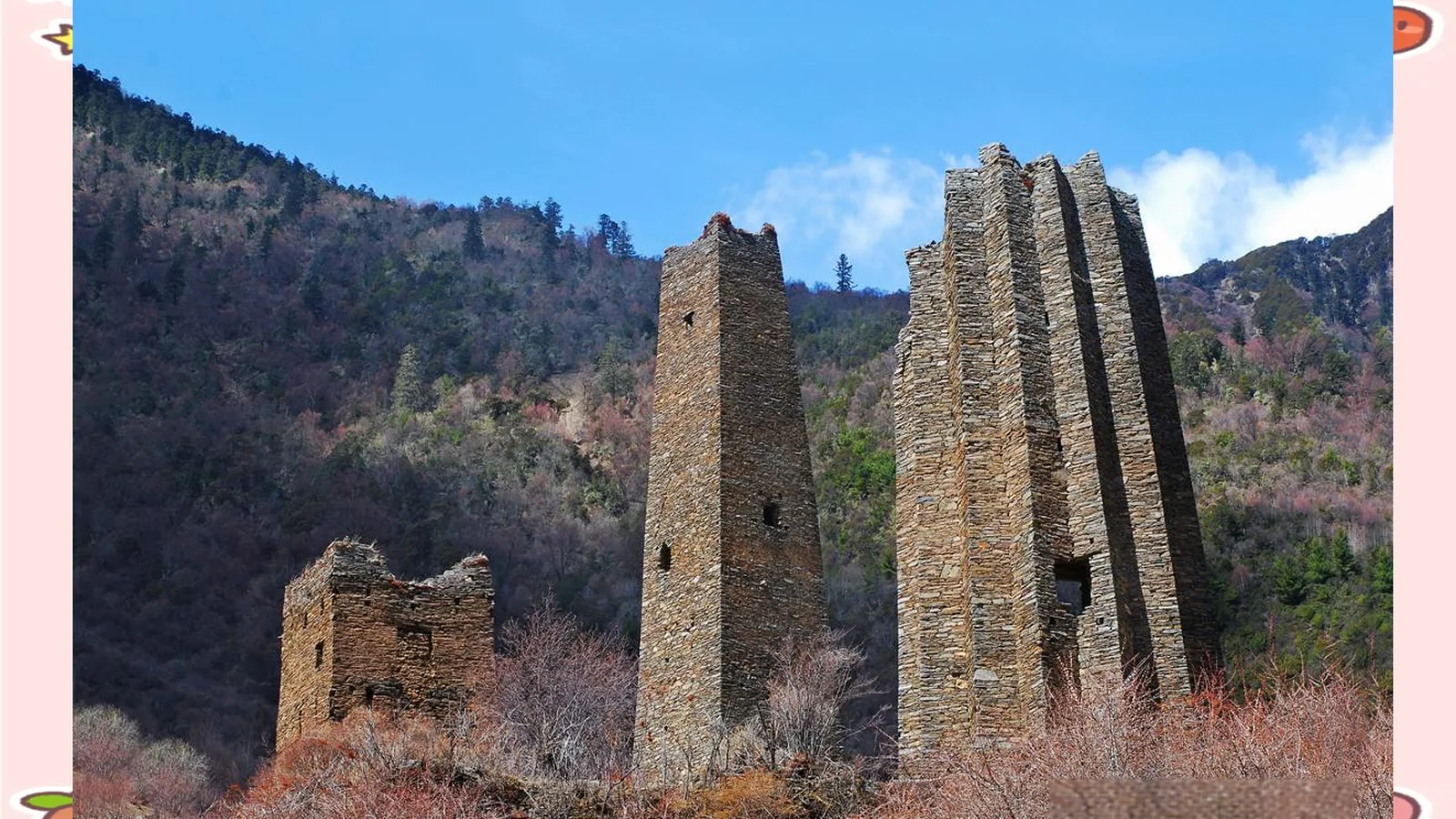
"The towers are the older, stranger half of Rgyalrong building, and seeing them next to an ordinary house makes the difference between the two obvious." — Field Guide to China, Danba in 2026
Zhonglu and Suopo: the second day
Most itineraries stop at Jiaju. The two neighbouring villages are the reason to stay a second day, and they cost little or nothing.
Zhonglu — free, quieter, better sunsets
Zhonglu (中路藏寨) sits 14 km from Jiaju, further up the same valley, and charges no entrance fee at all, per Field Guide to China and Trip.com. There is no shuttle bus and considerably fewer people, so the stone houses and orchards feel inhabited rather than observed. The village holds 88 surviving ancient watchtowers, several traceable to the Tang dynasty, and from mid-slope the sacred peak of Muoerduo Mountain fills the horizon to the north, per Travel of China. Chinese National Geographic has listed Zhonglu among Sichuan's top 100 photography locations.
Come for the sunset light on the ridges and, if you stay the night, for skies dark enough to matter.
Suopo — the towers, up close
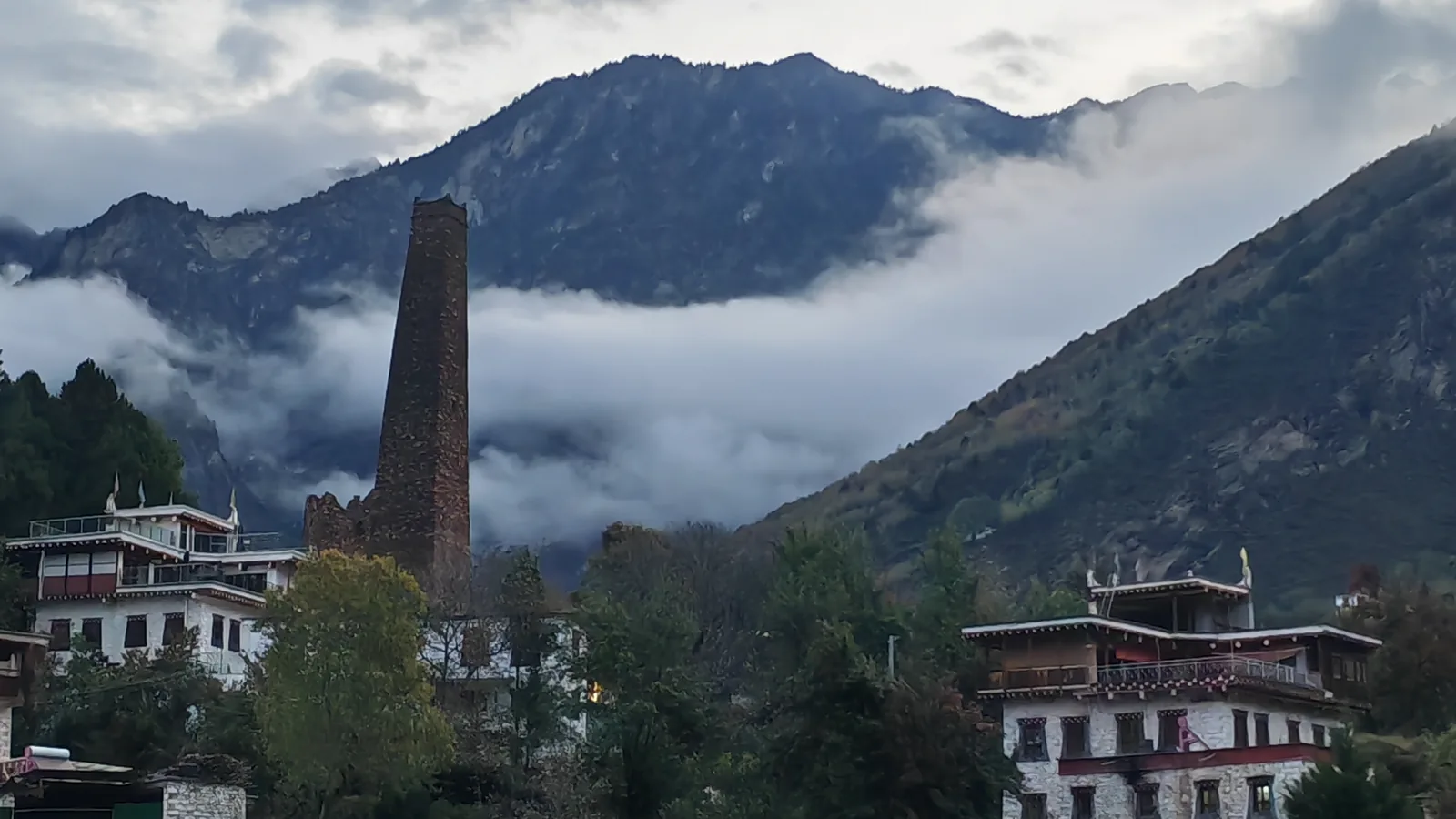
Suopo (梭坡) is about the towers. Where Jiaju and Zhonglu are villages of houses, Suopo is the place to see the stone watchtowers at close range, standing in groups on the slope across the river from the road, per Field Guide to China. The ticket is reported at about ¥30. Seeing the towers next to an ordinary house is what makes the scale of Rgyalrong building click — the houses are tall, and the towers dwarf them.
Dangling — the hikers' extension
Dangling (党岭) is a further valley for walkers, with hot springs and higher ground above the three villages, Field Guide to China reports. Transport in and out is by chartered car or on foot, and the quoted costs for horses, hot springs and cars are not consistent between sources, so budget loosely and confirm locally. It sits far higher than Jiaju, so the gentle-altitude point below does not carry over to this side trip.
When is the best time to visit Jiaju?
| Months | What you get | Watch out for |
|---|---|---|
| Late Mar–late Apr | Pear blossom: white canopies over red-and-white houses, snow still on the ridge | Pear Blossom Festival crowds; one-way traffic 11:00–16:00 on approach roads; book 4+ weeks ahead |
| May–June | Green terraces, fewer visitors, mild days | Rain builds toward summer; mountain roads can close after heavy rain |
| July–August | Warmest days, lush valley, summer escape from Chengdu heat | Rainy season; morning mist is frequent but heavy rain is possible |
| Mid-Oct–early Nov | Autumn colour: golden corn racks, red pear leaves, clearest light of the year | Peak photography season; guesthouses book out by mid-September |
| December–February | Quiet village, snow peaks, low prices | Roads can ice over; beginners should avoid driving at night |
Season summary per Travel of China, Field Guide to China (checked October 2026) and Trip.com (2026). Spring temperatures average 4–11°C; autumn days run 5–18°C and drop near freezing overnight, per Travel of China.
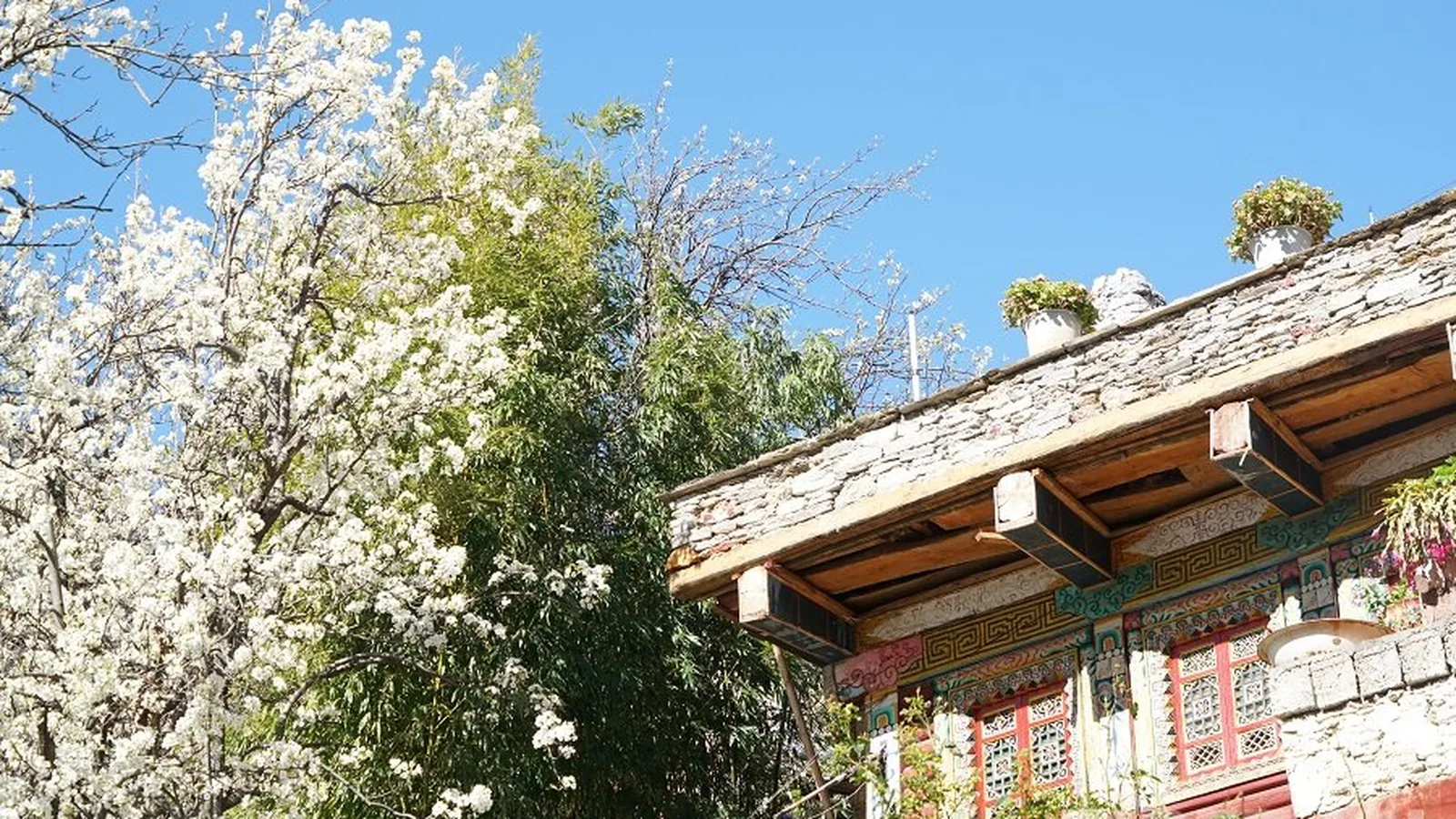
Spring is the famous window, autumn is the photographers' window. In late March to late April the pear trees that cover the lower slopes come into full bloom, white blossom canopies framing red-and-white stone houses with snow still capping the ridgeline behind, per Travel of China. The annual Danba Pear Blossom Festival draws significant domestic crowds, some approach roads run one-way between 11:00 and 16:00, and the festival brings Jiarong cultural performances — song, dance and Guozhuang circle dances in the evenings.
In mid-October to early November the palette turns bolder: golden corn racks hang from the eaves to dry, pear leaves turn a deep flame red, and against the white stone walls and the ink-blue plateau sky the effect is close to overwhelming, per Travel of China. That is the season most photographers return for — and the season when the better guesthouse rooms are gone by mid-September.
How to get to Danba Jiaju from Chengdu
- Bus: Chadianzi station, 06:30 daily, about ¥150, 7–8 hours to Danba town.
- Private car: about 325 km and 6 hours from Chengdu, over the Balang Mountain pass.
- Danba town to the gate: 8 km — taxi ¥30–60 (15–25 min) or the ¥35 scenic-area shuttle.
- Arrive before 09:00 or after 16:30 for thin crowds and the best light.
Take the bus, or drive — there is no train
No railway reaches Danba. The long-distance bus leaves Chengdu Chadianzi station at 06:30 daily, costs about ¥150 and takes 7–8 hours, per Travel of China. Buy the ticket at least a day ahead in pear-blossom season (late March to April) and the autumn peak (October to November); seats go fast. A direct Chengdu–Jiaju shuttle is listed at about ¥198 return, according to Field Guide to China — cheaper than two one-way bus fares because it is a different service, so compare the two before you choose.
By private car, allow about 6 hours
The drive is roughly 325 km from Chengdu, crossing the Balang Mountain pass above 4,000 m, per Field Guide to China. The road is a mountain road: sharp bends, few roadside stops in the final two hours, and possible ice on the higher stretches in winter. Carry motion-sickness tablets if you need them and pack snacks before leaving Chengdu, per Travel of China.
From Danba town to the village gate
Jiaju sits 8 km northwest of the county town. A taxi or chartered car costs ¥30–60 for the 15–25 minute drive — negotiate the return trip — or take the ¥35 scenic-area shuttle from the Jiaju Visitor Centre, which loops to the main viewpoints in about 20 minutes, per Travel of China.
Arrive before 09:00 or after 16:30
That is when the crowds thin and the light is best, per Travel of China. Between 11:00 and 16:00 the shuttle is crowded and the main viewpoints fill up.
A private car is the practical way to do Jiaju properly: the village gate, the opposite-hillside viewpoint, Zhonglu and Suopo are spread across the valley, and a car links two villages in half a day and all three in a full day, per Field Guide to China. See our Chengdu private car cost guide for what a charter typically costs.
| Day | Plan | Notes |
|---|---|---|
| Day 1 | Chengdu → Danba (morning departure), afternoon in Jiaju: visitor centre, viewing platforms 1–3, sunset at 17:30–19:30 | ~6 h driving; sleep in a village guesthouse for the dawn light |
| Day 2 | Morning mist 06:30–09:00 at the viewpoints, walk the village lanes, then Zhonglu (free) and Suopo towers (~¥30); drive back to Chengdu | Leave Danba by mid-afternoon; winter roads ice after dark |
Two-day plan structure per Sina, Western Sichuan 3-day loop (30 October 2026, updated 16 November 2026): the classic small loop runs Chengdu → Siguniangshan → Danba → Moshi Park → Tagong → Xinduqiao → Luding → Chengdu, about 600 km in 3 days and 2 nights, at roughly ¥1,500–2,500 per person excluding long-distance transport. Jiaju slots in as the low-altitude overnight stop at about 1,800 m, which is why the loop sleeps there after the higher passes.
With a third day, fold Jiaju into that small loop instead of driving straight back: day 1 Chengdu to Siguniangshan and on to Danba, day 2 Jiaju plus Moshi Park and Tagong Grassland, day 3 Xinduqiao and the Luding Bridge on the way home. Our Mount Siguniang guide covers the first leg, and the western Sichuan 5-day loop covers the full circuit.
Where to stay and eat in Jiaju
Staying inside the village is worth the extra planning. The morning mist and dawn light that define the best photographs are only accessible if you are already on the hillside when they arrive, per Travel of China. Several Jiarong families run guesthouses in their own stone houses — simple but honest, wooden-panel walls, firm beds, and mountain views that more expensive hotels rarely match.
Standard rooms run ¥200–400 a night, per Travel of China; Trip.com's 2026 guide lists view rooms at the better guesthouses from ¥380 to ¥1,600 and above. Book at least four weeks ahead for spring and autumn peak periods, and pick a guesthouse near viewing platforms 1–3 if photography is the point, per Sina (November 2026).
For food, arrange dinner with your guesthouse host that morning — most families cook to order rather than running a fixed menu, per Travel of China. The signatures are butter tea (salted, rich, served hot on arrival), tsampa (roasted barley flour mixed with butter tea) and yak meat hotpot at restaurants in Danba town. In Danba town itself, rooms are cheaper and the food strip is wider, but you give up the dawn light — the trade-off that decides most itineraries.
Practical tips for Danba Jiaju
Sort the visa first, not the bus ticket
Danba is outside the 240-hour transit visa-free stay area, which covers eleven Sichuan cities and does not include Ganzi, per Field Guide to China. If your plan is built on the transit rule, keep it to those eleven cities and treat Danba as a separate, visa-normal trip. The unilateral visa-free arrangement, which now covers a long list of countries for stays of up to 30 days with no stay-area geography, is the simpler way in for most nationalities; otherwise an ordinary tourist visa does the same job with more paperwork.
See our 240-hour visa-free transit guide for the full city list.
Altitude is gentle here — the pass is not
Danba town sits at about 1,800 m and Jiaju at 1,800–2,300 m, so altitude sickness is uncommon for most visitors, per Travel of China. The catch is the road in: the route from Chengdu crosses a pass above 4,000 m, and the final two hours have few stops. The Sina loop guides use Jiaju deliberately as the low overnight stop — about 1,800 m — after the higher country around Xinduqiao (about 3,300 m), because sleeping low after a high day is the easiest altitude strategy on this route.
If you are heading on to higher ground afterwards, see our altitude sickness guide.
Do not self-drive on a foreign licence
A foreign driving licence on its own does not entitle you to drive in mainland China, and an international driving permit is not accepted, Field Guide to China warns. A self-drive trip means arranging a temporary Chinese licence before you leave — if that sounds like more trouble than it is worth, a chartered car covers the same ground, and the driver handles the mountain road and the one-way festival traffic.
Pack for two seasons in one day
Spring averages 4–11°C with mornings considerably colder, and autumn days run 5–18°C but drop near freezing overnight, per Travel of China. Layer up regardless of the forecast: the valley creates its own microclimate, cloud cover drops the temperature fast, and a light down jacket plus a warm layer for the early-morning viewpoint are the difference between staying for the dawn light or retreating inside. Bring grippy shoes — the village lanes are steep — sunscreen, and at least ¥200 in cash for the gate and the older stalls, per Travel of China.
Respect the village you are walking through
Jiaju's houses are homes, not exhibits. Keep voices down in the lanes, ask before photographing residents at close range, and do not step onto rooftops or into courtyards uninvited. A few households rent out Tibetan dress for photographs — your guesthouse host will know which families still do, per Field Guide to China. Small courtesies are what keep a living village welcoming.
Bottom line: Jiaju earns its "most beautiful village" title honestly — whitewashed stone houses and watchtowers on a hillside that turns white in spring and gold in autumn, for ¥50 at the gate and a night in a family guesthouse. Two days from Chengdu, sleep in the village, catch the mist and the sunset, and spend the second day on free Zhonglu and the Suopo towers.
In summary: About 325 km and 6 hours by car from Chengdu (bus 06:30 from Chadianzi, about ¥150, 7–8 hours); Jiaju ¥50 entry + ¥35 optional shuttle, open all day year-round; best late March–late April for pear blossom and mid-October–early November for autumn colour; stay overnight for the 06:30–09:00 mist and 17:30–19:30 sunset; Zhonglu free and Suopo about ¥30 on day two; and Danba needs a proper visa — the 240-hour transit arrangement does not cover Ganzi.
Want Danba Jiaju without the logistics?
Western China Private Car Tours runs private car trips from Chengdu to Danba Jiaju: pickup at your Chengdu hotel, the mountain road over the Balang Pass, an early arrival that beats the 11:00–16:00 crowds, the village viewpoints at golden hour, an overnight in a village guesthouse, and Zhonglu and Suopo on day two — then on to Tagong and Xinduqiao if you have a third day. The driver communicates with guests via translation apps, so plans and pickup times are easy to change on the day.
Short on time? Our western Sichuan 5-day loop guide folds Jiaju into a five-day circuit with Siguniangshan, Moshi Park, Tagong and Kangding, or see our altitude sickness guide before any high-country trip.
Get a Private Car Quote on WhatsAppFrequently Asked Questions About Danba Jiaju
How much does Jiaju Tibetan Village cost in 2026?
As of November 2026, adult admission is ¥50 per person, with about half price (¥25) for students, children aged 6–18 and seniors aged 60 and over. The sightseeing shuttle inside the village is a separate ¥35 and is optional if you drive in yourself. Neighbouring Zhonglu village is free, and the Suopo watchtower site charges about ¥30.
How do I get from Chengdu to Danba Jiaju?
By private car it is about 325 km and roughly 6 hours from Chengdu, over the Balang Mountain pass. By bus, a daily service leaves Chengdu Chadianzi station at 06:30 and takes 7–8 hours for about ¥150. From Danba town the village gate is 8 km away — a taxi costs ¥30–60 for the 15–25 minute drive, or take the ¥35 scenic-area shuttle from the visitor centre.
When is the best time to visit Jiaju Tibetan Village?
Late March to late April, when the pear trees bloom white across the slopes, and mid-October to early November, when the leaves turn gold and red, are the two peak windows. Spring brings the Danba Pear Blossom Festival and the biggest crowds; autumn has the clearest light. Summer is green and quieter, winter is cold with possible ice on the mountain roads.
Can foreign visitors travel to Danba without a permit?
No special travel permit is needed for Danba — foreign passport holders travel freely in Garze Prefecture with a valid visa. What does not work is arriving on China's 240-hour transit visa-free entry: its Sichuan stay area is a fixed list of eleven cities and Ganzi is not among them. Enter on an ordinary tourist visa or a unilateral visa-free arrangement (up to 30 days) instead.
Is one day enough for Jiaju, or should I stay overnight?
Stay overnight. The village's best light is the morning mist, roughly 06:30–09:00, and the sunset glow around 17:30–19:30 — both are hard to catch on a day trip from Chengdu. One night in a village guesthouse (¥200–400 for a standard room) covers both, and a second day lets you add free Zhonglu village and the Suopo watchtowers before driving back.
Sources: Travel of China — Jiaju China: Stone Houses, Pear Blossoms, and the Mountain Road from Chengdu (¥50 entry, ¥35 shuttle, 8 km from Danba town, ~140 households, 4A since September 2016, pear blossom late Mar–late Apr, autumn mid-Oct–early Nov, guesthouses ¥200–400, bus 06:30 from Chadianzi ~¥150) / Field Guide to China — Danba in 2026 (checked October 2026; ¥50 ticket, Zhonglu free, Suopo ~¥30, ~325 km / ~6 h from Chengdu, shuttle return ~¥198, 240-hour transit visa-free does not cover Ganzi, altitude 1,800 m town / 2,000–2,100 m village) / Trip.com — Jiaju Tibetan Village Tickets 2026 (¥50 / ¥25 concession, ¥35 sightseeing bus, open 24 hours, golden hours 06:30–09:00 and 17:30–19:30, guesthouse registration discount ~¥30, view guesthouses ¥380–1,600+) / Sina News — Western Sichuan 3-day loop guide (30 October 2026; ~600 km small loop, ¥1,500–2,500 per person, Jiaju ~¥50, Danba overnight at ~1,800 m as altitude step-down) / Sina News — Western Sichuan 3-day loop, winter update (16 November 2026; morning mist 08:00–09:30, guesthouses near viewpoints 1–3, Jiaju tickets at the gate, no advance booking) / Sohu / Cover News — 2026 Danba Beauty Valley pageant final (16 November 2026; final held 14 November 2026, 30 contestants, Xingzhao Xiamu wins Golden Flower, Dongnüguo Square) / China Discovery — Jiaju Tibetan Village (¥50 ticket, open all day, ~140 households, 5 sq km, ranked No. 1 most beautiful village by Chinese National Geographic 2005). Images: Field Guide to China.