Mogao Grottoes & Dunhuang Guide (2026): Caves, Dunes & the Western Line
TL;DR: Dunhuang sits at the western end of the Hexi Corridor in Gansu, where the Silk Road split around the Taklamakan Desert — and it holds the single greatest concentration of Buddhist cave art in China. The Mogao Caves cost ¥238 in peak season (1 April–30 November) for two films and 8 caves, or ¥140 in winter (1 December–31 March) for 10 caves, and you must book online with your passport about 30 days ahead.
Pair the caves with Mingsha Mountain and Crescent Lake (¥110, valid 3 days) and a full-day western loop to Yangguan, Yumenguan and the Yadan Devil City (about ¥400–600 for a car and driver), and three days covers the town properly.
Book Mogao first, before flights and hotels. In July, August and the October Golden Week, the 6,000-a-day regular quota sells out weeks ahead, and there is no ticket window to fall back on.
Short answer: Dunhuang (敦煌) is a small oasis town in far western Gansu, watered by the Dang River at the end of the Hexi Corridor — the last properly Chinese town before the deserts, per Asia Undiscovered's November 2026 guide. Its name is usually glossed as "great and flourishing", and for a thousand years it was the place where monks, merchants and pilgrims stopped to rest, pray and pay for prayers on the road between India, Central Asia and China.
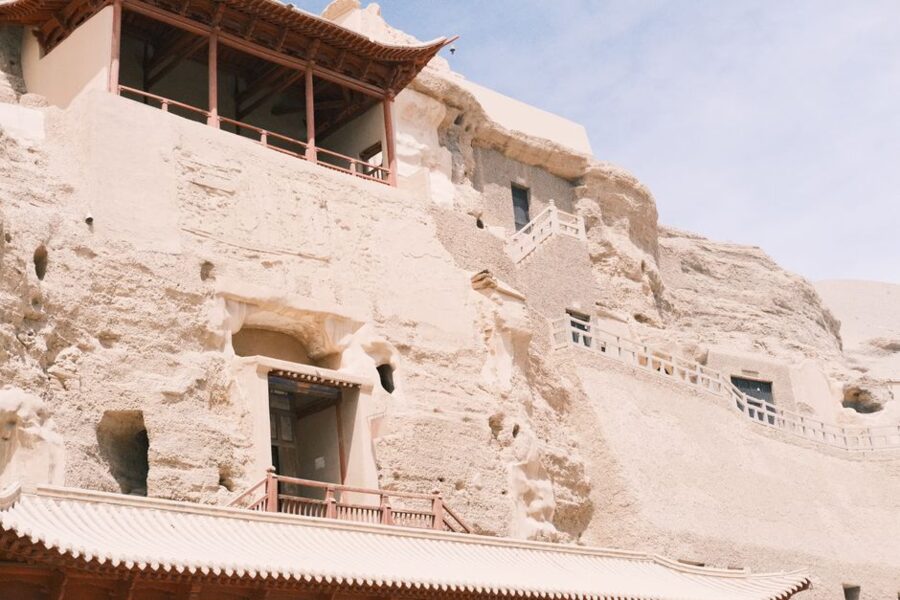
The Mogao Caves (莫高窟) are the reason to come: 735 caves cut into a cliff 25 km southeast of town, 492 of them holding murals or painted sculpture — about 45,000 square metres of wall painting and more than 2,000 painted clay figures, per the Dunhuang Academy's count cited by Asia Undiscovered. The first cave was cut in 366, when the monk Le Zun is said to have seen the cliff lit with golden light, and painting continued for about a thousand years through the Northern dynasties, the Sui, the Tang, the Tibetan occupation and the Western Xia.
The visit runs on rules: real-name tickets, a daily cap, timed slots and a photography ban inside the caves. A regular ticket starts at the Digital Exhibition Center on the edge of town with two films, then a shuttle about 15 km to the cliff, then 75 minutes to 2 hours through the caves with a site guide.
You cannot choose which caves you see — the Academy rotates them for conservation — but the 2026 rotation includes Cave 96 with its 35-metre Buddha, Caves 16 and 17 with the Library Cave, Cave 61 with its tenth-century panorama of the Wutai Mountains, and Cave 259 with the small smiling fifth-century Buddha.
The rest of Dunhuang is desert, and it is the other half of the trip. Mingsha Mountain, a range of dunes up to about 250 metres high, curls around Crescent Lake 5 km south of town; the Han frontier passes of Yangguan and Yumenguan stand in the Gobi 70–90 km west; and the wind-carved Yadan landforms, about 180 km out near the Xinjiang border, glow red at sunset. All prices below are as of November 2026.
The visa warning
One paperwork warning matters before anything else: China's 240-hour transit visa-free entry does not cover Gansu. Its stay area is a fixed list of provinces, and Gansu is not among them — so a trip that includes Dunhuang has to be built on an ordinary tourist visa or a unilateral visa-free arrangement of up to 30 days, per the 2026 Hexi Corridor guides. No separate travel permit is needed once you hold the right visa.
In short: If you want one stop that explains the Silk Road — a thousand years of painting in a cliff, a singing dune around a spring-fed lake, and a Han frontier that ends in a Devil City — Dunhuang is it, and it fits neatly at the end of the Qinghai–Gansu grand loop, which runs the same corridor from Xining through Qinghai Lake and Zhangye.
Key takeaways for Mogao Grottoes & Dunhuang
- Book Mogao the moment your dates are fixed. Regular tickets are ¥238 peak / ¥140 winter, capped at 6,000 a day, sold online only up to about 30 days ahead — and in summer and Golden Week they sell out weeks early, per the Dunhuang Academy's 2026 notice.
- Winter is the bargain season. From 1 December 2026 to 31 March 2027 the Mogao ticket drops to ¥140 and shows 10 caves instead of 8, Mingsha Mountain halves to ¥55, and Yangguan, Yumenguan, Yadan and the Xuanquanzhi ruins are half price, with a ¥188 all-access pass on offer.
- The Mingsha ticket is a 3-day ticket. One ¥110 entry (¥55 in winter) covers repeat visits for three days once your face is registered.
- The western loop needs a car. Yangguan, Yumenguan and Yadan are 70–180 km out on a 380 km loop with no useful public transport; a car and driver runs about ¥400–600 for the day, per the 2026 guides.
- Gansu is outside the 240-hour transit area. Arrive on a tourist visa or a unilateral visa-free arrangement of up to 30 days; no separate travel permit is needed for Dunhuang.
What are the Mogao Caves?
Mogao is a cliff, not a museum. From the outside it is more than a kilometre and a half of honeycombed rock above a dry riverbed, most of it faced with concrete walkways — and everything that matters is behind locked doors, per Asia Undiscovered. The rock is too soft to carve, so the statues are clay over wooden frames, and the colour has survived because the air here is so dry.
Who paid for it all? Everyone with money and a reason. Local ruling families funded whole caves and had themselves painted at the door as donors, merchants paid for a niche, and monks raised money from the faithful — the paintings were a way of earning merit, so the caves were shrines for worship and meditation, not galleries, per the same guide. The murals are a catalogue of medieval life: court scenes, musicians with lutes and harps, donors in Tang hats, and the flying apsaras — feitian (飞天) — that Dunhuang has made its emblem.
The Library Cave, told carefully
The most famous room is the one you cannot enter. On 22 June 1900, the Daoist monk Wang Yuanlu found a sealed doorway in the passage of what is now Cave 16; behind it, Cave 17 was packed floor to ceiling with about 50,000 manuscripts, paintings on silk and paper, and textiles, written between the fourth and the early eleventh centuries.
The Diamond Sutra found there, dated 868, is the oldest dated printed book in the world and now sits in the British Library — one reason the Library Cave is still a sore point in China, per Asia Undiscovered. Both caves are on the 2026 regular rotation, so they may well be on your route.
"The cave is dark until the guide's torch finds a face. Then there are hundreds of them: painted Buddhas in rows up the walls, a ceiling of flying figures trailing scarves, and in one corner a donor in a Tang hat who paid for all this some twelve centuries ago." — Asia Undiscovered, Dunhuang guide, November 2026
How much do Mogao Caves tickets cost?
Mogao runs two price calendars, and the winter one is the better deal. All figures are per the Dunhuang Academy's visitor page, checked in October 2026 by DunhuangTours.
| Ticket | Peak (1 Apr–30 Nov) | Low (1 Dec–31 Mar) | What you get |
|---|---|---|---|
| Regular (A ticket) | ¥238 (reduced ¥148) | ¥140 (reduced ¥95) | Two films, shuttle bus, guided visit to 8 caves (10 in winter); daily cap 6,000 |
| Foreign-language guided | ¥258 | ¥160 | Same visit with an English or other foreign-language guide |
| Emergency (B ticket) | ¥100 (reduced ¥55) | Not sold | Shuttle and 4 caves, no films; only on busy days when A tickets are gone; cap 12,000 |
| Special caves | ¥150–200 each | ¥150–200 each | One extra cave in a small group, arranged at the desk after your visit |
Sources: ticket table per DunhuangTours, Mogao Caves Tickets 2026 (prices from the Dunhuang Academy visitor page, checked October 2026) and Asia Undiscovered, Dunhuang guide (November 2026). Prices as of November 2026; confirm on the booking page, as the Academy changes arrangements by notice.
Opening hours in 2026 are 08:00–18:00 in the peak season, with the last check-in at 16:10, and 09:00–17:00 from December to March, with the last check-in at 15:10, per the Academy's 2026 announcement. The reduced price covers children aged 6 to 18, seniors aged 60 to 70 and full-time students in China — most concessions are tied to Chinese identity documents, so as a foreign adult, plan on the full price.
What the special caves hold
The special caves are where the finest Tang painting sits: Caves 45, 57, 156, 159, 217, 220, 254, 275 and 320 to 322 are kept apart and opened in small numbers. Cave 220 holds an early Tang mural of an emperor and his officials dated 642; Cave 156 shows General Zhang Yichao's army on parade after he threw the Tibetans out of Dunhuang in 848. If you care about Tang painting, Caves 45 and 57 are the ones people talk about, per Asia Undiscovered.
How to book Mogao Caves tickets with a passport
- Open the official channel: follow the WeChat service account "莫高窟参观预约网" and choose 预约购票, then Ticket Booking — the option for foreign passports and Hong Kong, Macao and Taiwan travel permits. The mini programme of the same name works the same way. Online booking runs 07:00–22:00 China time.
- Book with your passport number: tickets are real-name and timed, and the name and number must match the passport you bring. Book up to about 30 days ahead; in July, August and Golden Week (1–7 October) the regular quota goes fast once it appears.
- Pay with WeChat Pay or Alipay: set up WeChat Pay with a foreign card before you start, per the 2026 guides.
- Arrive 30 minutes early at the Digital Exhibition Center (8899 Yangguan East Road, about 9 km from the centre, or city bus 12). Exchange the booking for a paper slip, keep it — it is checked again at the caves — and leave big bags in the free left luggage.
- Watch the two films, then take the shuttle about 15 km to the cliff for the guided cave visit. Photography and filming are banned inside the caves, and so is touching the walls — breath, light and humidity damage the paint, and staff watch for phones.
Do not buy from resellers
The Academy says plainly that it has authorised no third party to sell Mogao tickets. In July 2026 it went further and named the platforms where touts had been reselling them — from Xianyu and Taobao to Meituan and Douyin — and warned that those tickets may simply not scan. The phone line (400-8333-715, 08:30–16:30) answers questions only; you cannot book by phone.
If Mogao is sold out
Two smaller cave sites run by the Dunhuang Academy make a good consolation. The West Thousand Buddha Caves (西千佛洞), about 35 km southwest of town on the road to Yangguan, hold about 22 painted caves above the Dang River and open 08:30–17:30 in peak season. The Yulin Caves (榆林窟), in a gorge in Guazhou County about 70 km south of the county town, are the site the Academy calls Mogao's sister site — the Western Xia murals are superb, and the price is ¥55 for foreign visitors and ¥40 for Chinese citizens, per Asia Undiscovered.
Mingsha Mountain & Crescent Lake: the singing dune
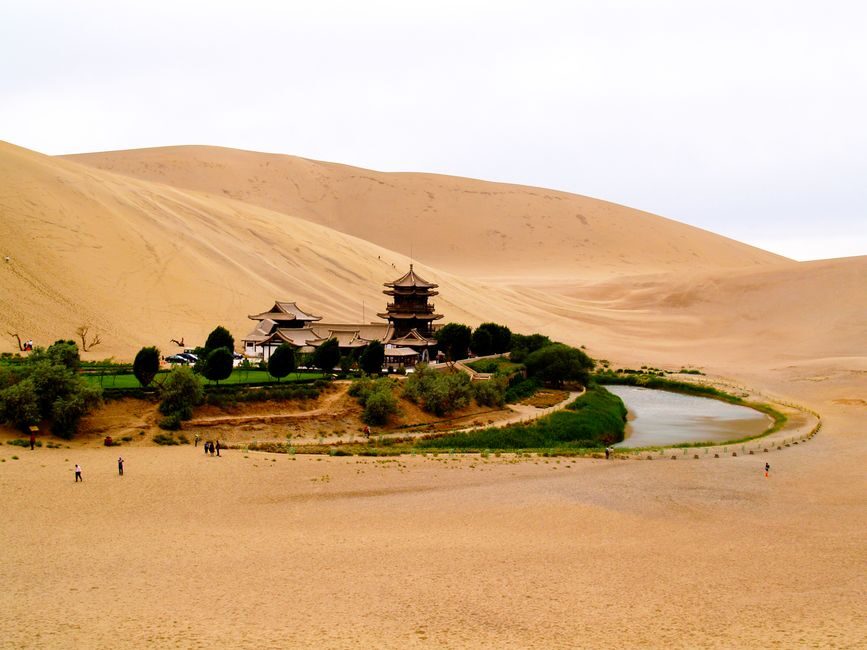
The sand starts at the southern end of town. Mingsha Shan (鸣沙山), the Singing Sand Mountain, is a range of dunes stretching some 40 km, and the scenic area entrance is about 5 km from the centre — a short taxi ride. Inside, the dunes rise in sharp-crested ridges around a small, curved spring-fed lake, Crescent Lake (月牙泉), with a rebuilt temple and pavilions on its shore.
The name comes from the sound. When the sand is dry and you slide down a steep face, the dune gives a low hum, like a distant drum — written about since the Han, loudest on dry, windy days, quiet after rain, per Asia Undiscovered. The dunes rise to about 250 metres, and the lake is about 218 metres long and 54 metres across at its widest, with a depth of around 5 metres.
The lake nearly disappeared. It is fed not by rain, which hardly falls here, but by groundwater from the Dang River fan surfacing in a hollow between dunes. As farms and wells pumped the groundwater down, the lake shrank: in 1960 it averaged four to five metres deep, and by the 1990s it was under a metre, with a sandbar starting to split it. Since 2008 the city has kept it alive by recharging the groundwater near the lake with river water — so the lake you see is real, but it is on life support, per the same guide.
Tickets, hours and the heat
The full-price ticket is ¥110 in the peak season (1 April–31 October) and ¥55 in the low season, valid for repeat entry over three days once your face is registered on first entry. Since 20 April 2026 the area sells tickets online only — through its WeChat account "鸣沙山月牙泉", the "游敦煌" mini programme, Trip.com or Meituan — and your identity document is checked at the gate. Hours from 20 April 2026 are 06:00–19:30, with shorter hours following sunrise and sunset in winter; the Sina 3-day guide (31 October 2026) notes winter entry stops at 18:30 and visitors already inside can stay until about 21:00.
Do not go at midday in summer. The sand gets hot enough to burn, there is no shade on the dunes, and the light is flat and white. The two good windows are dawn, when the ridges are sharp and the lake can be mirror-still, and the last two hours before sunset, when the sand turns orange and the heat lets go. Allow half an hour or more for the climb to the ridge above the lake, and use the ladder — it is far easier than the sand.
Camels, sledges and the other extras
Camel rides, sand sledging, electric carts, off-road buggies and helicopter flights are all sold separately inside the scenic area. The camel trains are the classic image — long lines of tethered Bactrian camels plodding up the dunes — and a ride costs about ¥100 per person for around 40 minutes, with a digital booking system added in 2025 to cut the queues. The sand sledge is the better value: you climb a slope, sit in a wooden sledge and slide down a fenced run, and the dune hums under you on the way. Rent the orange shoe covers at the gate (about ¥15 a pair); sand gets into everything, and sandals are useless on the slopes. Drones are not allowed.
Drive west: Yangguan, Yumenguan & the Yadan Devil City
West of Dunhuang the oasis ends abruptly and the Gobi begins: flat, stony, grey-brown desert to every horizon. The two Han frontier passes lie out here, Yangguan about 70 km southwest of town and Yumenguan about 90 km northwest, roughly 60 to 70 km apart by road. They sell separate tickets, so one ticket does not get you into both. Keep driving northwest from Yumenguan and the desert floor rises into rows of clay ridges carved by the wind — the Dunhuang Yadan National Geopark, about 180 km from town near the Xinjiang border. The classic western loop runs about 380 km in all, often with a stop at the West Thousand Buddha Caves on the way out.
| Stop | Distance | Ticket (2026) | Allow |
|---|---|---|---|
| Yangguan (阳关) | ~70 km southwest | ¥50 + ¥20 shuttle | 1–2 hours |
| Yumenguan (玉门关) | ~90 km northwest | ¥40 + ¥50 shuttle | 1.5–3 hours |
| Yadan National Geopark | ~180 km northwest | ¥50 + ¥70 compulsory shuttle = ¥120 | ~3 hours, to sunset |
| West Thousand Buddha Caves | ~35 km southwest | ¥30 | 1 hour, on the way out |
Sources: west-line table per Asia Undiscovered, Dunhuang guide (November 2026) and Sina News, Dunhuang classic 3-day plan (31 October 2026). Prices as of November 2026; Yumenguan hours from 15 November 2026 are 08:30–18:00, last shuttle 17:30.
Yangguan: the poem, not the walls
Almost nothing of the Han pass survives at Yangguan. What you visit is a modern gate complex and museum built near the site, and the real thing: a single eroded beacon tower on a ridge called Dundun Shan, looking out over the gravel where the old fort stood. Yangguan's fame comes from a poem — in the eighth century Wang Wei wrote a farewell to a friend posted west, ending "West of Yang Pass, there'll be no old friends" — and almost every Chinese visitor here can recite it. The surprise is green: irrigated vineyards run right up to the edge of the desert, and the grapes are dried into raisins in brick houses with honeycomb walls that let the wind through.
Yumenguan: the one that delivers
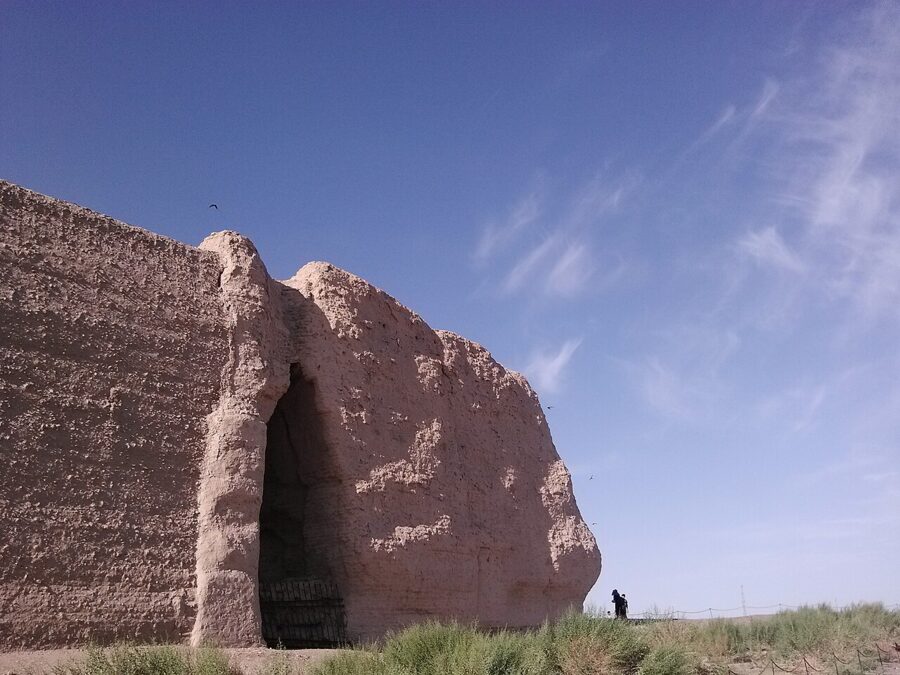
Yumenguan is the one that delivers. The pass itself is a small square fort of rammed earth, locally called Xiaofangpan (小方盘城), standing alone on a rise above the Shule River marshes — walls about ten metres high enclosing around 600 square metres, with nothing inside but sand. It is one of the sites in the Silk Roads listing the United Nations Educational, Scientific and Cultural Organization (UNESCO) inscribed in 2014; Yangguan is not. The ticket covers the whole site, and the electric shuttle links the scattered parts: Hecang (河仓城), the long crumbling walls of a Han granary about 15 km northeast, and one of the best-preserved stretches of the Han Great Wall anywhere — a low, layered rampart of reeds, tamarisk and gravel with beacon towers along it. The poem attached to Yumenguan is Wang Zhihuan's: "The spring wind never crosses Jade Gate Pass."
Yadan: the Devil City at sunset
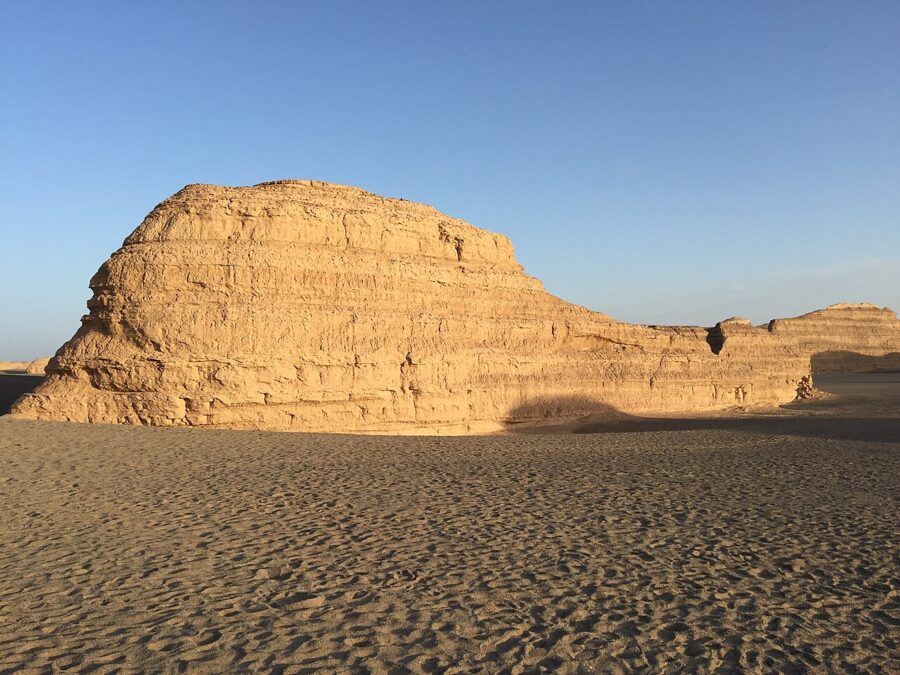
Yadan is the Chinese word for these wind-cut landforms, and it is where the English "yardang" comes from. The park covers more than 400 square kilometres, and private cars cannot drive into the core area — the shuttle buses stop at viewpoints where you can walk among the formations for ten or fifteen minutes before moving on. The park names its shapes — a lion, a peacock, a fleet of ships — but the scale and the emptiness are the point, and locals call the whole park the Devil City because the wind howls through the ridges after dark. Time your visit for late afternoon and stay to sunset: the ridges turn red and long-shadowed, and the drive back across the black desert under the stars is part of the experience. Two practical points: the road passes through military areas and police checkpoints, so carry your passport and ask your driver or hotel whether foreign visitors are currently being let through; and there is no mobile signal for long stretches, so download offline maps before you leave.
How to do the western loop in a day
Leave town by 08:00. Do Yangguan in the morning light, Yumenguan and the Han wall around midday, then Yadan in the late afternoon for sunset — you will be getting back to town at nine or ten at night, so this is a full-day trip. Public transport does not really cover it, so the choices are a car and driver (hotels and drivers in town quote about ¥400–600 for the day, per Asia Undiscovered; Sina's October 2026 guide quotes ¥400–500 for a 4-person car), the shared western-line bus (around ¥118 for the seat alone in 2026, tickets on top), or driving yourself with a Chinese licence, which most visitors do not have. Fill the tank before driving to Yadan: there is no fuel on the 158 km desert road.
When is the best time to visit Dunhuang?
| Months | What you get | Watch out for |
|---|---|---|
| May–June | Warm, clear, ahead of the summer rush; the Qilian foothills bloom with wildflowers | Mogao morning slots start to tighten |
| July–August | Longest days, full summer programme | Dunhuang hits 40°C and above; Mogao tickets sell out within minutes; biggest crowds |
| September–October | Cooler days, golden light, thinning crowds; the Silk Road (Dunhuang) International Cultural Expo is usually held in September | Golden Week (1–7 October) — Mogao A-tickets are nearly impossible; rooms tighten during the Expo |
| December–March | Half-price tickets, 10 caves instead of 8 at Mogao, no crowds, possible snow on the dunes | Daytime 0–10°C, January nights around −15°C; shorter hours; some sites close earlier |
Season summary per SinoWander, Hexi Corridor itinerary for foreigners (2026); OlaChina, Dunhuang Travel Guide (published 18 September 2026); and HostedChina, Dunhuang travel guide (checked 29 October 2026).
May to June and September to October are the best windows. Summer brings the heat and the crowds, and winter brings the cold — but winter is the value season: from 1 December 2026 to 31 March 2027 Dunhuang runs its winter-spring discount scheme, with Mogao at ¥140, Mingsha Mountain at ¥55, Yangguan, Yumenguan, Yadan and the Xuanquanzhi ruins at half price, and a ¥188 single-person package bundling the main sights with sightseeing buses, per WaysChina and the Xinhua report of 29 September 2026.
How to get to Dunhuang
- By air: Dunhuang Mogao International Airport is 13 km east of the city, with direct flights from Beijing (about 3.5 hours), Xi'an (about 2.5 hours), Lanzhou (about 2 hours), Chengdu (about 3 hours) and Shanghai (about 4 hours), per PlanChinaTrip's 2026 guide.
- By high-speed rail: Lanzhou West to Dunhuang takes about 7.5–9 hours on D-series trains via Xining, Zhangye West and Jiayuguan South — roughly 1,110 km, with a second-class seat around ¥324. From Jiayuguan South it is about 2.5 hours, and from Xi'an North the direct D train takes about 11 hours. Book on the official 12306 site or app in English with your passport.
- By conventional train: Dunhuang Station, 10 km east of town, takes overnight sleepers from Lanzhou in 12–15 hours from about ¥200. Liuyuan South, on the Lanzhou–Xinjiang high-speed line, is more than 100 km away — about a 2-hour bus to town.
- In town: taxis and DiDi cover the centre; bus 3 runs to the dunes for ¥1. For the western loop, hire a car with a driver — there is no useful bus to Yangguan, Yumenguan or Yadan.
Dunhuang as the end of a Silk Road trip
The cleanest way to do Dunhuang is as the last stop of a one-way Hexi Corridor run: fly into Lanzhou, ride west by train through Zhangye and Jiayuguan, and fly home from Dunhuang — or the reverse. The corridor is about 1,000 km of oases along the Gansu panhandle, hemmed in by the Qilian Mountains to the south and the Gobi to the north, and a 7-to-9-day loop from Lanzhou to Dunhuang lets a foreigner trace it without a tour group, a special permit or a rented car, per SinoWander. Our Qinghai–Gansu grand loop guide covers the full corridor from Xining, including the rainbow mountains of Zhangye on the way.
| Day | Plan | Notes |
|---|---|---|
| Day 1 | Morning: Mogao Caves (films + 8 caves, half a day). Afternoon: rest, Dunhuang Museum. Evening: Mingsha Mountain for sunset, then Shazhou Night Market | Book Mogao 30 days ahead; arrive at the Digital Center 30 minutes early |
| Day 2 | Western loop: Yangguan in the morning, Yumenguan and the Han wall at midday, Yadan for sunset; back in town 21:00–22:00 | ~380 km; car and driver about ¥400–600; carry your passport for checkpoints |
| Day 3 | Sunrise return to Mingsha Mountain on the same 3-day ticket; White Horse Pagoda; last shopping at the night market; fly or train out | Dunes at dawn are the quietest hour of the trip |
Three-day plan structure per Asia Undiscovered, Dunhuang guide (November 2026) and Sina News, Dunhuang classic 3-day plan (31 October 2026), adapted with 2026 ticket and transport figures from the sources above.
Where to stay and eat in Dunhuang
Sleep near the Shazhou Night Market, in the centre — most visitors eat dinner there, and the dunes, the station and the airport are all short taxi rides away. The market covers about 130,000 square metres in the middle of town: grills, noodle stalls, juice stands and long shared tables, plus carved gourds, Dunhuang-style paintings, silk scarves and dried fruit. It is touristy and prices run a little above the rest of town; go anyway, browse first, eat second, and buy souvenirs on the way out.
The town's signature dish is donkey meat yellow noodles, lürou huangmian (驴肉黄面): thin, springy hand-pulled wheat noodles, coloured slightly yellow, served with slices of braised donkey and a thick sauce of chopped mushroom, diced meat and tofu. Drink apricot skin water, xingpi shui (杏皮水), with everything — dried apricots simmered into a sweet-sour drink, served chilled. The rest of the local table turns up at the night market: niangpizi (cold wheat-starch strips with vinegar, garlic and chilli oil), huyang menbing (lamb slow-braised with sheets of dough steamed in the juices), shacong beef pies, and lamb skewers after dark.
Practical tips for Dunhuang
Sort the visa first, not the train ticket
Gansu is outside the 240-hour transit visa-free stay area. If your plan is built on the transit rule, keep it to the covered provinces and treat Dunhuang as a separate, visa-normal trip. The unilateral visa-free arrangement, which now covers a long list of countries for stays of up to 30 days, is the simpler way in for most nationalities; otherwise an ordinary tourist visa does the same job with more paperwork. See our 240-hour visa-free transit guide for the full picture.
Do not self-drive on a foreign licence
A foreign driving licence on its own does not entitle you to drive in mainland China, and an international driving permit is not accepted. A self-drive trip means arranging a temporary Chinese licence before you leave — if that sounds like more trouble than it is worth, a chartered car covers the same ground, and the driver handles the desert road and the checkpoints.
Pack for desert heat and desert cold in one day
Summer sand at Mingsha Mountain gets hot enough to burn bare feet, and winter nights drop to −15°C. Layer up regardless of the forecast: a windproof shell, a warm layer for the dawn viewpoint, sunscreen and sunglasses, and lip balm. The dunes have almost no shade, so a hat matters more here than at lower-altitude sights. Bring cash for the camel handlers and the smaller stalls — some prefer it — and download offline maps before the western loop, because there is no mobile signal for long stretches.
Respect the caves and the desert
Inside the caves, no photography, no touching the walls, no talking loudly — breath, light and humidity damage paint that has lasted 1,500 years. On the dunes, do not take a bottle of the coloured sand home; Crescent Lake survives on a groundwater recharge scheme, and the sand is part of the system. At Yadan, stay with the shuttle stops and do not wander off on your own in the park.
Bottom line: Dunhuang earns its place at the end of the Silk Road honestly — a thousand years of painting in a cliff you can only enter in a guided group, a singing dune wrapped around a lake that nearly disappeared, and a Han frontier that ends in a Devil City glowing red at sunset. Book Mogao a month ahead, give the dunes both a sunset and a sunrise on one 3-day ticket, and give the western loop a full day with a driver.
In summary: Mogao Caves ¥238 peak (films + 8 caves) or ¥140 winter (films + 10 caves), booked online with a passport up to 30 days ahead, 08:00–18:00 peak / 09:00–17:00 winter; Mingsha Mountain ¥110 (¥55 winter), valid 3 days, camel about ¥100; Yangguan ¥50, Yumenguan ¥40, Yadan ¥120 all-in, on a 380 km western loop with a car and driver at about ¥400–600 a day; best May–June and September–October, cheapest December–March; and Gansu needs a proper visa — the 240-hour transit arrangement does not cover it.
Want Dunhuang without the logistics?
Western China Private Car Tours runs private car trips in Dunhuang: airport pickup, a car and driver for the full western loop — Yangguan, Yumenguan, the Han wall and Yadan at sunset — plus transfers to the Mogao Digital Center and the dunes, timed around your cave booking. The driver communicates with guests via translation apps, so plans and pickup times are easy to change on the day.
Coming from Chengdu or Xining? Our Qinghai–Gansu grand loop guide runs the whole corridor by rail from Xining to Dunhuang, or see our 240-hour visa-free transit guide before you plan the visa.
Get a Private Car Quote on WhatsAppFrequently Asked Questions About Mogao Grottoes & Dunhuang
How much do Mogao Caves tickets cost in 2026?
As of November 2026, the regular Mogao ticket costs ¥238 in the peak season (1 April–30 November) and covers two films at the Digital Exhibition Center plus a guided visit to 8 caves, capped at 6,000 a day. From 1 December to 31 March it drops to ¥140 and covers 10 caves. A foreign-language guided ticket costs ¥258 in peak season and ¥160 in winter. The emergency ticket, sold only on busy peak-season days when the regular quota is gone, costs ¥100 for 4 caves and no films. Special caves cost ¥150–200 each on top.
How do I book Mogao Caves tickets with a foreign passport?
Book on the Dunhuang Academy's official channels only: the WeChat service account "莫高窟参观预约网" (choose 预约购票, then Ticket Booking for foreign passports) or the mini programme of the same name. Tickets are real-name and timed, booked with your passport number up to about 30 days ahead, and the name and number must match the passport you bring. The Academy has authorised no third-party seller, and in July 2026 it warned that resold tickets may not scan. Set up WeChat Pay with a foreign card before you start.
How many days do I need in Dunhuang?
Three days covers it well. Day 1: Mogao Caves in the morning (half a day including the films and shuttle), then Mingsha Mountain and Crescent Lake for sunset. Day 2: the western loop — Yangguan, Yumenguan and the Han wall, finishing at Yadan National Geopark for sunset, about 380 km round trip. Day 3: a sunrise return to the dunes on the same 3-day Mingsha ticket, the Dunhuang Museum, and the Shazhou Night Market. Two days works if you skip the museum and the sunrise.
What does the Mingsha Mountain ticket cover, and is it really valid for 3 days?
The ¥110 peak-season ticket (¥55 in the low season, 1 December–31 March) covers entry to Mingsha Mountain and Crescent Lake, and your face is registered on first entry so you can come back for repeat visits over three days — a sunset one evening and a sunrise the next morning on the same ticket. Camel rides (about ¥100 for 40 minutes), sand sledging, the shuttle bus and shoe covers are paid extras. Since 20 April 2026 tickets are sold online only, through the "鸣沙山月牙泉" WeChat account, the "游敦煌" mini programme, Trip.com or Meituan.
Can I visit Dunhuang on China's 240-hour transit visa-free entry?
No. Gansu is not among the provinces where 240-hour transit visa-free travellers may stay, so that arrangement does not cover Dunhuang. Enter on an ordinary tourist visa or a unilateral visa-free arrangement of up to 30 days instead. No separate travel permit is needed for Dunhuang itself — unlike Tibet, foreign passport holders travel freely in Gansu with a valid visa.
Sources: Asia Undiscovered — Dunhuang: The Mogao Caves, the Singing Sands and How to Plan a Trip to the Edge of the Gobi (November 2026; 735 caves / 492 with murals / 45,000 sq m / 2,000+ figures / first cave 366 / Library Cave 17 found 22 June 1900 / Diamond Sutra 868 / Cave 96 35 m Buddha / ticket table / booking rules / Mingsha ¥110 / Yangguan ¥50 / Yumenguan ¥40 / Yadan ¥120 / west loop 380 km / car ¥400–600 per day) / DunhuangTours — Mogao Caves Tickets 2026 (Academy visitor page, checked October 2026; A ¥238 / B ¥100 / winter ¥140 / special caves ¥150–200 / cap 6,000 / book mgk.org.cn or WeChat 莫高窟参观预约网) / DunhuangTours — Mogao Caves Winter Tickets 2026-27 (1 December 2026–31 March 2027; regular ¥140 / reduced ¥95 / 10 caves / hours 09:00–17:30 / sales to 15:00 / Mingsha ¥55 / Xinhua 29 September 2026 winter package) / Sina News — Dunhuang classic 3-day plan (31 October 2026; Mogao A ¥238 / Mingsha ¥110 3-day validity / Yadan ¥120 / Yumen ¥40 / Yangguan ¥50 / West Thousand Buddha ¥30 / west-line car ¥400–500 / winter hours 06:30–18:30) / WaysChina — Dunhuang Travel Guide: Mogao Caves Booking, Crescent Moon Spring and Getting There (2026; winter package 1 December 2026–31 March 2027 / ¥188 pass / foreign-language ticket ¥258 / ¥160 / train times 29 October 2026) / OlaChina — Dunhuang Travel Guide: Three Days at the End of the Corridor (published 18 September 2026; best May–June & September–mid-October / Gansu outside 240-hour transit area / Liuyuan South 100+ km / airport and rail) / SinoWander — China's Silk Road: The Hexi Corridor Itinerary for Foreigners (2026; 7–9 day loop / Lanzhou–Dunhuang 1,110 km / HSR 7.5–9 h / ~¥324 second class / June sweet spot). Images: Pexels photographs via Asia Undiscovered (Mogao cliff, Crescent Lake, Yumenguan, Yadan ridges).