Sanxingdui Museum Guide from Chengdu (2026)
Why Sanxingdui belongs on every Chengdu itinerary
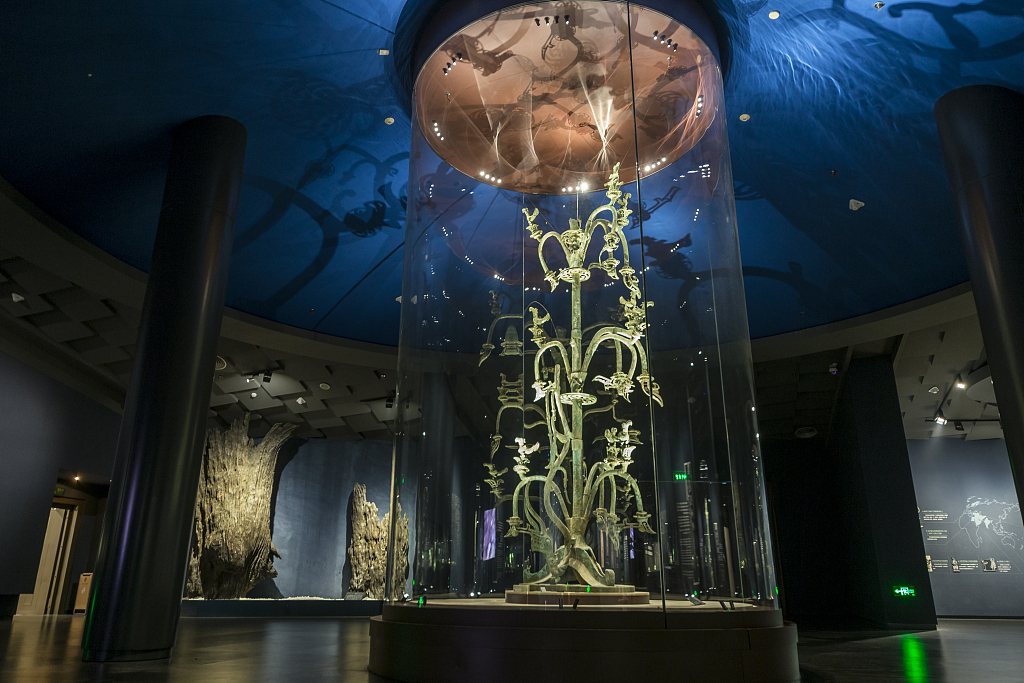
In 1986, archaeologists in Guanghan dug up two pits of bronzes that looked nothing like anything the world associated with ancient China — masks with cylindrical protruding eyes, a standing figure over 2.6 m tall, a bronze tree nearly 4 m high. It rewrote the story of Chinese civilization: the mysterious Shu kingdom had built a bronze age of its own, contemporary with the Shang dynasty, and it stayed buried for 3,000 years.
"Ten years ago, if you asked foreigners what Chinese archaeology is most famous for, many would say the Terracotta Army. Now, more and more foreigners mention Sanxingdui." — He Xiaoge, archaeologist of the Sanxingdui excavations
In 2021, six more sacrificial pits were re-excavated, and their finds are still being restored and unveiled. The new exhibition hall — opened July 2023 with five times the old display space — is where they all live now: temperature-controlled cases, a dedicated restoration lab you can watch through glass, and digital experiences built around the new discoveries.
According to the museum's own visitor data, 6.08 million people came in 2025, more than 80% from outside Sichuan. If there's one indoor attraction in the Chengdu region, this is it.
Which treasures should you not miss?
All the core artifacts now sit in the new hall. Six pieces carry the visit — and each one answers a question about a civilization that left no written records:
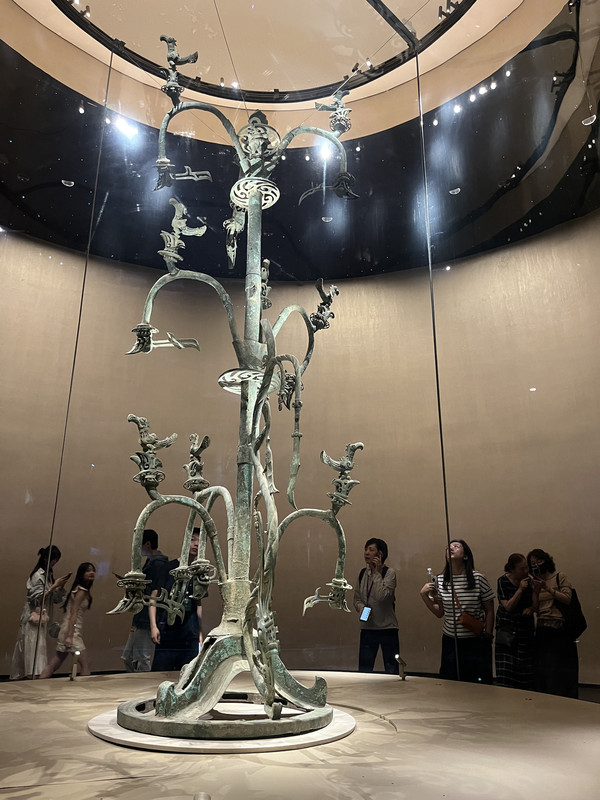
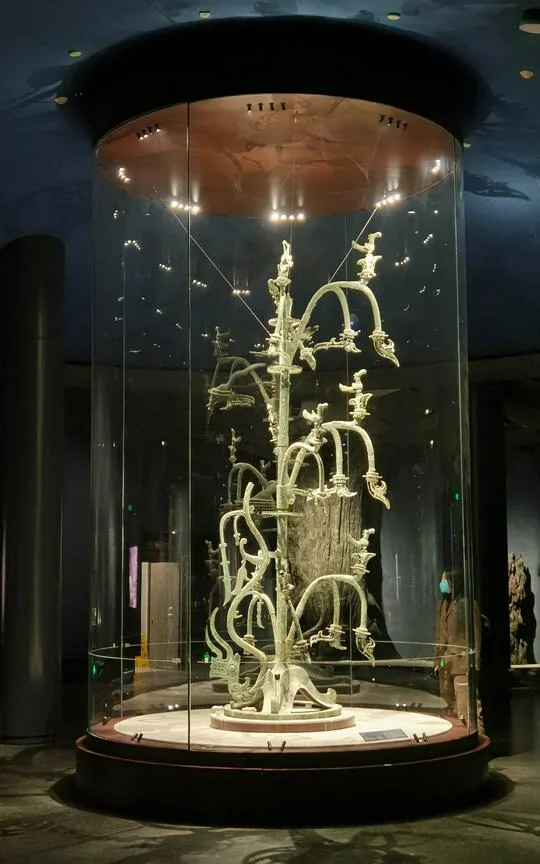
- Bronze divine tree (No. 1) — 3.96 m tall. Museum researchers note it is the largest single bronze artifact ever found in the world. Three tiers, three branches per tier, bronze birds perched on top — the Shu "stairway to heaven."
- Bronze standing figure — 2.62 m tall, nicknamed the "king of bronze statues." Enormous hands grip something long lost (a tusk or scepter, scholars guess); the three-layer robe marks a ruler or high priest.
- Gold staff — 1.42 m long, gold foil hammered over a wooden core (long since carbonized), engraved with fish, birds and human heads: the Shu symbol of kingly and divine power combined.
- Bronze longitudinal-eye mask — eyeballs stretched into cylinders, ears flared like fans. It matches the legend of Can Cong, the Shu ancestor with "longitudinal eyes," and is the prototype of the "thousand-mile eyes" motif.
- Gold mask fragment — recovered from pit No. 5, with gold content measured at 85% purity, and so well balanced it stands upright on its own with no support.
- The "fun" relics — a pottery pig that looks uncannily like the green pig from Angry Birds, and a three-legged pottery cooking vessel that proves Sichuan's hotpot obsession is several millennia old.
Suggested route through the new hall
The building rewards a bottom-up walk. Give it 3–4 hours:
- 1st floor, "Century Dream" — a century of digging: from the 1929 farmer's first find, to the 1986 pits that "woke the world," to the 2021 re-excavation. Context you need before the bronzes.
- 1st floor, "Majestic Capital" — the Shu kingdom's political and economic life: bronze heads, gold masks, and the cross-regional influences (Liangzhu jades, Shang-style bronze ornaments) that show Shu wasn't isolated.
- Upper floors, "Heaven, Earth, Humanity, Divinities" — the ritual core: the divine tree, the standing figure and the altar pieces under one soaring ceiling. This is the payoff — save your energy for it.
- Restoration lab (09:00–18:00) — one of China's few open conservation workshops; you can watch conservators work on freshly excavated ivory and bronzes through the glass.
- "Heaven and Earth Resonance" digital theater — the museum's dome theater: a 20 m light-emitting diode (LED) dome at ~16K resolution with 108 interactive "digital torches" that summon a bronze bird overhead. Book it when you reserve your ticket — it's capacity-limited.
Tickets & booking (as of Oct 2026)
- ¥72 adult; half-price for full-time students; free for visitors 60+ and children under 1.3 m or under 6 — but free entries still need a real-name reservation.
- Book 5 days ahead. Tickets release daily at 20:00 through the "Sanxingdui Museum" official WeChat account, mini-program, official website or Douyin account. There are no on-site ticket windows — unbooked visitors get turned away.
- Official channels only. The museum states it has authorized no third-party ticket sellers; tickets bought elsewhere risk failing at the gate. Foreign visitors book with a passport and enter by scanning it.
- Ticket-raise watch: a public hearing in 2024 proposed raising the price from ¥72 to ¥120. As of October 2026 the increase has not taken effect — but it's worth checking before you go.
- Opening hours: 08:30–18:00, last entry 17:00, closed only on Chinese New Year's Eve afternoon. During major holidays (Golden Week, Mid-Autumn, Spring Festival) the museum extends to 08:30–20:00 with evening tickets from 17:00.
Booking strategy: grab the 08:30 morning slot and start on the first floor while tour groups concentrate upstairs. The afternoon slot coincides with the peak — groups pour in around 15:00 and the halls get crowded fast.
How do you get from Chengdu to Sanxingdui?
Chengdu to Guanghan has three realistic options, and the right one depends on whether you also want the panda base. The key takeaway: the train is fast and cheap, but only a private car fits two attractions into one day.
| High-speed rail + taxi | Private car | Shuttle bus | |
|---|---|---|---|
| Route | Chengdu East → Guanghan North (~18–25 min, ~¥18, ~every 20 min) + taxi/shuttle ~15 min | Door to door, ~1 hr from central Chengdu | Chunxi Road International Finance Square (IFS) area → museum, direct |
| Last mile | Taxi ~¥15–20, or No. 13 shuttle (~¥2) from the station's right exit | None — driver waits at the gate | Departs on a fixed schedule |
| Panda combo | ❌ Transfers make the timing risky | ✅ Pandas → Sanxingdui in one day works | ❌ Fixed return time |
| Cost per person | ~¥40 round trip + transfers | Higher, split by group size | ~¥40–60 round trip |
Can you combine pandas and Sanxingdui in one day?
Yes — and it's the most efficient two-attraction day trip from Chengdu. The panda base sits in north Chengdu, directly on the road to Guanghan. The bottom line: do pandas first, when they're active, and Sanxingdui in the afternoon.
| Time | What |
|---|---|
| 7:30–12:00 | Chengdu Research Base of Giant Panda Breeding (go early — pandas are most active in the morning) |
| 12:00–13:00 | Drive ~40 min to Guanghan; lunch (try the local jinsi mian noodles) |
| 13:00–17:30 | Sanxingdui Museum — new hall route above, restoration lab, digital theater |
| ~19:00 | Back in Chengdu for hotpot |
By public transport the panda-to-Sanxingdui transfer involves base-exit buses, a metro ride, then the Guanghan train — one delay eats your museum slot. This combo is the single best argument for a private car in Chengdu.
Sanxingdui visitor tips (food, guides, luggage)
- Get a guide: Sanxingdui's bronzes come with no written records — without explanation they're beautiful but silent. The WeChat mini-program offers an audio guide (Cantonese available); human guides at the visitor center run ~¥400–600 per group.
- Free luggage storage at the visitor center — handy if you're heading straight there from the airport or train station.
- Food & souvenirs: the "Dui Dui Dui" café near the exit sells bronze-mask-shaped ice cream (matcha = bronze green) and gold-mask lattes; the gift shop's bronze-tree bookmarks and mask fridge magnets are the best-designed museum souvenirs in China.
- Best season: it's all indoors, so any month works. Combine with outdoor trips in March–June or September–November for the best Sichuan weather.
- Passport entry: foreign visitors scan the passport used at booking — bring the original.
Pandas in the morning, Sanxingdui in the afternoon?
Western China Private Car Tours runs the panda + Sanxingdui combo as a fixed-quote day trip: 7:30 hotel pickup, ticket-booking help, driver waits at the museum gate. No shopping stops; driver communicates via translation app.
Get a Free Quote on WhatsAppFAQ
Is the Sanxingdui Museum worth visiting from Chengdu?
Absolutely. 3,000-year-old bronzes unlike anything else in Chinese archaeology, and the 2023 new hall shows freshly restored finds from the 2021 pits. It drew 6.08 million visitors in 2025.
How do I buy tickets?
Five days ahead through the museum's official WeChat/mini-program/website/Douyin — tickets drop at 20:00 daily. ¥72 adult, half-price students, free for 60+ and under-1.3 m kids (all real-name reserved). No on-site windows.
How do I get there from Chengdu?
High-speed rail from Chengdu East to Guanghan North (18–25 min, ~¥18), then a 15-min taxi or No. 13 shuttle. Private car: ~1 hr door to door — the only option that reliably combines Sanxingdui with the panda base.
How long should I plan for the visit?
3–4 hours: 1st floor excavation history, upper floors for the ritual bronzes, plus the open restoration lab and the digital dome theater if time allows.
Can I combine Sanxingdui with the panda base in one day?
Yes — it's the classic combo: pandas 7:30–12:00, ~40 min drive to Guanghan, museum 13:00–17:30, back in Chengdu by evening. A private car makes the transfer timing reliable.
Sources: Sanxingdui Museum official holiday ticket notice via Sohu (2026 Mid-Autumn & National Day ticket release) / Trip.com Hong Kong Sanxingdui guide (transport, ticket & treasure details) / Sina News (summer ticket & booking guide) / Tencent News (2026 holiday extended hours). Photos: China Global Television Network (CGTN) new-hall coverage (hero) / Ctrip traveler photo / realchengdu.com.