Seda Buddhist Institute Visit (2026): Larung Gar Access, Tickets & Practical Rules
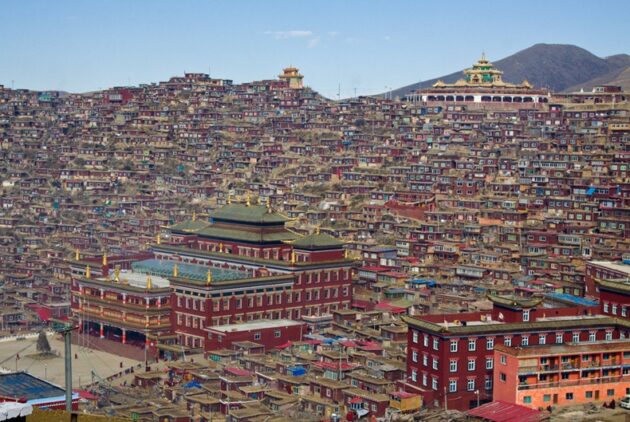
Short answer: Seda's Larung Gar — the world's largest Tibetan Buddhist institute, a valley of tens of thousands of red wooden huts at about 3,900 metres — is closed to foreign passport holders and has been since June 2016. Hong Kong, Macau and Taiwan residents may be able to register with the Sertar police for a guided visit. For everyone else, this guide explains who can go, how booking works, and which nearby Tibetan sites you can visit instead.
Eligible visitors must book three days ahead through the official WeChat mini program: slots open at 18:00, the daily cap is about 3,000 people as of November 2026, and the shuttle inside the valley costs ¥30. Entry to the academy itself is free.
All facts below are as of November 2026.
In short: Do not plan a Seda trip on a foreign passport and hope the rules have changed — they have not. Check the access rules first; if you cannot enter, the western Sichuan loop through Kangding, Tagong and Daocheng Yading offers the same plateau scenery without the checkpoint.
Key takeaways for visiting Seda
- Foreign passport holders cannot visit Larung Gar. The institute has been closed to foreign visitors since June 2016, and Seda County is officially closed to foreign travellers, with a checkpoint at Wengda, according to Voykit's Seda guide and Danana GO's 2026 guide.
- Eligible visitors need a booking, not just a ticket. Bookings open at 18:00, three days before the visit, through the official mini program, the daily cap is about 3,000 people, and peak-season slots sell out within minutes, per Sina News (13 November 2026).
- Entry is free; the shuttle is ¥30. A ¥200 deposit is refunded if you leave within 90 minutes. Last entry is 16:00 and the valley closes at 18:00.
- It is a 14–16 hour journey from Chengdu. The direct bus costs ¥208–240 one way; a private car costs roughly ¥1,000–2,000 for a round trip. Break the trip in Kangding to acclimatise.
- May and September to October are the best months. Clearer skies, daytime temperatures of -5 to 13 degrees Celsius, and less rain than the June–August monsoon season, according to TravelDojo's Larung Gar guide.
Can foreigners visit Seda Larung Gar?
No — not on a foreign passport. Larung Gar has been closed to foreign visitors since June 2016, and the restriction still stands as of November 2026. Seda County itself is officially closed to foreign travellers, and permits are rarely issued; a checkpoint at Wengda on the approach road turns back travellers without the right documents, according to Voykit.
Danana GO's 2026 guide adds that Hong Kong, Macau and Taiwan residents may register with the Sertar police for a guided visit with a domestic Chinese group, and that independent attempts by foreign visitors risk being escorted out of the area.
This matters because Seda is one of the most photographed places in western Sichuan, and many itineraries still list it as a standard stop. It is not a standard stop for international travellers. Before you build any plan around Larung Gar, confirm the current access rules with local authorities or a travel agency — and have a backup route ready. Our western Sichuan 5-day loop covers Kangding, Tagong and Xinduqiao, which are open to foreign visitors and deliver the same high-plateau Tibetan scenery.
One more honest note: the traditional sky burial ceremony at Larung Gar is no longer open to visitors at all, including domestic tourists, out of cultural sensitivity, according to Danana GO. Do not plan a visit around it, and never photograph funeral ceremonies.
How does the booking system work?
For eligible visitors, entry to the Larung Gar valley is tightly controlled. The rules below are drawn from Sina News reporting dated 13 November 2026, based on October 2026 on-the-ground checks and the official booking mini program's own guidance.
The booking rules at a glance
| Rule | Detail (as of November 2026) |
|---|---|
| Booking channel | WeChat mini program for Larung Gar valley entry — the only official online channel |
| Release time | Three days ahead, at 18:00 sharp; be in the app by 17:55 |
| Daily cap | About 3,000 people a day (1,200–3,200 in October, depending on season and festivals) |
| Admission | Free — the academy charges no entry fee |
| Shuttle | ¥30 round trip inside the valley; the shuttle runs from the entrance to the Mandala area |
| Deposit | ¥200, refunded automatically if you leave within 90 minutes |
| Hours | Last entry 16:00, valley closes 18:00; allow 3–4 hours inside |
| Offline option | Jinma Grassland distribution centre in Seda County, from 08:00, about ¥48 for same-day afternoon slots |
| Identification | Real-name booking, one person one ticket, face recognition at entry |
Sources: booking rules, cap and hours per Sina News (13 November 2026); offline price and shuttle details per Sina News (25 October 2026) and Trip.com's Seda guide. Rules as of November 2026.
What if you have no booking?
Without a booking, you cannot enter the core valley — there is no same-day ticket window at the gate and no way to buy your way in on arrival. The surrounding areas are different: Seda County town, Jinma Grassland and Dongga Monastery need no booking at all and are open to private cars, which makes them the practical fallback if your slot does not come through.
"If you only remembered one thing about Seda, remember the 18:00 release time. Set an alarm for 17:55, fill in your companions' details in advance, and confirm at 18:01 — by then, only waitlist places are usually left." — Sina News, Seda access guide (13 November 2026)
How do I get to Seda from Chengdu?
Seda sits about 650–780 km northwest of Chengdu in Garze Tibetan Autonomous Prefecture, and the road is the whole journey — there is no railway, and the nearest airport, Garze Gesar Airport, is about 200 km away with infrequent flights.
By bus: a daily bus leaves Chengdu Chadianzi Bus Station at around 06:30 via Maerkang, reaching Seda County after 14–16 hours for ¥208–240. The bus stops at the academy entrance before continuing into Seda town, 20 km further on. Book 2–3 days ahead — seats sell out, per Danana GO. A second route runs via Kangding and Luhuo from Xinnanmen Bus Station at 06:10 and 06:15.
By private car: a private car from Chengdu costs roughly ¥1,000–2,000 for a round trip, according to Danana GO, and is the only option that lets you stop on the way — which matters, because the sensible way to do this trip is to overnight in Kangding (2,600 m) and acclimatise before climbing to 3,900 m. From Seda town to the academy, 20 km away, shared minivans cost ¥7–10 per person.
By air: Garze Gesar Airport is about 200 km from Seda, but flights are infrequent and you still need onward road transport, so flying rarely saves time over driving from Chengdu.
Planning a western Sichuan road trip instead?
Western China Private Car Tours runs private cars from Chengdu across the western Sichuan plateau — Kangding, Tagong, Xinduqiao and the Daocheng Yading route — with overnight stops built in so you acclimatise properly. Our drivers communicate with guests via translation apps, so pickup times and route changes are easy to arrange on the road.
See our western Sichuan 5-day loop and our Daocheng Yading guide for the open alternatives to Seda.
Get a Private Car Quote on WhatsAppWhen is the best time to visit Seda?
Larung Gar sits at about 3,900 metres, and the annual average temperature is just 1.7 degrees Celsius, so "best time" here means the least punishing window, not warm weather. TravelDojo's climate data for the valley puts the range at -19 to 16 degrees across the year, with about 679 mm of annual rainfall concentrated in summer.
| Season | Temperature | What to expect |
|---|---|---|
| May, September–October | -5 to 13°C | Best balance: clearer skies, stable conditions, less rain — the recommended window |
| June–August | 2 to 16°C | Warmest months, but the monsoon brings most of the year's rain and muddy paths |
| November–February | -19 to 5°C | Very cold and dry, clear skies and few visitors, but harsh conditions and limited services |
| March–April | -11 to 9°C | Cold, overcast, strong ultraviolet light; early-spring light suits photography |
Sources: seasonal temperatures and rainfall per TravelDojo (updated November 2026); annual average temperature per Trip.com's Seda guide. Temperatures as of November 2026.
Four major prayer gatherings punctuate the year at the academy — the Shenbian, Sakya, Mingjing and Youxi month prayers — each lasting about eight days and drawing large crowds, according to Danana GO. Dates follow the Tibetan calendar and shift each year, so check the current year's calendar before travelling, and expect accommodation to be scarce during festivals.
What is there to see inside Larung Gar?
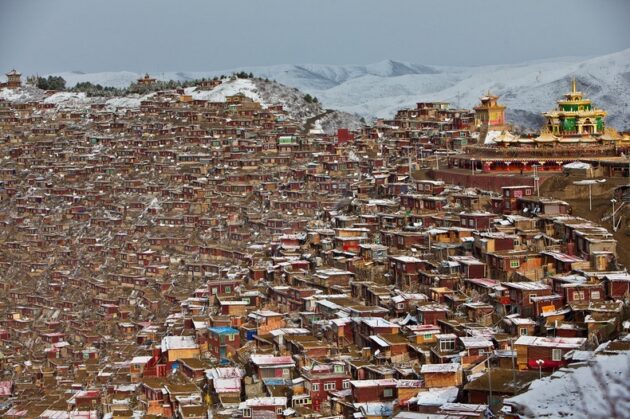
Larung Gar is a working monastery, not a theme park. Founded in 1980 by Khenpo Jigme Phuntsok, it grew from a mountain hermitage into the world's largest Tibetan Buddhist institute, home to tens of thousands of monks, nuns and lay students — Sina News puts the figure at more than 30,000 practitioners — living in thousands of red wooden cabins spread across the valley at about 4,000 metres.
"Visiting today means seeing an active monastic community in a remote, high-altitude setting where facilities are basic and the pace is contemplative." — TravelDojo, Larung Gar Visitor Guide (updated November 2026)
The assembly hall, the Mandala and the debates
The main assembly hall: the heart of the academy, where daily prayers and teachings take place. Visitors can observe quietly from designated areas, and the 5:00 p.m. scripture debates in the main hall are open to the public — a lively, public display of Buddhist scholarship, according to Danana GO.
The Mandala viewpoint: the highest point of the academy, where pilgrims walk clockwise around the prayer wheel. The viewing platform looks out over the whole valley and is the best place for the classic panorama photograph. Registration is required to climb the mountain, and same-day descent is mandatory.
The red huts, the nunnery and the evening lights
The red huts themselves: the sight that makes Seda famous. Narrow paths wind between the cabins, and the view from the hilltop near Larung Hotel at dusk — when the valley lights come on — is the image most visitors remember. Walk quietly, dress modestly, remove hats inside temples, and ask permission before photographing monks or nuns.
Pema Khandro Duling Nunnery: one of the principal nunneries at Larung Gar, notable because the institute has been important for advanced training of nuns, according to TravelDojo. Some areas have restricted access, so follow local guidance.
Alcohol is strictly prohibited in the valley, and the academy's vegetarian ethos means you should not bring meat inside. Small vegetarian restaurants downhill from the main hall serve noodles, dumplings and zanba (roasted barley paste with butter tea) for about ¥10–30.
Where to stay and eat
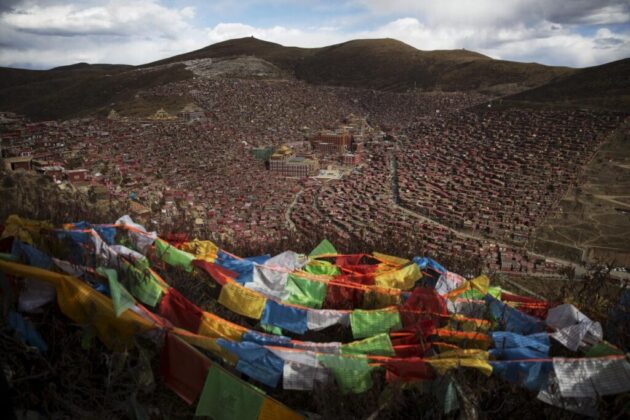
Inside the valley: Larung Hotel (also called Tancheng Hotel) offers basic rooms with shared bathrooms for about ¥65–200 a night, according to Danana GO. Book early during festivals, and expect unreliable hot water and heating in winter. A few monks or nuns offer informal homestays, but these depend on local hospitality and cannot be booked in advance.
In Seda town, 20 km away: modern three-star hotels such as Seda Shengcheng, Seda Shengyu and Seda Foyuan run about ¥240–280 a night with private bathrooms. Staying in town the night before your visit is the practical choice: you arrive rested, you are already acclimatised, and you can enter the valley early the next morning.
Eating: on site, vegetarian meals cost about ¥10–30. In Seda town, Tibetan and Sichuanese restaurants serve momos, yak butter tea and spicy noodles for about ¥15–40 a meal. Bring snacks from Chengdu — dining options in the valley are limited, and prices are higher because of the remote location.
Altitude and etiquette: what to know before you go
At about 3,900–4,200 metres, Larung Gar is high enough that altitude sickness is a real risk, not a footnote. Acclimatise in Chengdu (500 m) or Kangding (2,600 m) for one to two days, stay hydrated, and consider altitude medication before you arrive, according to Danana GO. Our altitude sickness guide covers the 24–48 hour rule, warning signs and when to descend — read it before any trip above 3,500 metres.
Etiquette matters more here than at a normal scenic spot, because this is a place of study and worship. Dress modestly with long trousers and covered shoulders, keep your voice down, do not photograph residents without permission, and never photograph inside religious buildings or at funeral ceremonies. Cash is useful: ATMs are scarce in the valley and digital payments may not be accepted everywhere, so bring enough renminbi.
Bottom line: Seda is one of the most extraordinary sights in China — and one of the hardest for international travellers to reach. If you are eligible to visit, reserve your slot the moment bookings open, stay a night in Seda town, and give yourself a full morning inside the valley. If you are not eligible, do not waste the trip: Kangding, Tagong, Xinduqiao and Daocheng Yading are open, spectacular, and on the same road west from Chengdu.
In summary: Foreign passport holders are closed out of Larung Gar since 2016; eligible visitors reserve a slot when bookings open at 18:00, three days before the visit, pay ¥30 for the shuttle, and enter before 16:00. May and September–October are the best months, Kangding is the smart overnight stop, and the open alternatives — Tagong, Xinduqiao, Yading — are well worth the same drive.
Frequently Asked Questions About Visiting Seda
Can foreign tourists visit Seda Larung Gar?
As of November 2026, no. Larung Gar has been closed to foreign passport holders since June 2016, and Seda County is officially closed to foreign travellers, with a checkpoint at Wengda. Hong Kong, Macau and Taiwan residents may be able to register with the Sertar police for a guided visit with a domestic Chinese group. Always verify the current access rules before planning.
How do I book a visit to Larung Gar?
Eligible visitors book through the WeChat mini program for Larung Gar valley entry, when slots are released at 18:00, three days before the visit. The daily cap is about 3,000 people as of November 2026, and peak-season slots sell out within minutes. A round-trip shuttle ticket costs ¥30 and a ¥200 deposit is refunded if you leave within 90 minutes. Last entry is 16:00 and the site closes at 18:00.
How much does it cost to visit Seda?
Entry to the academy itself is free. The cost is the ¥30 round-trip shuttle inside the valley, plus a refundable ¥200 deposit. The bigger cost is getting there: the bus from Chengdu costs ¥208–240 one way and takes 14–16 hours, while a private car from Chengdu runs roughly ¥1,000–2,000 for a round trip, per 2026 guides.
What is the best time to visit Seda?
May and September to October offer the best balance: daytime temperatures around -5 to 13 degrees Celsius, clearer skies and less rain. June to August is the warmest (2–16 degrees) but brings most of the year's rain and muddy paths. Winter, from November to February, runs -19 to 5 degrees with clear skies but harsh cold and limited services.
How long does it take to get to Seda from Chengdu?
Seda is about 650–780 km from Chengdu. The direct bus from Chengdu Chadianzi Bus Station leaves around 06:30 and takes 14–16 hours. Most travellers break the journey with an overnight stop in Kangding (2,600 m), which also helps with acclimatisation before the 3,900 m altitude at Larung Gar.
Sources: Danana GO — Sertar Larung Wuming Buddhist Academy Travel Guide (2026; founded 1980, foreign restrictions since June 2016, bus ¥208–240, private car ¥1,000–2,000 round trip, 17:00 debates, Larung Hotel ¥65–200, festivals) / TravelDojo — Larung Gar Visitor Guide (updated November 2026; seasonal temperatures -19 to 16°C, 679 mm annual rainfall, Pema Khandro Duling Nunnery, access restrictions) / Sina News — Seda access guide (13 November 2026; 3,000-a-day cap, 3 days ahead 18:00 release, ¥30 shuttle, 16:00 last entry, 18:00 close, Jinma Grassland and Dongga Monastery open without booking) / Voykit — Seda, Sichuan travel guide (county officially closed to foreign travellers, Wengda checkpoint, permits rarely issued). Images: valley photographs courtesy of Danana GO.