Zhangye Danxia Guide (2026): Rainbow Mountains, Tickets & the Best Light
TL;DR: Zhangye Danxia — the Rainbow Mountains — is a striped sandstone landscape about 40 km west of Zhangye city in Gansu, inside a United Nations Educational, Scientific and Cultural Organization (UNESCO) Global Geopark. An adult visit costs ¥70 for entry plus ¥38 for the mandatory shuttle, ¥108 in total; from 11 November 2026 to 28 February 2027 the gate ticket is half price, so the total is ¥73. Come for the late-afternoon light, allow about three hours for the four viewing platforms, and sort out your ride back to town before you go in.
One day covers the Rainbow Mountains. Two days add Binggou Danxia, a quieter park of tall sandstone walls about 13 km away, or Mati Temple, a group of cliff cave temples about 65 km south in the Qilian foothills. Zhangye sits on the high-speed line between Lanzhou and Dunhuang.
Book nothing in advance for the park itself — the ticket is bought at the gate or on the park's official mini programme — but do not build your day around sunset. In autumn 2026 the park closed at 18:00 and this winter it closes at 17:00, while the sun sets later than that.
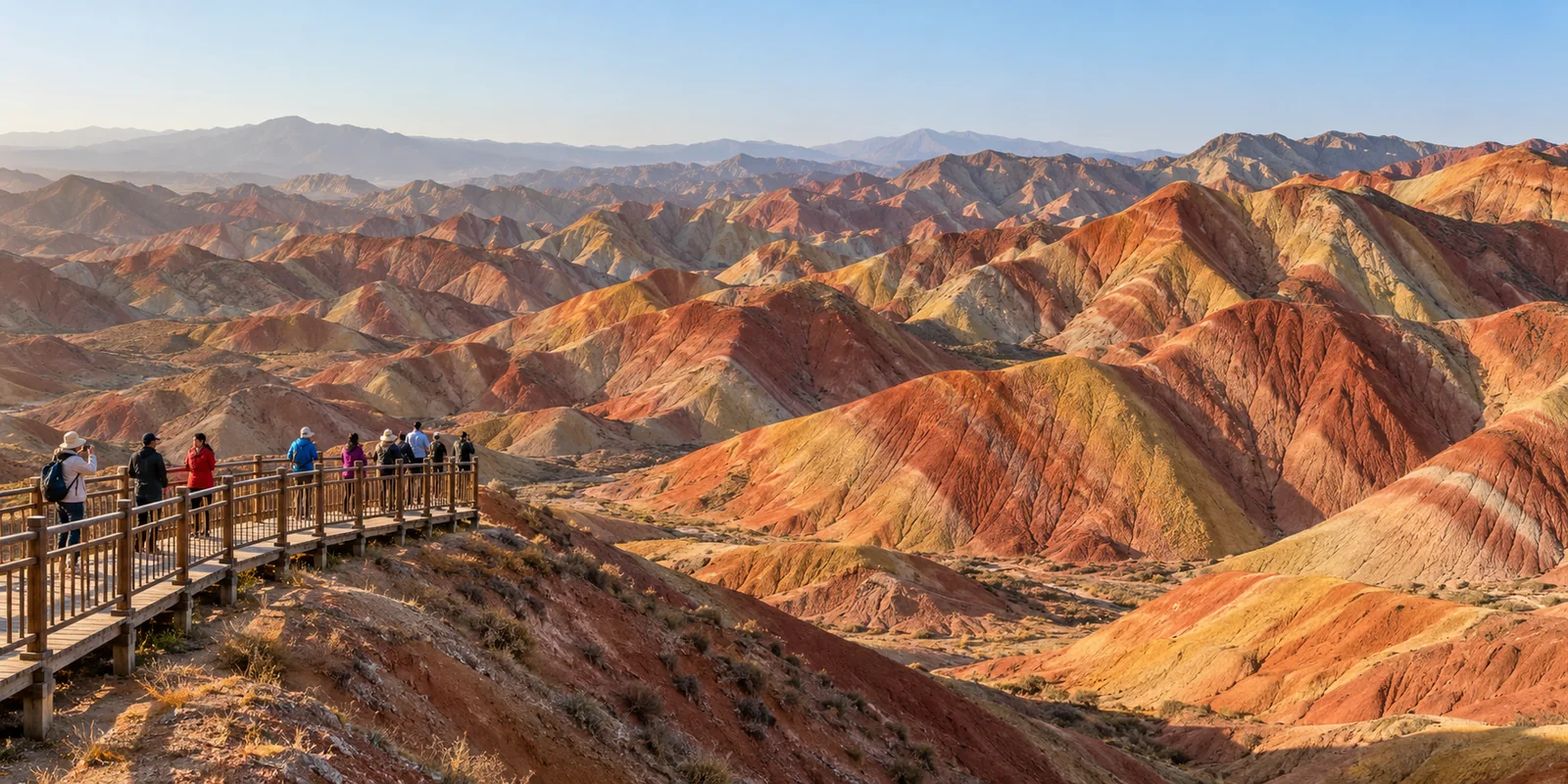
Short answer: The Zhangye Danxia National Geopark (张掖七彩丹霞) is a 5A scenic area and a UNESCO Global Geopark, designated in 2020, covering about 50 square kilometres of coloured hills in Linze and Sunan counties, west of Zhangye city in the Hexi Corridor. The stripes are real rock: red, orange, ochre and pale grey sandstone beds laid down in the Cretaceous period, folded and then cut by wind and water over tens of millions of years. You do not hike freely across the hills.
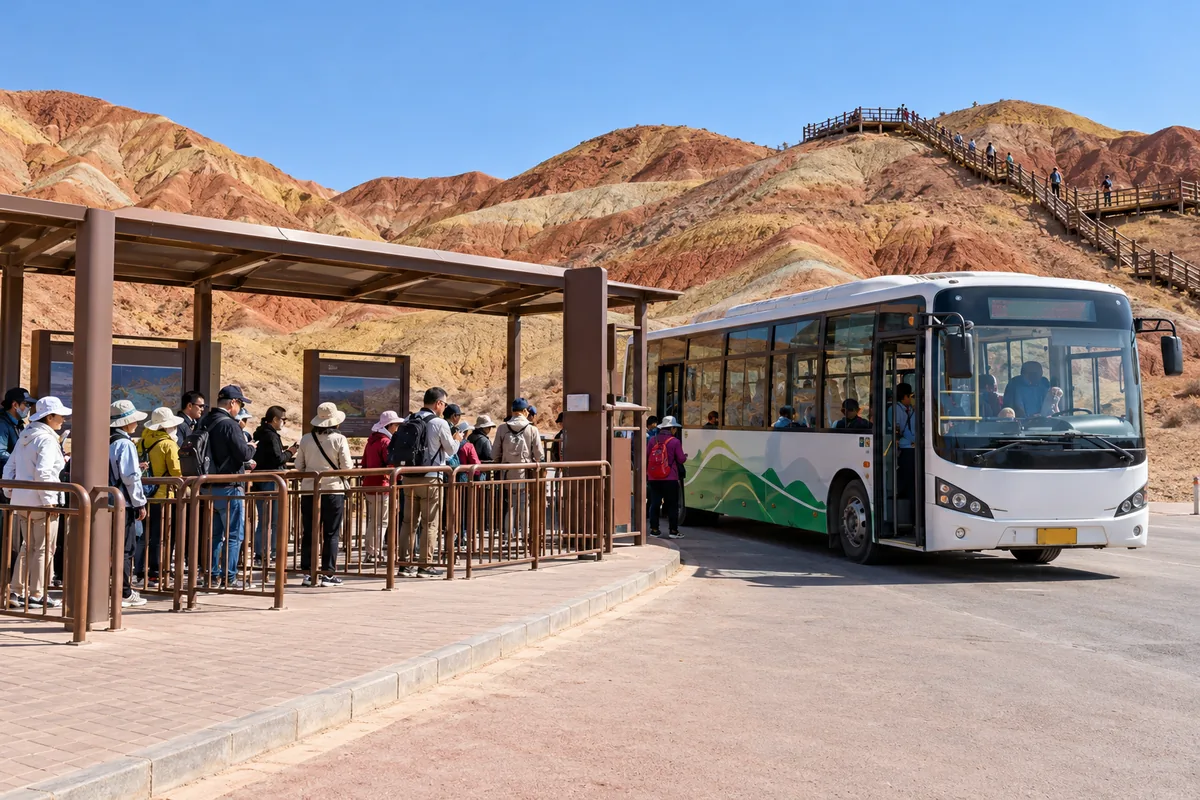
You ride a compulsory shuttle around a one-way 29 km loop and get off at four named viewing platforms, where boardwalks and stairs lead to the viewpoints.
The colours are real, but how strong they look depends on the light and on moisture, per WaysChina's November 2026 guide. Harsh midday sun makes the stripes look pale. Low sun in the late afternoon, or the first hours after opening, brings out the reds and oranges. A day after rain, when the rock is still damp, the colours are noticeably deeper. If you only have one visit, aim for late afternoon.
Tickets are two parts: a ¥70 entry ticket (raised from ¥54 on 5 January 2026) and a ¥38 shuttle ticket, ¥108 in total for an adult. This winter the city of Zhangye is running a half-price campaign (11 November 2026–28 February 2027) on first-gate tickets at the geopark and at every 4A and 3A scenic area in the municipality — the gate ticket drops to ¥35 for domestic and foreign visitors alike, but the shuttle stays ¥38, so the real total is ¥73, per China Trip Shelf's status check of 12 November 2026. All prices below are as of November 2026.
The sunset trap
Zhangye runs on Beijing time but lies far to the west, so the sun sets late: after 8 pm in midsummer and after 6 pm through September and October. The park's hours follow the season, not the sunset — 08:30–17:00 in winter, 06:30–18:00 from March to October — and in autumn 2026 the published 18:00 closing already came before the sun went down. Plan on the late, low light before closing, arrive at least three hours before the gate shuts, and ask at the gate when the last shuttle back runs on the day.
In short: If you want the single most photographed landscape of the Hexi Corridor — banded hills that turn red and orange in low sun, a half-price ticket this winter, and a half-day of easy boardwalk walking — Zhangye Danxia is it, and it fits neatly into the Qinghai–Gansu grand loop, between Qinghai Lake and Dunhuang.
Key takeaways for Zhangye Danxia
- Budget ¥108, or ¥73 this winter. Entry ¥70 + shuttle ¥38 since 5 January 2026. This winter (to 28 February 2027) the gate ticket is half price (¥35) for everyone, including foreign visitors — but the shuttle is not discounted, so the total is ¥73, not ¥54.
- Chase the light, not the sunset. The best windows are about 08:30–10:00 and after about 15:30; midday flattens the colours. The park closes at 17:00 in winter and 18:00 in autumn — before sunset — so arrive at least three hours before closing.
- The shuttle decides your day. A one-way 29 km loop links four named platforms — Xianyuan, Yunhai, Jinxiu and Hongxia — with buses about every 20 minutes and a full lap of around 40 minutes. There is no walking between platforms and no bus back to a stop you have passed, so decide your stops before you board.
- One day is enough; two is better. One afternoon covers the Rainbow Mountains. A second day adds Binggou Danxia (about 13 km away) or Mati Temple (about 65 km south), and a second chance if the first afternoon is cloudy or dusty.
- Sort the ride back first. The last public bus out leaves around 16:30 and return times are not published. A taxi, a ride-hailing car or a driver for the day — or a bed at Danxiakou by the North entrance — is the reliable way to end the day.
What is Zhangye Danxia?
Zhangye Danxia is a striped sandstone landscape whose name means "seven-colour Danxia" — and the hills live up to it in the right light. The beds were laid down in the Cretaceous period, about 140 million years ago, per Sohu's November 2026 geopark coverage, then folded by the Himalayan mountain-building and carved by wind and rain into the ridged, layered hills you see today.
The geopark is the core scenery of the Zhangye UNESCO Global Geopark, designated in 2020, and a national 5A scenic area. In November 2026 it was also named one of Ctrip's 2027 China Wonders list "Top 10 transcendent landscapes" and one of the "2027 China 100 must-visit sights".
About 50 square kilometres are inside the geopark boundary, per WaysChina's November 2026 guide, but visitors move through roughly 4 square kilometres of it. There are seven named viewing points in total; four of them are served by the shuttle, and the other three sit on a separate "deep tour" route that runs through canyons before joining the main platforms. The visitor area sits at about 1,500–1,800 metres, so the air is thin and dry, the wind is real, and the boardwalks are exposed with almost no shade.
"The colours are real, but how strong they look depends on the light and on moisture. Harsh midday sun makes the stripes look pale. Low sun in the late afternoon, or the first hours after opening, brings out the reds and oranges." — WaysChina, Zhangye Rainbow Mountains Guide, November 2026
How much do Zhangye Danxia tickets cost?
Every visitor needs two tickets, and the shuttle is not optional, because the platforms are spread along a 29 km bus route. All figures are per the park's published prices, checked in November 2026 by WaysChina and China Trip Shelf.
| Ticket | Price (2026) | Winter half price (11 Nov 2026–28 Feb 2027) | Notes |
|---|---|---|---|
| Entry (adult) | ¥70 | ¥35 | Raised from ¥54 on 5 January 2026; half price applies to domestic and foreign visitors alike |
| In-park shuttle | ¥38 | ¥38 (not discounted) | Mandatory; one-way loop, buses about every 20 minutes |
| Total, adult | ¥108 | ¥73 | About a third off the door-to-door cost, not half |
| Students / seniors 60–69 | About ¥66 | Ask at the window | Concessions are usually checked against Chinese identity documents; ask whether your passport or student card qualifies |
| Seniors 70+ | Free entry; about ¥38 shuttle | Shuttle still charged | — |
| Deep-tour route | About ¥328–388 | Not discounted | Restricted areas, limited daily numbers; book ahead; closes to new arrivals at 16:00 in winter |
| Summer night tour | About ¥188 | Not running in winter | Evening entry plus a light show at the fourth platform, summer only |
| Binggou Danxia (separate site) | About ¥40 + ¥20 shuttle | Confirm at the gate | Different formations about 13 km away; not part of the Rainbow Mountains ticket |
Sources: ticket table per WaysChina, Zhangye Rainbow Mountains Guide (November 2026; ¥70 from 5 January 2026, ¥38 shuttle, hours and platform order) and China Trip Shelf, Zhangye Danxia in Winter (verified 12 November 2026; half-price campaign 11 November 2026–28 February 2027, ¥35 gate / ¥73 total, winter hours 08:30–17:00). Prices as of November 2026; confirm at the gate, as the park changes arrangements by notice.
Buying tickets with a foreign passport
Buy through the park's official WeChat mini programme, its partner online travel platforms, or the windows at the visitor centre. Since May 2026 the visitor centre has had self-service ticket machines that switch to English, Japanese, Korean, Russian and Thai and walk you through choosing a ticket, an identity check and payment — but foreign-passport handling at the machines is inconsistent, so the manual ticket window is the safer choice for a foreign passport, per both guides.
Carry your passport: the park has not published exactly which documents its ticketing accepts, so have the passport ready rather than a copy. Outside holiday weeks you do not need to book days ahead; in July and August, buying the day before saves time in the queue, and around National Day (1–7 October) check the park's announcements for any booking requirements.
What your ticket stub still buys
Keep the stub. Within seven days of your visit it gives ¥20 off accommodation and dining at Zhangye Hotel and at four-star hotels across the city — one redemption per room or per table. Within three days, an inbound boarding pass for Zhangye airport gets you half-price skiing at Qilian Mountains International Ski Resort and Shandan Foshan Ski Resort. Both perks are winter-specific in practice: the ski discount only exists while there is snow, and the hotel discount is aimed at exactly the season you are travelling in, per China Trip Shelf.
Opening hours, by season
The park's timetable has two settings, and the winter one is short. Check the park's official WeChat account ("张掖七彩丹霞旅游景区") for the season of your visit, because the hours move with the sun.
| Season | Hours | What it means |
|---|---|---|
| 1 November–28 February | 08:30–17:00 | Last entry 17:00; deep-tour route closes to new arrivals at 16:00; not a sunrise destination — the gate opens at 08:30 and in early December the sun is already low by 16:30 |
| 1 March–31 October | 06:30–18:00 | Autumn closing at 18:00 already comes before sunset |
| 28 April–31 August 2026 | 05:30–19:00 | Longest hours of the year; deep-tour entry ends 18:00 |
Sources: hours per China Trip Shelf (verified 12 November 2026) and WaysChina (November 2026; summer hours from the Linze county notice of 16 April 2026).
Winter is the bargain season, and it is not a compromise on light: low sun all day is exactly what the landform wants, and what you lose is hours, not quality. What you may gain is snow — a thin cover on the coloured beds makes the strata read more clearly, not less. But snow also stops the shuttles, so telephone the park before you set out if there has been a fall. The shuttle loop stops in snow and high wind, and in December and January that is a real possibility, with no refund structure worth relying on.
The shuttle loop and the four platforms
The standard visit stops at four viewing platforms. Their official names are Xianyuan (七彩仙缘台, "fairy encounter"), Yunhai (七彩云海台, "sea of clouds"), Jinxiu (七彩锦绣台, "brocade") and Hongxia (七彩虹霞台, "rainbow glow"). From the North and East entrances the order is Xianyuan, Yunhai, Jinxiu, Hongxia; from the West entrance it is Yunhai, Jinxiu, Hongxia, then Xianyuan. Xianyuan and Hongxia are transfer stops, where you may change buses. The park has three entrances — East, West and North — and the North entrance is the main one; you are expected to leave by the same gate you came in, which matters because your driver needs to know which gate to wait at.
The platforms have names, not numbers. Older guides talk about "Platform 1" to "Platform 4" and say "Platform 4 is the best"; the park itself uses only the names above, and the order changes with your gate, so a number from a blog post may not match your route. Use the names when you ask staff or your driver, per WaysChina.
One-way means what it says. There is no shuttle back to a stop you have already passed, and no walking alternative — the distances between platforms are measured in kilometres of exposed ridge. Decide before boarding which two stops get your time: the last two, Jinxiu and Hongxia, carry the classic layered-colour views that most photographs of the site are taken from. If your day is compressed by a train or a flight, ride past the first two and spend the time at the far end of the loop. Allow about three hours for all four platforms without rushing, and four on a holiday weekend.
When to go, and the best light
Summer and early autumn are the easiest months: long days, warm weather and the most reliable light. July, August and the first week of October (China's National Day holiday) are also the busiest, with long queues for the park shuttle. Late September and October are a good balance of light, temperature and crowds, but nights get cold. Spring is often windy, and on dusty days the colours look flat. Winter is very cold and the days are short, but the park stays open, and a thin layer of snow on the ridges is a look some photographers come for.
Colour at a danxia landform is a function of sun angle. Overhead light flattens the bands into a uniform ochre; low, raking light separates them. The two windows worth planning around are 08:30 to about 10:00, when the gate opens into the best morning light and the shuttle queues are shortest, and after about 15:30, the second good window and the one that coincides with the emptiest shuttles. From 11:00 to 15:00 in winter the light is at its weakest, and the site photographs as grey-brown rather than red.
The practical rule from both November 2026 guides is the same: arrive at least three hours before closing, ride straight to the platforms, and ask staff when the last bus back to your gate runs.
Rules that get people in trouble
Stay on the boardwalks: the park's protection regulations ban stepping on, climbing, scratching or marking the Danxia hills. Drones are prohibited across the geopark — this is enforced, not advisory — and the park runs its own sightseeing flights, so ask at the gate before you take a drone out. Pets cannot go in, but there is a free pet-minding point at the park.
Getting to Zhangye: trains, flights and the ride back
Zhangye sits in the Hexi Corridor in Gansu, roughly halfway between Lanzhou and Dunhuang. The high-speed train is how almost everyone arrives. Zhangye West Station (张掖西站) is on the high-speed line between Lanzhou and Xinjiang, with direct trains to the other Silk Road stops. Train tickets in China are sold in the passenger's real name, and you buy them with your passport — on the official 12306 English website, which accepts foreign passports, or on Trip.com. With a foreign passport you go through the staffed gate at the station, because the automatic gates do not read passports.
| From Zhangye West | Direct D trains | Journey time |
|---|---|---|
| Lanzhou West | 14–15 a day each way | 2 h 41 min – 3 h 22 min; D2682 departs Lanzhou West 09:08, arrives 12:15, second class ¥149.50 |
| Xining | 14–15 a day each way | 1 h 41 min – 2 h 9 min |
| Jiayuguan South | 13 a day from Zhangye West | 1 h 11 min – 1 h 38 min |
| Dunhuang | 2 a day each way, or 4 a day to Liuyuan South then on by road | 4 h 4 min – 4 h 30 min; from Zhangye West 15:16 and 16:50, from Dunhuang 07:30 and 08:40 |
| Xi'an North | 7 a day from Zhangye West | 6 h 12 min – 6 h 42 min |
Sources: train times per WaysChina (12306 sample for 10 October 2026; timetables change, so check 12306 or Trip.com for your date) and China Trip Shelf (Lanzhou–Zhangye D2682, November 2026).
By air and into town
From Zhangye West to town, a taxi or DiDi is the easiest way into the centre; city bus Xin 1 also runs towards the city's west bus station. Zhangye has a small airport, Zhangye Ganzhou Airport, with a limited number of domestic routes — on the day of writing it had services to Lanzhou Zhongchuan, Xi'an, Beijing Daxing, Chongqing, Wuhan, Urumqi and Dunhuang — and the drive into the city is about 40 minutes either way. For most Silk Road trips the train is simpler.
Getting to the park and back
Getting there is easy. Getting back to town in the evening, after the park closes, is the part to plan. The park's own travel guide lists a bus from Zhangye West Bus Station (in the city, not at the train station) to the North entrance car park: departures on the hour from 09:00 to 12:00, then at 15:30 and 16:30, about one hour each way, ¥15 — but that timetable dates from 2022, so check the current times at the bus station.
The bus is fine for getting there. It does not solve the return: the last bus out leaves at 16:30 and return times are not published, so plan on a taxi or DiDi back. The drive from town to the North entrance takes roughly 40 minutes to an hour each way, and finding a car at the gate at closing time can take a while, because many drivers do not want to drive out empty. Ask your outbound driver to wait or come back at an agreed time, and agree that before you set off.
Entering China: visas and the 240-hour transit question
You cannot fly into Zhangye from abroad, so you enter China somewhere else first, usually Beijing, Shanghai or Xi'an, and continue by train or domestic flight. One warning: the guides disagree on whether Gansu is covered by China's 240-hour transit visa-free stay area. Our own Dunhuang guide treats Gansu as outside it, while a November 2026 winter guide for Zhangye says Gansu is fully inside it, with Lanzhou Zhongchuan and Dunhuang Mogao airports both on the list of eligible ports. Do not build a Zhangye stop on the transit route alone — check the current official port and nationality lists before you book, and plan on a tourist visa or the 30-day unilateral visa-free entry that covers tourism for citizens of 50 countries.
Is Binggou Danxia worth it?
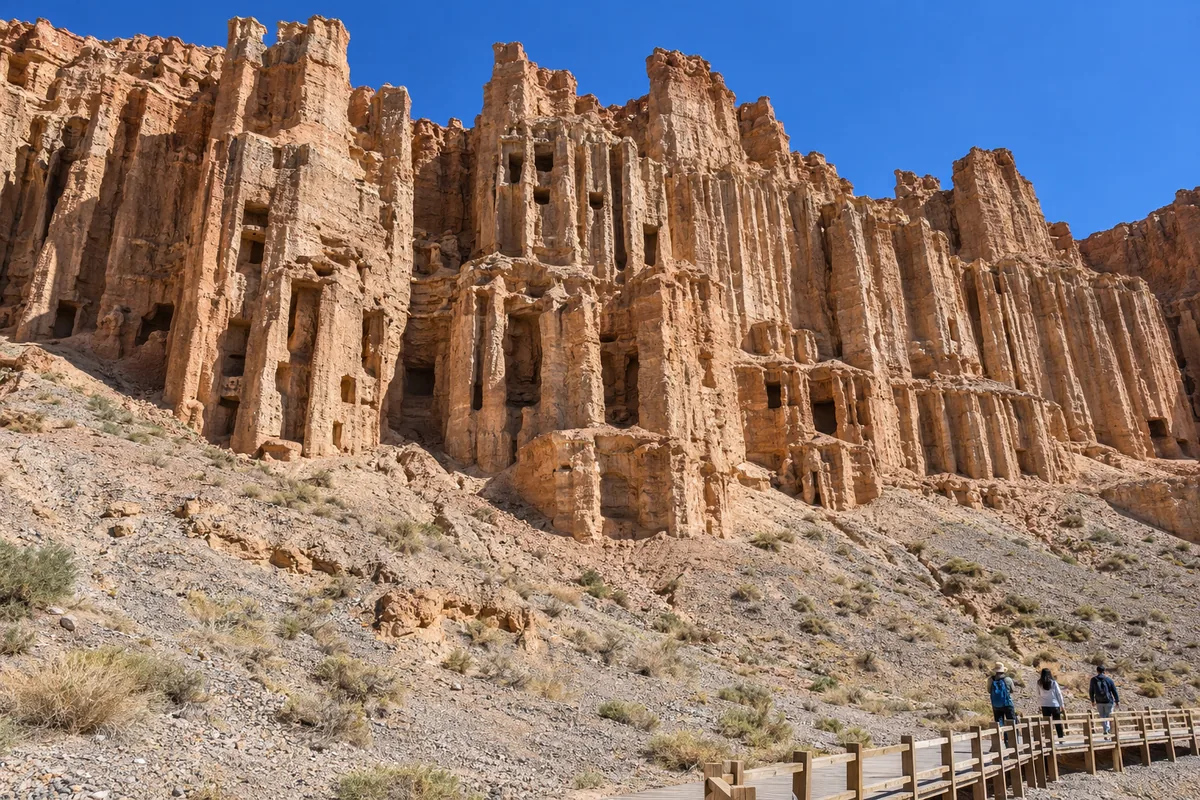
Binggou Danxia (冰沟丹霞) is a different park, not a part of the Rainbow Mountains. It is known for tall sandstone walls worn into shapes that look like windows, columns and palaces, rather than for coloured stripes — the stripes in most photos of "Zhangye Danxia" are at the Rainbow Mountains. Binggou is higher up, between about 1,500 and 2,550 metres, and it gets far fewer visitors. Tickets are cheaper: entry is roughly ¥40 plus a shuttle of about ¥20, so confirm the current prices and opening hours at the gate.
Is it worth it? If you like rock shapes and quieter boardwalks, yes. If you came only for the colours and have one afternoon, skip it and spend the time at the Rainbow Mountains. With a car, you can see both on the same day, since they are only about 13 km apart: Binggou around midday, when harsh light matters less for shapes than for colours, then the Rainbow Mountains in the late afternoon. By public transport the combination does not work.
Mati Temple and the Giant Buddha Temple
Mati Temple: cliff caves in the Qilian foothills
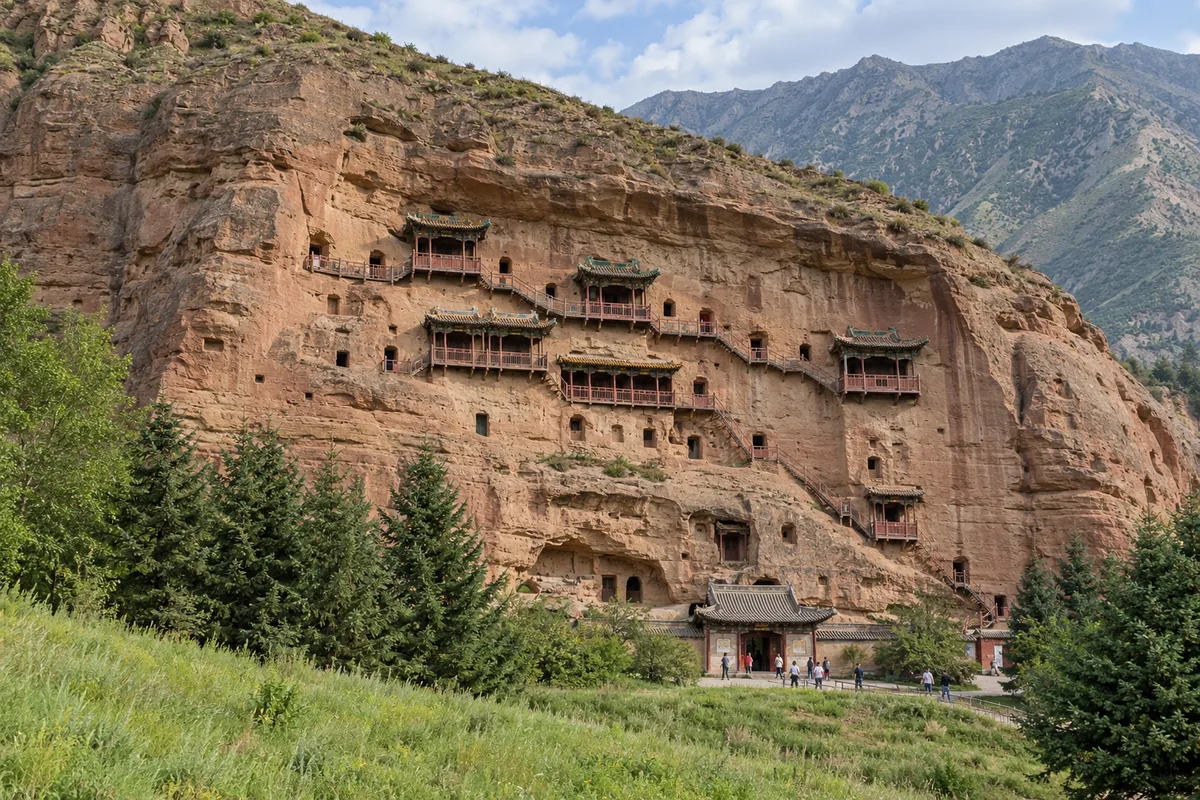
Mati Temple (马蹄寺, "Horse Hoof Temple"). This is a group of Buddhist cave temples cut into sandstone cliffs in the Qilian foothills, about 65 km south of Zhangye, in Sunan Yugur Autonomous County, home of the Yugur minority. The first caves were cut more than 1,600 years ago, under the Northern Liang kingdom; today there are more than 70 caves and niches in seven groups. The best known is the "Thirty-Three Heavens" (三十三天) cave, a stack of shrines on several levels in one cliff face. Inside, you climb narrow stairs and tunnels between levels, which some visitors find tight. The setting is part of the appeal: grassland and mountains instead of desert.
Allow half a day including the drive, and go by hired car, because public transport out there is slow. It is higher and cooler than Zhangye, so bring a warm layer even in summer. Check the current ticket price and opening hours before you go.
Giant Buddha Temple: Asia's largest indoor reclining Buddha
Giant Buddha Temple (大佛寺). This is the easiest sight to fit in, because it is in the city centre at 28 Minzhu West Street, on city bus routes 1, 4, 5, 18 and 23. It is the largest surviving royal temple of the Western Xia (西夏), a kingdom that ruled this region about a thousand years ago. Its main hall holds Asia's largest indoor reclining Buddha, made of clay over a wooden frame. The temple also keeps a complete early printing of the Ming-dynasty Buddhist canon.
It is open 07:00 to 18:30, and last entry is usually earlier than closing, so arrive by about 17:30. One to one and a half hours is enough, so it fits on the morning before an afternoon at the Rainbow Mountains, or before an evening train. Check the ticket price at the gate.
Pingshanhu Grand Canyon: a third-day option
Pingshanhu Grand Canyon (平山湖大峡谷). A red sandstone canyon in the desert about 56 km from town, also a national geopark. It is worth it only if you have a third day and a car; on a two-day visit, Binggou or Mati is a better use of the time.
Stay in town or at Danxiakou?
Stay in Zhangye city if you are arriving and leaving by train, want more choice of restaurants, or plan to see the Giant Buddha Temple. Hotels in town are mostly business hotels and mid-range chains, easy to reach from Zhangye West, and the evening food streets are close by. The cost is the drive to the Rainbow Mountains, about an hour each way, and the evening taxi problem described above.
Stay at Danxiakou (丹霞口), the hotel and guesthouse area by the North entrance, if you want to stay until closing without worrying about the ride back, or want to be at the gate when it opens for the morning light. Choice is smaller, there is less to do in the evening, and you still need a car to get to Zhangye West for your next train. Whichever you choose, make sure the place you book accepts foreign guests; most hotels do, but some small guesthouses cannot register foreign passports. Our suggestion: for a one-night stop with an afternoon at the park, Danxiakou makes the day much simpler. For two nights, one in each, or both in town with a driver for the park day, both work well.
What is closed this winter
Yanzhi Mountain scenic area, east of Zhangye and traditionally paired with the geopark on a two-day loop, closed on 30 October 2026 and is not expected to reopen until early April 2027. Guides that still include it in a winter itinerary are out of date, per China Trip Shelf.
One day or two: sample plans
One day (arrive in the morning, leave the next day). Arrive at Zhangye West by late morning and drop your bags. See the Giant Buddha Temple around midday, then drive to the Rainbow Mountains by mid-afternoon and stay until closing. Go back to town with your pre-arranged driver, or sleep at Danxiakou. Take a morning train onward.
Two days (recommended).
- Day 1: Arrive, check in, see the Giant Buddha Temple. Rainbow Mountains from mid-afternoon to closing.
- Day 2: Either Binggou Danxia (pair it with a second, shorter look at the Rainbow Mountains with a new shuttle ticket) or a half day at Mati Temple. Then an afternoon or evening train. If you are heading to Dunhuang, remember the direct trains leave Zhangye West in the afternoon, which fits a morning trip to Binggou.
What to eat
Zhangye food is northwestern wheat-and-meat cooking. Try cuoyu noodles (搓鱼面), short hand-rolled noodles shaped like little fish, usually stir-fried or in soup; chao bola (炒拨拉), chopped beef or lamb and offal fried on a hot iron plate with peppers; and niurou xiaofan (牛肉小饭), small pieces of dough in beef broth. Ganzhou Market (甘州市场), a food market in the city centre, is the easiest place to try several dishes in one evening, and pointing at what other people are eating works fine.
Dry air, wind and how fit you need to be
Zhangye is dry, sunny and often windy. The platforms have almost no shade, so bring sunscreen, sunglasses, a hat and plenty of water, plus a scarf or buff for dust. Even in summer it gets cold once the sun goes down, so carry a warm layer for the late afternoon. The boardwalks involve some stairs, but the bus does the long distances, so anyone who can manage a few flights of steps will be fine. Mati Temple's cave stairs are steeper and narrower.
Bottom line: Zhangye Danxia earns its place in the middle of the Silk Road honestly — banded hills that turn red and orange in low sun, a UNESCO Global Geopark with a half-price ticket this winter, and a half-day of easy boardwalk walking between four named platforms. Come for the late light, not the sunset; the park closes before the sun goes down. Give Binggou or Mati Temple the second day if you have it, and let a driver handle the evening ride back.
In summary: Zhangye Danxia, about 40 km west of Zhangye city, costs ¥70 entry + ¥38 shuttle = ¥108, or ¥73 in the winter half-price window (gate ¥35, shuttle not discounted, to 28 February 2027); hours 08:30–17:00 in winter and 06:30–18:00 from March to October, closing before sunset in autumn and winter; four named platforms — Xianyuan, Yunhai, Jinxiu, Hongxia — on a one-way 29 km shuttle loop, about three hours; best light 08:30–10:00 and after 15:30, better still the day after rain; trains from Lanzhou West about 3 hours, Xining about 2 hours, Jiayuguan just over an hour, Dunhuang two direct trains a day at about 4 hours; Binggou about ¥40 + ¥20 and Mati Temple about 65 km south for day two; and do not build the trip on the 240-hour transit route without checking the current official port list first.
Want Zhangye without the logistics?
Western China Private Car Tours runs private car trips in Zhangye: pickup at Zhangye West station or the airport, a car and driver for the Rainbow Mountains at the best light, plus Binggou Danxia and Mati Temple on day two — timed around the park's hours and your onward train, with no evening taxi hunt at the gate. The driver communicates with guests via translation apps, so plans and pickup times are easy to change on the day.
Continuing west? Our Dunhuang guide covers the Mogao Caves and the dunes, or see the Qinghai–Gansu grand loop for the whole corridor by rail.
- Message us on WhatsApp with your dates, party size and whether you want Binggou or Mati Temple on day two.
- Get a fixed quote for the car and driver, including station or airport pickup and the evening ride back from the North entrance.
- Meet your driver at Zhangye West and ride to the park timed for the late-afternoon light — the driver communicates with guests via translation apps, so pickup times are easy to change on the day.
Frequently Asked Questions About Zhangye Danxia
How much does Zhangye Danxia cost in 2026?
As of November 2026, an adult pays ¥70 for the entry ticket plus ¥38 for the mandatory in-park shuttle, ¥108 in total. The gate ticket rose from ¥54 to ¥70 on 5 January 2026. In the winter half-price window (11 November 2026–28 February 2027) the first-gate ticket is half price for domestic and foreign visitors alike, so the gate costs ¥35 and the total is ¥73, because the shuttle is not discounted.
What are the opening hours of Zhangye Danxia?
From 1 November to 28 February the park is open 08:30–17:00, with the deep-tour route closing to new arrivals at 16:00. From 1 March to 31 October it is open 06:30–18:00, and in high summer (28 April–31 August 2026) it opened 05:30–19:00. Because Zhangye runs on Beijing time but lies far to the west, the sun sets after 8 pm in midsummer and after 6 pm through September and October — so in autumn and winter the park closes before sunset.
When is the best light at Zhangye Danxia?
Low sun brings out the reds and oranges; harsh midday sun makes the stripes look pale. The two good windows are roughly 08:30–10:00 in the morning and after about 15:30 in the afternoon. A day after rain is even better, because damp rock looks noticeably deeper in colour. Summer and early autumn give the most reliable light, while a thin layer of snow on the ridges in winter is a look some photographers travel for.
How do I get to Zhangye Danxia from the city?
The park is about 40 km west of Zhangye city, roughly 40 minutes to an hour by road. Most visitors arrive by high-speed train at Zhangye West — about 3 hours from Lanzhou West, 2 hours from Xining, just over an hour from Jiayuguan South and about 4 hours from Dunhuang on one of two direct trains a day. A public bus runs from Zhangye West Bus Station to the North entrance for about ¥15, but the return is the hard part: the last bus leaves around 16:30, so a taxi, a ride-hailing car or a driver for the day is the reliable way back.
Is one day enough for Zhangye Danxia?
Yes, for the Rainbow Mountains alone: arrive by late morning, see the Giant Buddha Temple in town around midday, then spend the afternoon at the park until closing and leave by morning train the next day. Two days is better — the second day adds Binggou Danxia, about 13 km away, or Mati Temple, about 65 km south in the Qilian foothills, and gives you a second chance if the first afternoon is cloudy or dusty.
Sources: WaysChina — Zhangye Rainbow Mountains Guide: Tickets, Shuttle, Best Light and Getting There (November 2026; ¥70 entry from 5 January 2026 / ¥38 shuttle / 29 km loop / four named platforms / hours 05:30–19:00 summer, 06:30–18:00 autumn, 08:30–17:00 winter / train times 10 October 2026 / Binggou ¥40+¥20 / Mati Temple 65 km / Giant Buddha Temple 07:00–18:30 / bus ¥15 / food) / China Trip Shelf — Zhangye Danxia in Winter (verified 12 November 2026; half-price campaign 11 November 2026–28 February 2027 / gate ¥35, total ¥73 / winter hours 08:30–17:00 / deep tour closes 16:00 / Yanzhi Mountain closed 30 October 2026–early April 2027 / ticket-stub perks ¥20 hotel, half-price skiing / D2682 Lanzhou–Zhangye ¥149.50) / Sohu — Zhangye winter half-price policy (November 2026; 11 November 2026–28 February 2027, first-gate tickets half price at Zhangye Danxia and all 4A/3A scenic areas in the municipality, domestic and foreign visitors alike) / Sohu — Zhangye Danxia on Ctrip's 2027 China Wonders list (November 2026; "Top 10 transcendent landscapes" and "2027 China 100 must-visit sights"). Images: WaysChina photographs (Rainbow Mountains ridges, shuttle bus, Binggou walls, Mati Temple cliff).